

India’s digital insurance landscape is witnessing a defining moment as Bengaluru-headquartered insurtech unicorn Acko General Insurance (Acko) formally kicks off its initial public offering (IPO) preparations. Founded in 2016 by serial entrepreneur Varun Dua and Ruchi Deepak, Acko has transformed how Indians purchase motor and health insurance by pioneering a 100% direct-to-consumer (D2C) digital model that entirely eliminates traditional brokers and commission agents. In recent filings tracked by Zerodha’s IPO Portal and institutional investment desks, Acko has mandated global and domestic investment banks to steer a public listing targeting a valuation between $2.0 billion and $2.5 billion (approx. ₹16,700 crore to ₹20,900 crore).
Acko IPO Quick Answer (AEO Summary):
Acko Insurance is preparing for a public listing in early 2027 following a confidential pre-filing submission with SEBI in H2 2026. The proposed issue size is estimated between $250 million and $350 million (approx. ₹2,100 crore to ₹2,950 crore), structured as a combination of a fresh equity issuance and an Offer for Sale (OFS) by early venture backers. The IPO is targeting an enterprise valuation of $2.0 billion to $2.5 billion, representing a substantial premium over its previous $1.4 billion unicorn valuation. Acko reported operational revenue of ₹2,887 crore in FY25 (+35% YoY) with net operating losses narrowing rapidly toward breakeven. The issue is lead-managed by Morgan Stanley, ICICI Securities, and Kotak Mahindra Capital, with listing planned on both the BSE and NSE.

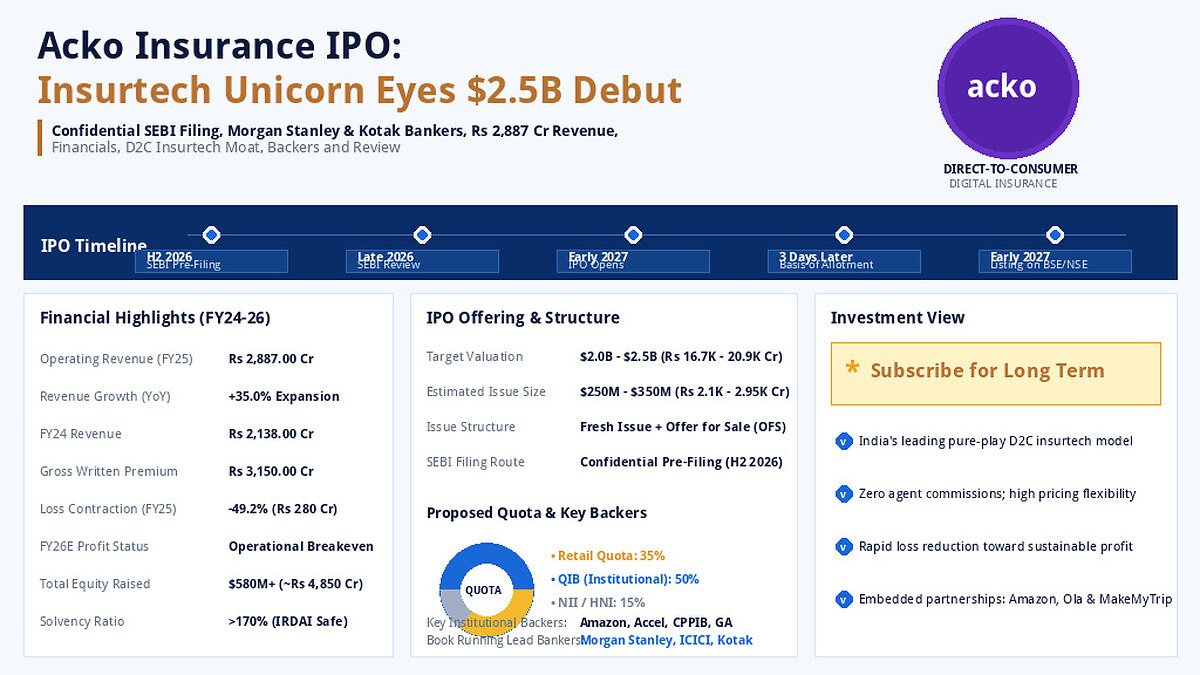
1. Acko IPO Key Facts, Offering Blueprint & Lead Bankers
Unlike traditional public issues that publish draft prospectuses directly into the public domain, Acko is adopting the progressive confidential pre-filing mechanism permitted by SEBI. This route allows the company to engage in regulatory reviews and address queries confidentially before unveiling the updated Draft Red Herring Prospectus (U-DRHP) to institutional and retail investors.
| IPO Parameter | Current Detail / Guidance |
|---|---|
| Company Name | Acko General Insurance Limited (Acko Technology & Services Pvt Ltd) |
| Founder & CEO | Varun Dua (Co-founder: Ruchi Deepak) |
| Incorporation Year & HQ | 2016 | Bengaluru, Karnataka, India |
| Sector | Insurtech / Digital Direct-to-Consumer (D2C) General Insurance |
| IPO Filing Route | Confidential Pre-Filing with SEBI |
| Draft Filing Timeline | Second Half of 2026 (H2 2026) |
| Expected Listing Date | Early 2027 (Q1 2027 Target) |
| Target Valuation | $2.0 Billion – $2.5 Billion (₹16,700 Cr – ₹20,900 Cr) |
| Estimated Issue Size | $250 Million – $350 Million (₹2,100 Cr – ₹2,950 Cr) |
| Issue Structure | Fresh Issue (Growth Capital) + Offer for Sale (OFS) |
| Listing Exchanges | BSE (Bombay Stock Exchange) & NSE (National Stock Exchange) |
| Book Running Lead Managers | Morgan Stanley India, ICICI Securities, Kotak Mahindra Capital |
2. Why Acko is Choosing SEBI’s Confidential Pre-Filing Route
The decision to opt for confidential pre-filing highlights mature financial planning. Introduced by SEBI in late 2022 and increasingly favored by high-growth new-age technology firms, confidential filing offers several distinct strategic benefits:
- Protection of Proprietary Underwriting Data: Under standard DRHP filings, granular operating metrics, algorithm architectures, customer acquisition costs (CAC), and product loss ratios are immediately open to competitors. The confidential route shields commercial intelligence until the issue is cleared by regulators.
- Flexibility on Market Timing: Once draft observations are issued by SEBI under this route, the company enjoys a 16-month window to execute its public issue, allowing management to wait for optimal market liquidity and bullish macro conditions instead of rushing to list.
- Testing Institutional Demand: Management can conduct limited marketing interactions with qualified institutional buyers (QIBs) to calibrate the pricing band and issue size prior to public disclosure.
To understand broader listing dynamics and compare ongoing new-age issues, explore our comprehensive Upcoming IPOs in Indian Market 2026 Calendar & Tracker, as well as the historic analysis of the Jio Platforms IPO.
3. Business Model: The Pure D2C Insurtech Disruption
To appreciate Acko’s valuation multiple, one must examine its core operating divergence from traditional legacy insurers like New India Assurance, Oriental Insurance, and ICICI Lombard:
1. Elimination of Agent Intermediary Commissions
Traditional non-life insurers in India allocate between 15% to 35% of their premium intake toward distributor commissions, agency incentives, and physical branch networks. Acko operates as a 100% digital D2C insurer. Policies are purchased directly through the Acko mobile application or website. By eliminating intermediary payouts, Acko passes savings back to policyholders through lower annual premiums (often 20% to 40% cheaper for car and bike coverage) while preserving healthy underwriting margins.
2. Instant Paperless Claims & Automated Underwriting
Acko leverages machine learning algorithms and computer vision for minor vehicle claims. Policyholders upload photos of damaged body panels via smartphone, triggering automated damage assessment, digital claim approval, and instant direct-bank payouts within minutes—bypassing traditional physical surveyor delays.
3. Embedded Micro-Insurance Ecosystem
Acko pioneered high-volume, low-ticket micro-insurance partnerships with Indian consumer tech giants. These include trip insurance embedded into ride-hailing apps (Ola), electronics protection on e-commerce platforms (Amazon India), and domestic travel disruption coverage on MakeMyTrip. This embedded engine acts as an ultra-low-cost top-of-funnel customer acquisition channel, converting micro-insurance buyers into high-ticket motor and comprehensive health insurance policyholders.
4. Financial Performance & Revenue Trajectory (FY23 – FY26E)
Acko has demonstrated compounding top-line momentum over the past three fiscal years, fueled by rapid expansion in its retail motor book and the launch of high-ticket health coverage under the Acko Platinum Health banner.
| Metric (₹ in Crores) | FY 2023 (Audited) | FY 2024 (Audited) | FY 2025 (Audited) | FY 2026E (Projected) |
|---|---|---|---|---|
| Operating Revenue | ₹1,585 Cr | ₹2,138 Cr | ₹2,887 Cr | ₹3,550+ Cr |
| Year-on-Year Growth (%) | +42.1% | +34.9% | +35.0% | +23.0% |
| Gross Written Premium (GWP) | ₹1,750 Cr | ₹2,380 Cr | ₹3,150 Cr | ₹3,900+ Cr |
| Net Loss Trajectory | ₹(738) Cr | ₹(551) Cr | ₹(280) Cr | Near Breakeven / Net Profit |
| Loss Contraction (%) | Base Year | -25.3% | -49.2% | Turnaround |
The most compelling financial trend is the drastic narrowing of net losses: Acko curtailed its annual burn from ₹738 crore in FY23 down to ₹280 crore in FY25, with internal disclosures and industry reports pointing to operational breakeven and potential net profitability during FY26. This sharp turnaround validates the operating leverage of its proprietary tech platform as recurring policy renewals incur near-zero incremental acquisition costs.
5. Peer Group Comparison: Acko vs. Listed Insurtech Competitors
Public market investors will benchmark Acko against listed peers across the general insurance and insurtech ecosystem. In May 2024, Prem Watsa-backed Go Digit General Insurance successfully completed its ₹2,614 crore IPO, validating public market appetite for digital-first insurers. Below is an institutional comparative matrix:
| Company Name | Operating Model | Market Cap / Target Val | Distribution Strategy | Profitability Status |
|---|---|---|---|---|
| Acko General Insurance | Pure Digital Insurtech (Underwriter) | $2.0B – $2.5B (Proposed IPO) | 100% Direct-to-Consumer (D2C) | Transitioning to Net Breakeven / Profit |
| Go Digit General Insurance | Digital-Led General Insurer | ~₹26,000 Crore (~$3.1B) | Hybrid: Digital + Corporate Partners + POSPs | Profitable (PAT ~₹182 Cr in FY24) |
| PB Fintech (Policybazaar) | Online Marketplace / Aggregator | ~₹75,000 Crore (~$9.0B) | Comparison Portal & Tele-Assistance | Profitable at Consolidated Level |
| ICICI Lombard General Ins. | Legacy Multi-line General Insurer | ~₹92,000 Crore (~$11.0B) | Bancassurance, Agency & Corporate Brokers | Highly Profitable (PAT ~₹1,900+ Cr) |
Strategic Differentiation: While Go Digit relies substantially on Point of Sales Persons (POSP agents) and offline motor dealer tie-ups, Acko owns the customer relationship directly from quote generation to claims settlement. This direct touchpoint grants Acko unmatched proprietary data on driver behavior, medical claims histories, and customer lifetime value (LTV).
6. Capital Table & Marquee Institutional Backers
Since inception, Acko has raised more than $580 million (approx. ₹4,850 crore) across multiple equity financing rounds. Its shareholder registry includes world-class sovereign wealth and venture capital institutions:
- General Atlantic: Premier global growth equity fund, providing institutional governance and cross-border tech scale.
- Accel Partners & Lightspeed Venture Partners: Silicon Valley venture pioneers who backed Acko from early seed and Series A stages.
- Amazon India: Strategic corporate investor; integrates Acko directly across Amazon’s checkout flow for electronics, appliances, and two-wheeler insurance.
- CPP Investments (CPPIB): Canada Pension Plan Investment Board, offering permanent, patient pension capital.
- Multiples Private Equity & Elevation Capital: Prominent domestic growth funds with deep regulatory and capital market networks.
The proposed Offer for Sale (OFS) component of the IPO will allow early institutional backers to liquidate partial holdings, satisfying fund life-cycle mandates while retaining significant skin in the game post-listing.
7. Regulatory Landscape: IRDAI Compliance & Solvency Margin
Operating as a regulated general insurer under the Insurance Regulatory and Development Authority of India (IRDAI), Acko is subject to strict statutory benchmarks:
- Solvency Ratio: Insurers must maintain a minimum statutory solvency margin of 150%. Acko has consistently maintained its solvency ratio well above 160%–180%, ensuring ample claims-paying buffer. Fresh capital raised through the IPO will further augment this regulatory solvency capital as its gross premium book scales toward ₹5,000 crore.
- Expense of Management (EoM) Regulations: In August 2026, the IRDAI issued a directive temporarily restricting Acko from opening new physical branch offices for six months due to a technical exceedance of EoM ceilings during FY25. Because Acko is a digital-first insurer with minimal reliance on physical storefronts, analysts note this operational restriction has negligible commercial impact on customer acquisition while incentivizing management to enforce tighter operational automation ahead of the IPO filing.
8. Investment Analysis: Strengths vs. Key Risk Factors
Before committing capital to any upcoming tech issue, institutional and retail investors must weigh the company’s competitive moats against market and regulatory risks:
| Core Strengths & Catalysts | Key Risk Factors & Challenges |
|---|---|
| 1. Zero Intermediary Drag: Direct distribution yields superior pricing power and structural cost savings over traditional agency networks. | 1. Intense Price Competition: Legacy insurers and aggregators like Policybazaar discount aggressively in motor own-damage (OD) policies. |
| 2. Rapid Loss Contraction: Losses dropped from ₹738 Cr to ₹280 Cr in 2 years, with net profitability within sight. | 2. Underwriting Volatility: Expansion into comprehensive health insurance carries claims ratio risks from hospital inflation and severe disease spikes. |
| 3. High Brand Equity & Retention: Exceptional Net Promoter Scores (NPS) drive high organic policy renewal rates with minimal marketing expense. | 3. Regulatory Oversight: IRDAI policies on product approvals, commission capping, and EoM ceilings restrict commercial pricing autonomy. |
| 4. Strategic Blue-Chip Backing: Cap table bolstered by Amazon, CPPIB, General Atlantic, and Accel ensures top-tier corporate governance. | 4. Secondary OFS Pressure: Sizable Offer for Sale (OFS) tranches from early venture funds could create supply overhang upon listing. |
For investors managing broader portfolio allocations amidst changing interest rate cycles, consult our foundational framework on portfolio risk mitigation and dip-buying rules.
9. Summary & Investment Verdict: Apply or Avoid?
Acko Insurance represents one of the pure-play insurtech opportunities in emerging market equities. By successfully demonstrating that general insurance can be sold, underwritten, and serviced entirely via smartphone without armies of brokers, Acko has built a durable consumer franchise.
Verdict for Long-Term Investors: If the issue is priced sensibly within the proposed $2.0B to $2.5B valuation band (valuing the firm at ~4.5x–5.5x price-to-sales, comparable to Go Digit’s listing benchmark), Acko offers compelling multi-year growth potential. Its transition from loss-making startup to sustainable net profitability marks the exact inflection point where institutional tech investors favor public market entry. We recommend tracking the official U-DRHP disclosures upon filing in H2 2026.
10. Frequently Asked Questions (FAQ) – Acko Insurance IPO
What is Acko IPO?
Acko IPO is the proposed public offering of equity shares by Acko General Insurance Limited, India’s leading digital direct-to-consumer (D2C) insurtech company, seeking listing on the BSE and NSE.
What is the expected valuation of Acko IPO?
Acko is targeting an IPO valuation between $2.0 billion and $2.5 billion (approximately ₹16,700 crore to ₹20,900 crore), a significant increase from its previous private valuation of $1.4 billion achieved in 2021.
When will Acko file its DRHP with SEBI and when is the listing?
Acko is adopting SEBI’s confidential pre-filing mechanism, with draft papers expected to be submitted in the second half of 2026 (H2 2026). The actual public listing is targeted for early 2027.
Who are the lead managers appointed for Acko IPO?
Acko has appointed Morgan Stanley India, ICICI Securities, and Kotak Mahindra Capital as book-running lead managers to structure and manage the public issue.
What was Acko’s revenue in FY25?
Acko reported operational revenue of ₹2,887 crore in FY25, representing a robust 35% year-on-year expansion compared to ₹2,138 crore recorded in FY24.
Is Acko profitable before its IPO?
Acko narrowed its net operating losses significantly from ₹738 crore in FY23 to ₹280 crore in FY25, with projections and management guidance targeting operational breakeven and net profitability heading into FY26–FY27.
Who are the major investors backing Acko?
Acko is backed by prominent global and domestic venture capital and institutional investors, including General Atlantic, Accel Partners, Amazon India, CPP Investments (CPPIB), Lightspeed Venture Partners, Multiples Private Equity, and Elevation Capital.