


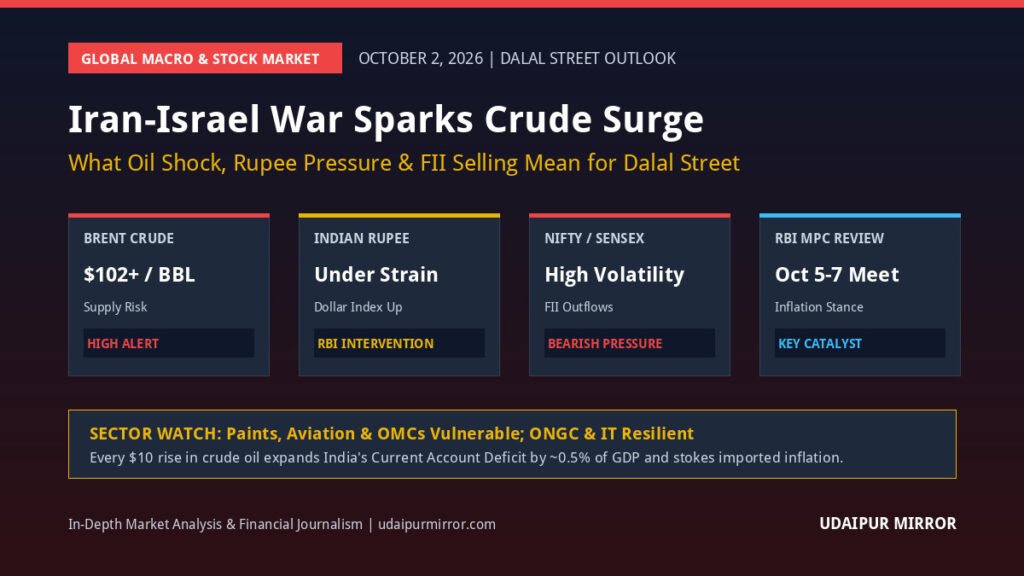
Mumbai / New Delhi: As domestic bourses observe a holiday for Gandhi Jayanti on October 2, market participants across Dalal Street are closely monitoring the sharp escalation in Middle East geopolitical conflict. Following direct missile strikes and retaliatory threats between Iran and Israel, global energy benchmarks have witnessed intense volatility, with Brent crude surging above $100–$103 per barrel. For India—the world’s third-largest oil consumer importing over 85% of its crude needs—the sudden energy spike poses a triple challenge: imported inflation, rupee depreciation, and foreign institutional investor (FII) capital flight ahead of the upcoming Reserve Bank of India (RBI) Monetary Policy Committee meeting.
Key Market Takeaways & Fast Assessment (AEO Summary)
| Economic Trigger | Current Market Status | Direct Impact on Dalal Street |
|---|---|---|
| Brent Crude Oil | Trading elevated between $100 – $103/bbl | Expands India’s Current Account Deficit (CAD); margin squeeze for input-heavy sectors. |
| US Dollar Index (DXY) | Strengthening above 104.50 | Accelerates capital flight from emerging markets towards safe-haven US assets. |
| Indian Rupee (INR) | Under pressure near multi-month lows | Spurs aggressive RBI currency interventions; inflates domestic fuel procurement bills. |
| FII Outflows | Aggressive net selling on Indian cash equities | Limits upward momentum in Nifty 50 and Sensex; heavy weightage banking stocks drag. |
| RBI MPC Policy | Policy review scheduled for October 5–7, 2026 | Dampens expectations of early rate cuts; MPC likely to maintain hawkish vigilance. |
Why Crude Oil Shocks Hit India Harder Than Other Emerging Markets
India’s macro-economic fundamentals are uniquely sensitive to crude price fluctuations. According to historical fiscal correlations published by the Reserve Bank of India and leading brokerage houses:
- Current Account Deficit (CAD): Every permanent $10 increase in crude oil prices expands India’s current account deficit by approximately 0.4% to 0.5% of GDP (roughly $14 to $16 billion annually).
- Wholesale & Retail Inflation: Higher oil prices add 30 to 45 basis points (bps) to headline Consumer Price Index (CPI) inflation through transport tariffs, freight surcharges, and petrochemical derivative inputs.
- Corporate Profit Margins: Raw material input costs for non-financial corporations jump by an estimated 1.2% to 2.5%, directly impacting operating EBITDA margins in the subsequent quarter.
Sectoral Impact: Who Wins and Who Loses on Dalal Street
When stock exchanges resume trading, the market will experience sector-specific divergence. Here is how key industry verticals are positioned:
| Sector | Impact | Key Impacted Stocks | Fundamental Driver |
|---|---|---|---|
| Upstream Oil & Gas | Positive / Beneficiary | ONGC, Oil India | Realize higher net crude realizations ($/bbl) on domestic exploration. |
| IT Services & Exporters | Defensive / Resilient | TCS, Infosys, HCLTech, Wipro | Earn foreign revenues in USD; weaker Rupee provides an earnings translation tailwind. |
| Pharmaceuticals | Defensive Hedge | Sun Pharma, Dr. Reddy’s, Cipla | Inelastic healthcare demand and robust export exposure cushion portfolio drawdowns. |
| Paints & Coatings | High Vulnerability | Asian Paints, Berger Paints, Kansai Nerolac | Crude derivatives constitute over 50% of raw material costs; margins face sharp contraction. |
| Aviation & Logistics | High Vulnerability | InterGlobe Aviation (IndiGo), SpiceJet | Aviation Turbine Fuel (ATF) accounts for 40% of airline operating expenses. |
| Tyres & Synthetic Rubber | Negative | MRF, Apollo Tyres, CEAT, Balkrishna Ind. | Synthetic rubber and carbon black costs rise in tandem with base crude oils. |
| Oil Marketing (OMCs) | Margin Squeeze | IOCL, BPCL, HPCL | Absorb refining and marketing under-recoveries while retail pump prices remain fixed. |
Will Retail Petrol and Diesel Prices Rise in India?
Despite Brent crude climbing above $100 per barrel, domestic retail fuel prices in India are expected to remain stable in the immediate term. The Central Government and state-run refiners have historically maintained a pricing buffer to insulate consumers from acute geopolitical energy spikes, especially ahead of assembly elections and peak festive demand in October and November.
However, this stability comes at a price. Oil marketing companies (OMCs) are currently absorbing substantial marketing losses (under-recoveries) on auto fuels. If crude prices sustain above $100/bbl for an extended period beyond three to four weeks, the government may evaluate either calibrated excise adjustments or targeted upstream windfall levies to bridge the fiscal gap.
The Upcoming RBI Monetary Policy Committee (MPC) Meeting
The Reserve Bank of India’s Monetary Policy Committee is scheduled to meet from October 5 to 7, 2026, to announce its bi-monthly rate decision. Before the Middle East escalation, consensus expectations were building towards a possible dovish pivot or stance change toward “neutral”.
With Brent crude now crossing the critical psychological $100 barrier and the Dollar Index firming up, analysts widely expect Governor Shaktikanta Das and the MPC members to keep the benchmark Repo Rate unchanged at 6.50%. The central bank is likely to emphasize geopolitical supply risks and reiterate its unwavering commitment to anchoring inflation at the 4% target.
Actionable Strategy for Traders and Long-Term Investors
Market experts from Dalal Street advise against emotional panic-selling during geopolitical flare-ups. Historically, conflict-induced market corrections offer rewarding accumulation opportunities for disciplined investors:
- Maintain Asset Allocation Discipline: Avoid speculative leveraged long positions in high-beta sectors like consumer discretionaries, auto components, and mid-cap real estate until crude volatility stabilizes.
- Continue Systematic Investment Plans (SIPs): Rupee-cost averaging during headline-driven market dips systematically lowers acquisition costs across high-quality index funds and large-cap mutual funds.
- Utilize Defensives as Portfolio Anchors: Increase tactical weightages in cash-rich, low-debt sectors such as IT, Pharmaceuticals, and select private banking leaders with strong deposit franchises.
- Strict Stop-Loss for Intraday Traders: Given expected volatility spikes in the India VIX (Volatility Index), traders should reduce lot sizes and enforce strict stop-losses across derivative contracts.
Related Reading & Market Insights
- Commercial LPG Cylinder Price Hiked in October 2026: 19-Kg City Rates & Aadhaar Rule
- Why Indian Stock Market Fell 570+ Points: 5 Major Structural Catalysts
- Dalal Street Holiday Outlook: GIFT Nifty, Asian Indices & Opening Cues
- Gold & Silver Rates Today: Bullion Soars as Safe-Haven Demand Spikes
Frequently Asked Questions (FAQs)
1. How does the Iran-Israel war impact the Indian stock market?
The conflict threatens crude oil shipping routes through the Persian Gulf and the Strait of Hormuz, causing crude prices to surge past $100/bbl. Higher oil prices widen India’s trade deficit, pressure the rupee, spark foreign institutional investor (FII) outflows, and squeeze corporate operating margins across manufacturing and transport sectors.
2. Which stocks benefit when crude oil prices rise?
Domestic upstream oil and gas producers like ONGC and Oil India directly benefit from higher crude realizations. Additionally, export-heavy sectors like IT Services (TCS, Infosys) and Pharmaceuticals benefit defensively from currency depreciation tailwinds.
3. Which sectors suffer the most when crude oil surges?
Paints (Asian Paints, Berger Paints), Aviation (IndiGo), Tyres (MRF, Apollo Tyres), and Oil Marketing Companies (IOCL, BPCL, HPCL) suffer the most because crude oil derivatives constitute their primary operating inputs.
4. Will the RBI cut interest rates in the October 2026 MPC meeting?
A rate cut is highly unlikely in the October 5–7 meeting. The recent spike in crude oil introduces imported inflationary risks, which will prompt the Reserve Bank of India to maintain the repo rate steady at 6.50% and keep a vigilant policy stance.
5. Should retail investors stop mutual fund SIPs during this conflict?
No. Financial planners recommend maintaining regular SIP investments. Market corrections driven by geopolitical events are typically short-to-medium term in nature, providing long-term investors an opportunity to accumulate mutual fund units at lower net asset values (NAVs).