


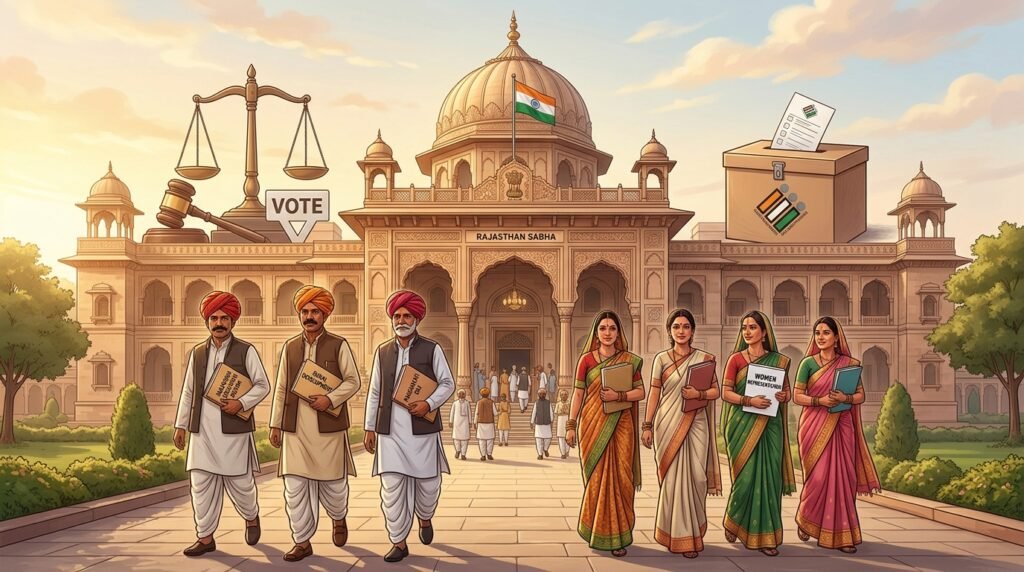
In a decisive and consequential policy pivot, the State Cabinet has formally abolished the three-decade-old Rajasthan two child norm for contesting Panchayati Raj and urban local body elections. The landmark decision, cleared during a comprehensive cabinet review chaired by Chief Minister Bhajanlal Sharma in Jaipur, removes Section 19(l) of the Rajasthan Panchayati Raj Act, 1994, and corresponding provisions in the Rajasthan Municipalities Act. Consequently, aspiring public representatives across rural and urban constituencies will no longer face disqualification if they have more than two children.
This historic amendment arrives at a crucial juncture as rural local bodies prepare for the high-stakes Rajasthan Panchayati Raj Elections 2026 scheduled for November. For over thirty years, the restrictive stipulation prevented thousands of grassroots leaders, particularly women and rural youth, from entering active electoral politics.
Cabinet Mandate: Why Rajasthan Scrapped the Rule
First introduced in 1994 to incentivize family planning and curb population growth, the two-child threshold served its demographic purpose during the late twentieth century. However, recent demographic indicators, including the National Family Health Survey (NFHS-5), demonstrate that Rajasthan’s Total Fertility Rate (TFR) has declined to 2.0, well below the replacement level of 2.1.
Addressing the press following the cabinet conclave, Parliamentary Affairs Minister Jogaram Patel emphasized that the policy had outlived its original intent. Furthermore, extensive field feedback revealed that the rule led to unintended social consequences, such as fraudulent birth declarations, legal disputes, and abandonment of girl children in rural belts.
“Demographic realities in Rajasthan have transformed fundamentally over the past three decades,” the Minister stated. “Continuing with punitive electoral barriers penalizes dedicated social workers rather than promoting population stabilization. Therefore, our government decided to democratize grassroots representation by abolishing the Rajasthan two child norm unconditionally.”
Immediate Electoral Impact on 2026 Panchayat Polls
The revocation of the Rajasthan two child norm will dramatically alter the candidate selection landscape for upcoming Gram Panchayat, Panchayat Samiti, and Zila Parishad contests. Political parties across the spectrum are now revising their candidate shortlists, as numerous seasoned community workers who were previously ineligible can now submit nomination papers without legal hurdles.
Moreover, administrative analysts point out that this reform aligns with regional governance modernization, paralleling major regional initiatives like the Udaipur division development projects aimed at empowering local bodies. By widening the talent pool, village councils can leverage experienced community organizers to steer grassroots welfare delivery.
Legal Process and Ordinance Promulgation
Because the Rajasthan Legislative Assembly is currently not in session, the Cabinet has forwarded an ordinance recommendation to Governor Haribhau Bagade for formal promulgation. Once signed, the ordinance will take effect immediately, ensuring the State Election Commission incorporates the amended eligibility criteria into the model code of conduct and nomination guidelines.
Additionally, the Law Department has confirmed that pending disqualification petitions and ongoing election petitions centered solely on the two-child ceiling will be reviewed under the transitional provisions of the new legal framework.
Timeline of Rajasthan Electoral Eligibility Reforms
| Year | Key Legislative Milestone | Impact on Candidates |
|---|---|---|
| 1994 | Introduction of Section 19(l) in Panchayati Raj Act | Barred candidates with >2 children born after cutoff date |
| 2015 | Mandatory minimum educational qualifications added | Disqualified illiterate and non-matriculate rural candidates |
| 2019 | Scrapping of mandatory education criterion | Restored universal candidacy rights regardless of schooling |
| 2026 | Cabinet scraps Rajasthan two child norm | Universalizes candidacy rights irrespective of family size |
Community and Political Reactions Across Rajasthan
Reactions from civil society organizations, sarpanch unions, and legal experts across Mewar, Marwar, and Shekhawati have been overwhelmingly positive. Women’s rights collectives have specifically welcomed the measure, noting that female sarpanches frequently bore the brunt of marital disputes and false complaints regarding family size.
With the notification expected within days, Rajasthan becomes one of the pioneering northern states to formally detach local democratic candidacy from family size, establishing an inclusive precedent for grassroots federalism in India.