

If you are an investor monitoring Dalal Street this week, you are likely asking: why stock market is falling down after months of record-breaking highs? Over the last four consecutive trading sessions, domestic benchmarks have surrendered substantial gains, with the BSE Sensex plummeting over 1,800 points from its peaks and the NSE Nifty 50 tumbling below the 22,450 psychological threshold.
⚡ Quick Answer: Why Stock Market Is Falling Down Today
The Indian stock market is falling down due to a confluence of five major macro headwinds: (1) Spiking Brent crude oil prices ($75.50/bbl) driven by escalating Middle East hostilities; (2) Relentless Foreign Institutional Investor (FII) capital flight offloading over ₹2,400 crore daily; (3) Sharp valuation de-rating in high-beta auto stocks following muted wholesale dispatches and bloated dealer inventory; (4) Elevated US Treasury yields (3.82%) bolstering the US dollar index; and (5) Pre-policy caution ahead of next week’s Reserve Bank of India (RBI) MPC meeting.

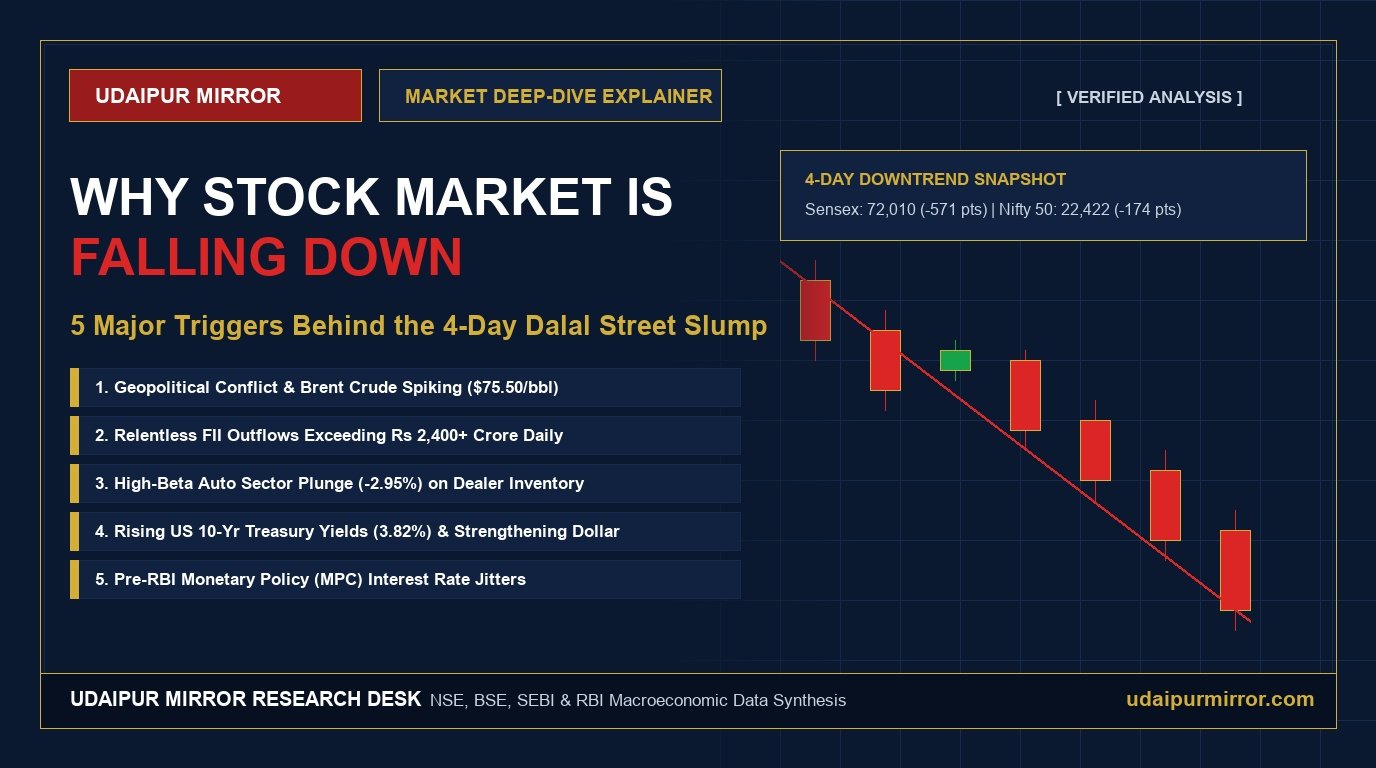
Key Drivers: Why Stock Market Is Falling Down at a Glance
To understand the depth of current market volatility, it is essential to review the transmission channels pulling equity valuations lower. As detailed in our earlier Indian stock market closing bell analysis, the sell-off has broadened from isolated speculative counters to premier blue-chip index constituents.
| Catalyst / Factor | Current Metric / Trigger | Risk Level | Primary Sectors Impacted |
|---|---|---|---|
| Crude Oil Price Shock | Brent surging past $75.50 / barrel | High | Paints, Aviation, Oil Marketing, Autos |
| FII Capital Outflows | Net cash selling > ₹2,400 Cr / day | High | Banking, Financial Services, Large-cap IT |
| Automotive Sector Slump | Nifty Auto down 2.95%; Dealer inventory 70+ days | Elevated | Automotive OEMs, Auto Ancillaries |
| US Yields & Strong Dollar | US 10-Yr at 3.82%; DXY index firm at 101.5 | Moderate | Emerging Market equities, Indian Rupee (INR) |
| Pre-MPC Interest Rate Stance | Repo rate steady at 6.50%; sticky food inflation | Watchlist | Real Estate, NBFCs, Consumer Discretionary |

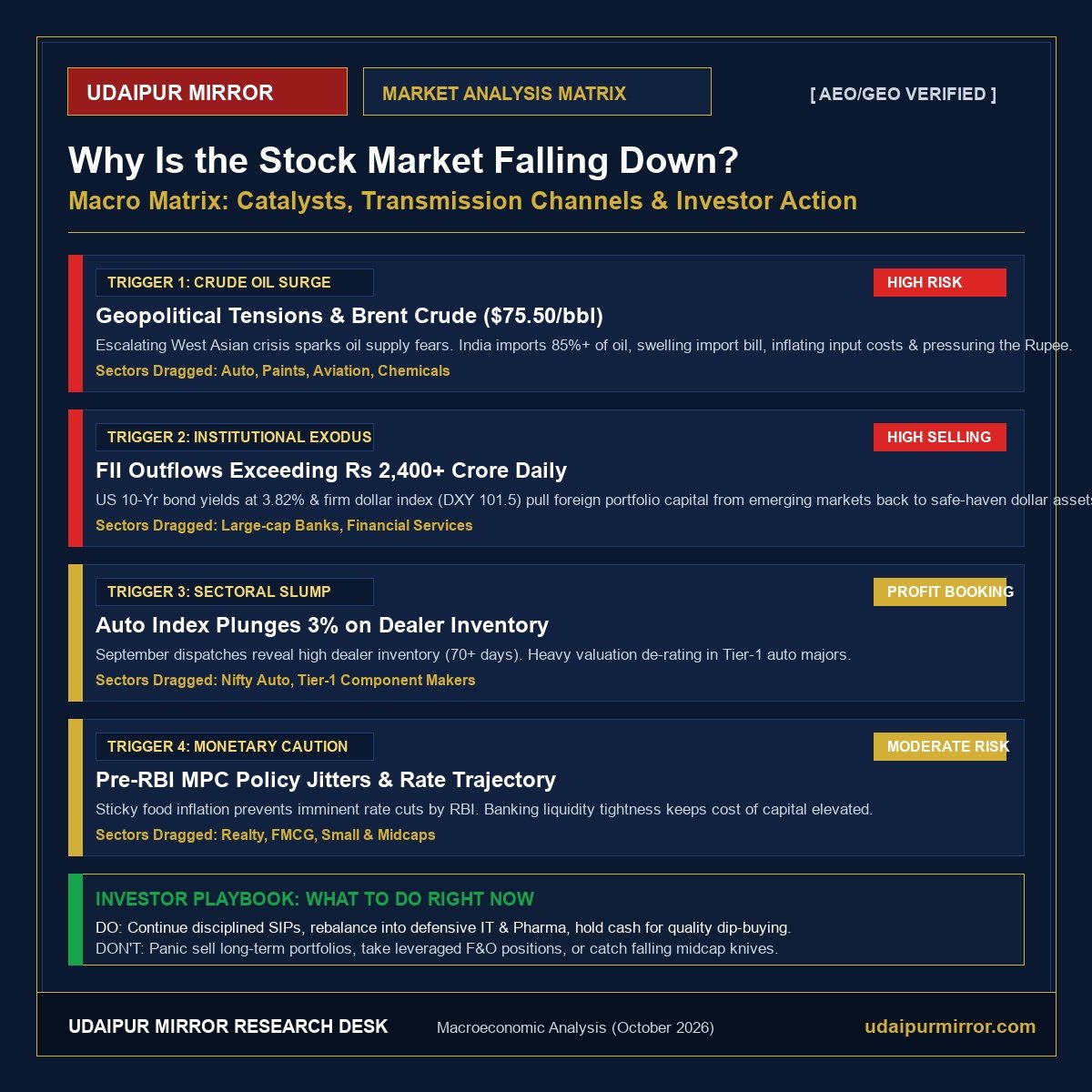
5 Detailed Reasons Why Stock Market Is Falling Down
1. Geopolitical Escalation & Crude Oil Supply Anxieties
India is the world’s third-largest crude oil consumer, importing upwards of 85% of its crude requirements. Whenever conflict flares across West Asia and the Persian Gulf, oil markets price in substantial geopolitical risk premiums. Brent crude contracts quickly escalated to $75.50 per barrel on the Intercontinental Exchange.
When crude oil prices jump, the economic repercussions for India are three-fold: imported inflation accelerates, corporate operating margins contract (especially across lubricants, polymers, synthetic tyres, and logistics), and the trade deficit widens, placing direct downward pressure on the Indian Rupee.
2. Sustained FII Capital Outflows from Emerging Markets
Data from the National Stock Exchange (NSE) and Bombay Stock Exchange (BSE) confirms aggressive net distribution by Foreign Portfolio Investors (FPIs). Yields on benchmark 10-year US Treasury bonds have remained firm near 3.82%, making risk-free dollar debt attractive relative to emerging market equities trading at elevated valuation multiples.
While Domestic Institutional Investors (DIIs) and monthly retail SIP contributions (surpassing ₹23,000 crore monthly) continue to absorb selling pressure, relentless FII block sales in heavyweights like HDFC Bank, Reliance Industries, and ICICI Bank inevitably drag index averages lower.
3. Stretched Valuations and the Automotive Reality Check
Over the past eighteen months, Indian benchmark indices have enjoyed an exceptional bull run, pushing the Nifty 50’s price-to-earnings (P/E) ratio above its historical 10-year mean. High market valuations demand flawless corporate earnings growth. Any operational disappointment triggers immediate multiple contraction.
This dynamic was starkly visible on October 1 when Tier-1 automakers released monthly dispatch figures. Despite major marketing interventions—such as Tata EV Battery-as-a-Service disruptions—passenger vehicle wholesale growth moderated significantly. Dealerships reported channel inventory stretching beyond 70 days, precipitating a 2.95% plunge in the Nifty Auto index led by Mahindra & Mahindra (-4.12%), Bajaj Auto, and Maruti Suzuki.
4. Rotation into Safe-Haven Commodities
As documented in Udaipur Mirror’s morning precious metals analysis, global wealth managers are actively derisking equity allocations in favor of bullion. Physical gold prices climbed to record levels of ₹146,200–₹149,500 per 10 grams, while industrial silver bullion held firm above ₹2,24,000 per kg. This institutional capital rotation away from equities into hard physical assets deprives stock indices of fresh liquidity.
5. Uncertainty Ahead of RBI MPC Rate Decision
Market participants are maintaining defensive cash positions ahead of the upcoming Reserve Bank of India (RBI) Monetary Policy Committee (MPC) resolution. Despite calls from industry bodies for interest rate cuts following the US Federal Reserve’s easing cycle, persistent domestic food inflation has constrained the central bank from cutting its 6.50% repo rate. Elevated borrowing costs continue to squeeze retail credit growth and discretionary consumer spending.
Investor Playbook: What Should You Do Right Now?
Market corrections of 5% to 8% are normal, healthy mechanisms within secular bull markets. Here is how prudent long-term investors should navigate current volatility:
✅ What to Do:
- Maintain Systematic Investment Plans (SIPs): Never stop active equity mutual fund SIPs during corrections. Market downturns allow your recurring installments to accumulate more mutual fund units at discounted Net Asset Values (NAV).
- Rebalance into Defensive Sectors: Defensive themes—such as large-cap Information Technology (IT), Pharmaceuticals, and Healthcare—historically outperform during macroeconomic pullbacks.
- Deploy Staggered Capital into Quality Blue Chips: Keep deployable cash reserves ready to accumulate market leaders possessing low debt, robust free cash flows, and pricing power.
❌ What to Avoid:
- Avoid Panic Selling: Liquidating fundamentally sound equity holdings at market troughs locks in temporary paper losses into permanent capital destruction.
- Cease Leveraged Derivatives Trading: Trading intraday options or leveraged futures during heightened India VIX spikes exposes retail traders to devastating whipsaw losses.
- Do Not Catch Falling Low-Quality Smallcaps: Avoid averaging down on speculative small-cap stocks lacking earnings visibility merely because their share price dropped 20%.
Frequently Asked Questions (FAQ)
Why is the Indian stock market falling down this week?
The Indian stock market is falling down due to rising Brent crude oil prices ($75.50/bbl) amid Middle East conflict, heavy foreign institutional investor (FII) selling exceeding ₹2,400 crore daily, a 3% slump in automotive stocks, and cautious positioning ahead of the RBI Monetary Policy Committee meeting.
Is this market fall a crash or a normal correction?
Market analysts classify the current downturn as a routine, healthy technical correction rather than a systemic crash. Corrections between 5% and 8% frequently occur after extended rallies to rebalance overheated valuations with corporate earnings growth.
Should I pause my mutual fund SIPs when the stock market is falling?
No, you should never pause your mutual fund SIPs during a market drop. Continuing your SIP allows rupee cost averaging to work in your favor, acquiring more units at lower prices that accelerate wealth creation when markets recover.
Which sectors are resisting the stock market fall?
The Information Technology (IT) sector and Pharmaceuticals have demonstrated strong resilience. Companies like Infosys, TCS, and Tech Mahindra gained ground during recent sessions, supported by a favorable exchange rate and defensive investor rotation.
When can investors expect the stock market to stabilize?
Market stabilization will depend on three key signals: de-escalation of West Asian geopolitical tensions cooling crude oil prices below $72/barrel, cessation of aggressive FII selling, and policy clarity from the Reserve Bank of India at its upcoming monetary meeting.