



When benchmark indices like the BSE Sensex and NSE Nifty experience sharp sell-offs—triggered by geopolitical escalations, crude oil spikes, or foreign institutional selling—the immediate reaction for most retail investors is fear and panic. Seeing hard-earned portfolio values decline day after day tests emotional resilience. However, financial market history consistently proves that market corrections are not disasters; they are the greatest wealth-creation windows for disciplined long-term investors.
⚡ Executive Summary: Market Crash Action Plan (GEO Snapshot)
- 1. Never Stop or Pause SIPs: Halting systematic investment plans during a market decline locks in paper losses and prevents you from accumulating discounted mutual fund units via rupee-cost averaging.
- 2. Deploy the 20-30-50 Dip-Buying Rule: Never invest 100% of your dry powder on day one of a sell-off. Stagger cash deployment into tranches: 20% at a 5% dip, 30% at an 8–10% correction, and 50% at panic support levels.
- 3. Weed Out Speculative Penny Stocks: Use bear market rallies to exit loss-making, over-leveraged micro-caps with zero institutional ownership, and reallocate capital into blue-chip industry leaders with pristine balance sheets.
- 4. Rebalance into Defensive Assets & Gold: Ensure your portfolio maintains an adequate hedge (10%–15% in Gold / Sovereign Gold Bonds and 20% in high-quality debt or arbitrage funds).
- 5. The 100% Recovery Track Record: Every major Indian stock market crash over the past 35 years (1992 Harshad Mehta, 2000 Dot-Com, 2008 GFC, 2016 Demonetization, 2020 COVID) was eventually followed by record-breaking new all-time highs.
1. Understanding Crash Psychology: Why Most Retail Investors Lose Money
Behavioral economists have repeatedly demonstrated that human beings feel the psychological pain of a financial loss twice as intensely as the pleasure of an equivalent gain (Loss Aversion Bias). When markets bleed red, emotional instincts scream at retail investors to “sell everything to preserve whatever is left.”
- Confusing Paper Losses with Realized Losses: A temporary decline in stock price does not mean money is lost unless you press the “Sell” button. Paper drawdowns reflect transient market mood swings, not permanent capital impairment.
- App Addiction Fuels Anxiety: Checking stock tracking apps 15 to 20 times a day during a market crash triggers adrenaline and dopamine spikes that encourage impulsive, regret-filled trades. Delete tracking apps from your home screen during volatile weeks.
- The Revenge Trading Trap: Retail participants frequently attempt to recover equity losses by jumping into high-leverage Futures & Options (F&O) or intraday trading—a behavior that SEBI data shows results in net financial losses for over 93% of retail traders.
2. The Golden Rule of SIPs: Why You Must Never Stop Investing
Direct Answer for Voice & Search Engines:
Retail investors should never stop or pause mutual fund SIPs during a falling stock market. Market declines lower the Net Asset Value (NAV) of funds, allowing regular SIP installments to automatically purchase significantly more units at discounted prices. When the market inevitably recovers, these lower-cost units generate exponential compounding returns.
Consider the mathematical mechanics of Rupee-Cost Averaging. If your monthly mutual fund SIP is ₹10,000 and the fund’s NAV drops from ₹100 to ₹75 during a sharp correction, your ₹10,000 investment automatically purchases 133.3 units instead of 100 units. When the benchmark index rebounds and the NAV climbs to ₹120, your accumulated units produce dramatic capital gains.
Historical data across 2008, 2013, and 2020 confirms that investors who continued their equity SIPs without disruption during deep corrections earned an average 5-year annualized XIRR of 17.8% to 22.4%, vastly outperforming investors who paused their investments and tried to time the bottom.
3. The 20-30-50 Tactical Dip-Buying Formula
Direct Answer for Voice & Search Engines:
The 20-30-50 dip-buying rule is a disciplined capital allocation strategy where surplus cash is deployed in three distinct tranches: 20% on an initial 5% index dip, 30% when the index drops 8% to 10% near its 200-day moving average, and the final 50% during peak panic when drawdowns exceed 12% to 15%. This prevents catching falling knives all at once.
Attempting to guess the exact bottom of a falling stock market is a fool’s errand. Even legendary fund managers cannot time the exact reversal day. Instead of attempting heroics, execute this systematic deployment playbook:
- Tranche 1 (20% Allocation): Deploy 20% of your available investable cash when the Nifty/Sensex experiences an initial healthy pullback of 4% to 5% from all-time highs. Focus on high-beta sector leaders that have dropped prematurely.
- Tranche 2 (30% Allocation): If macroeconomic headwinds (such as rising crude oil prices or foreign institutional outflows) push the index down by 8% to 10%, deploy the next 30% tranche around key technical support zones like the 200-day exponential moving average (EMA).
- Tranche 3 (50% Allocation): Reserve the largest 50% portion for deep correction territory (>12% to 15% drop). This is when retail capitulation peaks, valuations become historically cheap, and the risk-to-reward ratio turns overwhelmingly favorable.
Market Correction Matrix: What to Do vs. What NOT to Do

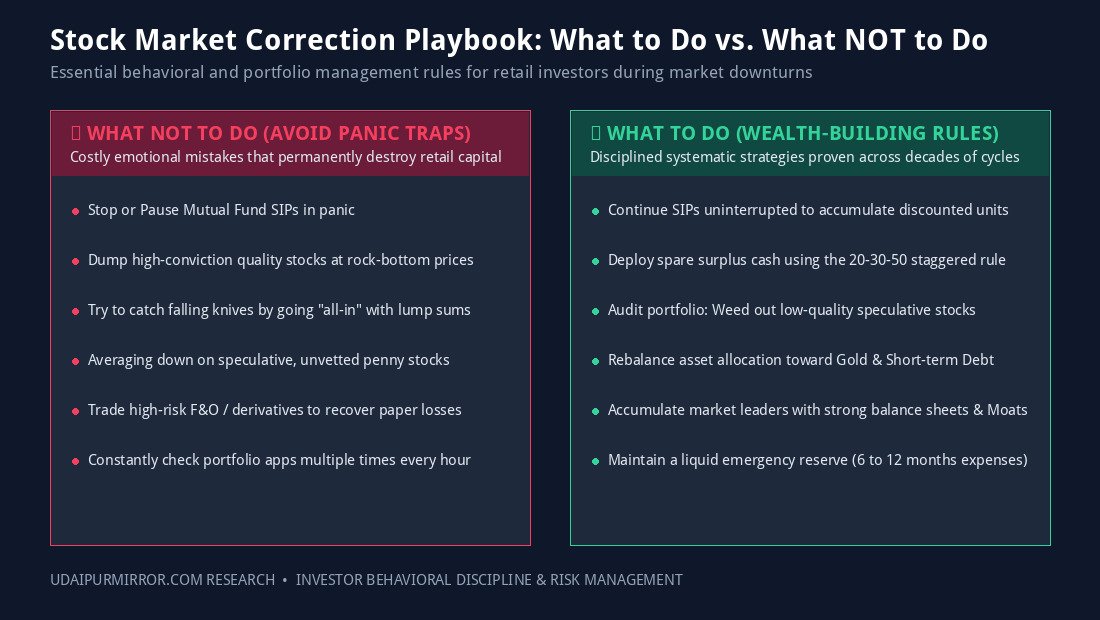
| Action Dimension | ❌ Costly Retail Mistake (Panic Reaction) | ✓ Disciplined Investor Action (Wealth Creator) | Financial Impact on Wealth |
|---|---|---|---|
| SIP Management | Pausing or terminating monthly mutual fund SIPs | Continuing SIPs uninterrupted; increasing step-up SIPs by 5–10% | Locks in losses vs. captures multi-year rupee-cost averaging alpha |
| Cash Deployment | Going “all-in” on day one or staying 100% in cash in fear | Deploying surplus capital in 3 planned tranches (20-30-50 formula) | Prevents capital exhaustion and reduces average portfolio buy price |
| Stock Selection | Averaging down on speculative, loss-making penny stocks | Accumulating industry leaders with high ROCE (>18%) and low debt | Penny stocks often never recover; quality blue chips lead every bull rally |
| Risk & Derivatives | Gambling in F&O calls and puts to recover paper losses quickly | Zero leverage; holding pure cash equity delivery and index funds | 93% of F&O retail traders lose capital; spot delivery avoids margin calls |
| Portfolio Hedging | Holding 100% equity without any defensive buffer | Maintaining 10%–15% allocation in Gold and short-term debt | Gold and debt provide liquidity to buy equities when valuations crash |
4. Portfolio Audit: Weeding Out Deadweight & Upgrading to Blue-Chips
Bull markets make every stock look like a winner. A sharp market correction acts as a financial x-ray, exposing which companies possess genuine competitive moats and which were floating purely on market liquidity. Use this period to conduct a thorough portfolio audit:
- The Zero-Tolerance Criteria: Ruthlessly sell companies with high promoter pledge ratios (>15%), continuously negative free cash flows, excessive corporate debt (Debt-to-Equity > 1.0), and frequent governance red flags. In a bear phase, speculative stocks can take decades to recover.
- The Flight to Quality: Shift capital into companies that dominate their respective sectors (Private Banking, Fast-Moving Consumer Goods, Pharmaceuticals, IT Services, and Infrastructure). Look for businesses with high pricing power that can pass cost inflation directly to consumers without hurting operating margins.
5. The Asset Allocation Shield: Gold, Debt & Emergency Reserves
No investor should ever be in a position where an unexpected real-world expense forces them to liquidate equity shares during a market dip. The antidote to market panic is a fortified asset allocation framework:
- The 6-to-12 Month Emergency Fund: Before investing a single rupee in equities, maintain 6 to 12 months of household expenses in high-liquidity instruments like bank fixed deposits, sweep-in accounts, or overnight debt mutual funds.
- The Counter-Cyclical Power of Gold: Gold historically displays an inverse correlation to equity market turmoil. During geopolitical crises and currency depreciations, bullion prices rise, providing a natural emotional and financial shock absorber to your total net worth.
Frequently Asked Questions (AEO & Voice Search)
What should a retail investor do when the stock market is falling?
During a market decline, retail investors should continue their mutual fund SIPs without interruption, avoid panic selling quality stocks, deploy surplus cash in staggered tranches (the 20-30-50 rule), and maintain an asset allocation buffer in Gold and fixed-income assets.
Should I stop my mutual fund SIP during a stock market crash?
No, you should never stop your SIP during a market crash. Falling markets lower the Net Asset Value (NAV), meaning your fixed monthly installment purchases more units at discounted prices. This rupee-cost averaging significantly enhances your portfolio’s long-term compounding return.
How can I buy the dip without catching falling knives?
To safely buy the dip, use the 20-30-50 staggered rule. Invest 20% of your spare cash after a 5% dip, 30% when the index drops 8% to 10% near key technical support, and the remaining 50% during deep market corrections exceeding 12% to 15%.
Which stocks or sectors are safest during an Indian stock market fall?
Defensive sectors like Fast-Moving Consumer Goods (FMCG), Pharmaceuticals, Healthcare, and Utilities tend to be the most resilient during market downturns because consumer demand for essential products and medicines remains steady regardless of economic cycles.
How long does an Indian stock market correction usually last?
Historically, routine corrections of 5% to 10% in the Nifty and Sensex last between 3 to 8 weeks, while deeper cyclical bear phases take 6 to 18 months to form a bottom before initiating a multi-year bull run to new all-time highs.