


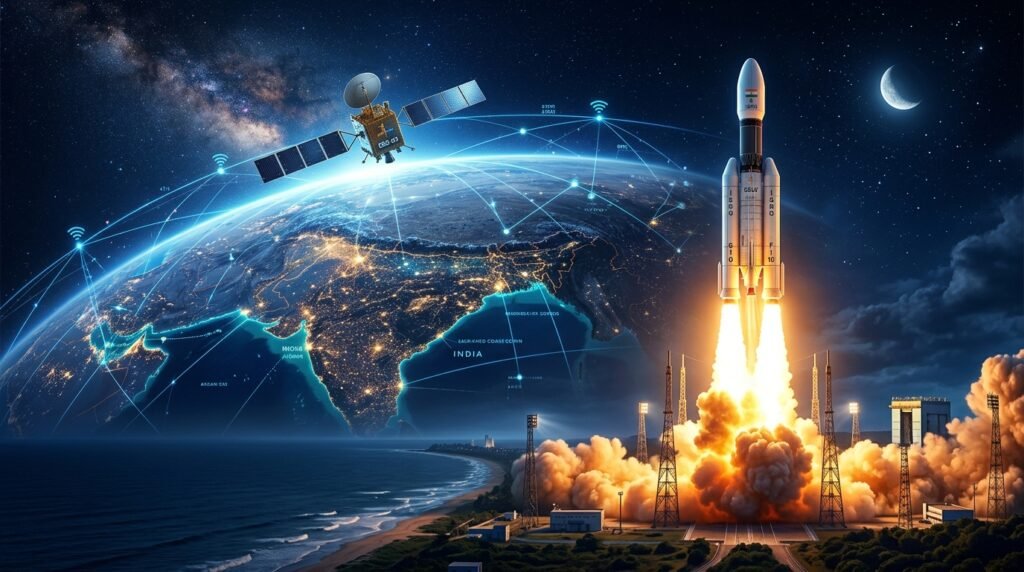
In a major milestone for India’s sovereign space infrastructure, the Indian Space Research Organisation (ISRO) is finalizing launch preparations for the critical ISRO NVS-03 satellite launch. Targeted for mid-October 2026 from the Satish Dhawan Space Centre in Sriharikota, the mission will inject the second-generation navigation satellite into geosynchronous transfer orbit. Crucially, the deployment will revitalize the NavIC (Navigation with Indian Constellation) network, ensuring robust positioning accuracy across the subcontinent.
Strategic Importance of the ISRO NVS-03 Satellite Launch
India’s regional navigation satellite system operates independently of foreign positioning networks such as American GPS, Russian GLONASS, or European Galileo. However, several first-generation IRNSS spacecraft have surpassed their operational lifespans or experienced clock anomalies. Consequently, the ISRO NVS-03 satellite launch restores optimal constellation redundancy, providing uninterrupted real-time coordinates across India and extending fifteen hundred kilometers beyond national borders.
Furthermore, the spacecraft will ride aboard ISRO’s proven Geosynchronous Satellite Launch Vehicle (GSLV-F15). Specifically, the mission represents a vital link in the second-generation NVS satellite series, following the successful orbiting of NVS-01. Therefore, aerospace scientists at the Space Applications Centre (SAC) are conducting comprehensive integrated simulations ahead of final launch vehicle stacking.
Advanced Indigenous Atomic Clocks and New L1 Band
Technologically, the NVS-03 spacecraft features major indigenous innovations developed by Indian scientists. Most notably, the satellite incorporates an indigenously developed Rubidium atomic clock, replacing imported European timing units. Because high-precision timing forms the foundation of satellite navigation, these indigenous atomic clocks safeguard strategic operational autonomy.
| Mission Parameter | Technical Specification | Operational Role |
|---|---|---|
| Satellite Series | Second-Generation NVS-03 | Constellation replenishment and signal upgrade |
| Launch Vehicle | GSLV Mk II (GSLV-F15) | Geosynchronous Transfer Orbit (GTO) injection |
| Primary Payloads | L1, L5, and S-Band Transponders | Dual civilian and encrypted military frequencies |
| Atomic Timing Unit | Indigenous Rubidium Clock (SAC Ahmedabad) | Nanosecond-precision signal synchronization |
| Coverage Footprint | India + 1,500 km Regional Perimeter | Subcontinental positioning and marine navigation |
Applications Across Civilian, Aviation, and Defense Sectors
In addition to sovereign defense capabilities, the introduction of the civil L1 band allows consumer 5G smartphones to access NavIC signals directly. For instance, modern logistics fleets, quick-commerce platforms, and AI-driven hyperlocal delivery networks will achieve sub-meter delivery precision. Meanwhile, civilian airliners and marine vessels navigating the Indian Ocean will benefit from hardened anti-jamming signals.
Moreover, the expansion of indigenous digital technologies mirrors national strides across the broader economic and fintech landscape. As highlighted in recent analysis of India’s evolving digital transaction policies, self-reliant infrastructure forms the backbone of sustained economic leadership.
Final Preparations at Sriharikota Spaceport
According to official mission tracking reports from ISRO and the Department of Space, the NVS-03 satellite has already completed acoustic, thermal vacuum, and solar array deployment tests. Currently, payload integration specialists in Bengaluru are preparing the satellite for transit to the launch base. Following stage propellant loading, the Mission Readiness Review (MRR) committee will formally clear the vehicle for countdown.
Ultimately, the upcoming ISRO NVS-03 satellite launch cements India’s position among an elite group of nations operating self-sufficient satellite navigation architectures. By pairing cutting-edge research with strategic self-reliance, ISRO continues to power India’s digital and technological transformation.