Office Address
14, Residency Road, Udaipur, Rajasthan 313001
Office Address
14, Residency Road, Udaipur, Rajasthan 313001


NEW DELHI: NEW DELHI — As Indian retail investors increasingly look beyond traditional equities for portfolio diversification, the debate surrounding gold etf vs crypto etf has intensified. With evolving regulatory guidelines in 2026, understanding the fundamental differences between these two digital-age investment vehicles has never been more critical. While Gold ETFs derive their value from physical gold backed by SEBI-regulated custodians, crypto-linked financial instruments operate within a vastly different speculative ecosystem. Meanwhile, broader economic policy discussions, such as Trump’s Midterm Poll Setback Won’t Derail India-US Trade Talks: Official, continue to shape global liquidity trends that indirectly affect asset class valuations across developing markets.
⚡ Quick Highlights: Gold ETF vs Crypto ETF in India: 2026 Rules & Comparison
Gold Exchange Traded Funds (ETFs) represent units representing physical gold, which may be in paper or dematerialized form. Each unit is typically backed by physical gold of high purity. For Indian retail investors, Gold ETFs eliminate the safety concerns, making charges, and purity doubts associated with physical jewellery or bars purchased during festive seasons.
Furthermore, as domestic markets mature, institutional capital allocation towards advanced technologies mirrors trends seen in reports like India is funding deeptech. Who will buy what it builds?, highlighting how structured investment products provide necessary security and transparency for long-term wealth preservation.
“Gold ETFs bridge the gap between traditional safety and modern stock exchange liquidity, offering retail investors peace of mind.” — Senior Commodity Strategist
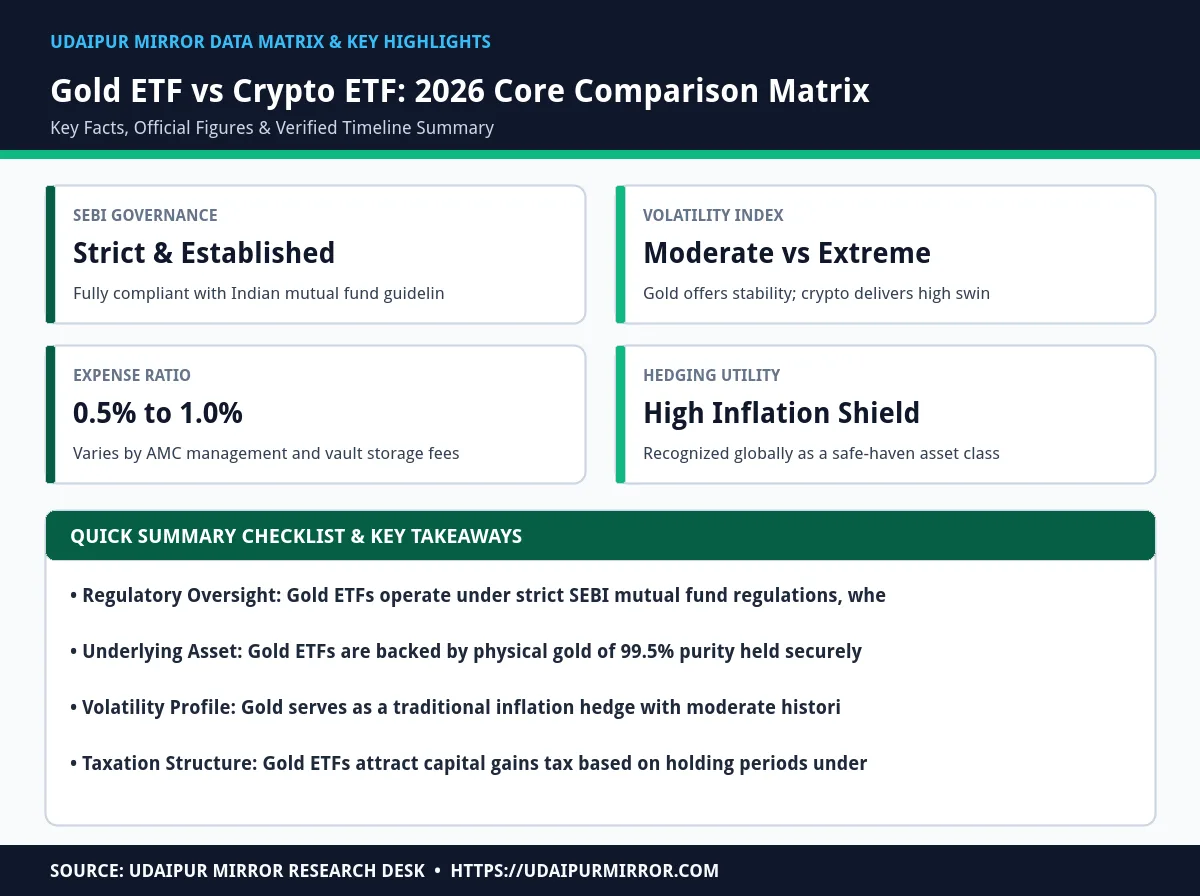
Review this structured tabular comparison to evaluate how Gold ETFs stack up against cryptocurrency-backed investment funds across critical financial and regulatory parameters for the year 2026.
| Evaluation Parameter | Gold Exchange Traded Funds | Crypto Exchange Traded Funds | Indian Regulatory Status |
|---|---|---|---|
| Primary Backing | Physical Gold (99.5% purity) | Digital Tokens / Coins | SEBI Regulated vs Emerging |
| Historical Volatility | Low to Moderate | Very High | Market Dependent |
| Inflation Hedge | Proven historical store of value | Experimental digital hedge | Variable acceptance |
| Exchange Traded | Yes (NSE / BSE) | Limited / Emerging formats | Approved domestic channels |
| Storage & Custody | Independent Institutional Vaults | Digital Custodians & Hot/Cold Wallets | Strict Audit Mandates |
Crypto ETFs offer indirect exposure to digital assets such as Bitcoin or Ethereum without requiring the investor to manage private keys or set up independent crypto exchange accounts. While global markets have witnessed rapid adoption of spot crypto funds, the regulatory framework in India remains tightly controlled to protect retail participants from excessive speculation and systemic financial risks.
Investors must carefully evaluate the risk-reward ratio before allocating capital to digital asset funds. Unlike gold, which has thousands of years of established monetary history, cryptocurrencies derive their valuation largely from network adoption, market sentiment, and macroeconomic liquidity cycles.
“Cryptocurrency investment vehicles demand rigorous risk management due to their inherent price unpredictability.” — Fintech Policy Analyst
When constructing a balanced portfolio, financial advisors generally recommend treating gold as a strategic core holding for crisis mitigation and inflation hedging. Conversely, digital assets are classified as high-risk satellite holdings suitable only for aggressive investors with a high risk tolerance.
Balancing these two asset classes requires a disciplined approach. Allocating 5% to 10% of a portfolio to gold provides a reliable shock absorber during equity market downturns, whereas exposure to crypto-linked instruments should be strictly limited to capital that an investor can afford to lose entirely. (Also read: India is funding deeptech. Who will buy what it builds?).
Taxation plays a decisive role in determining net returns for Indian taxpayers. Gold ETFs are generally taxed under capital gains rules applicable to non-equity mutual funds, depending on the prevailing holding period thresholds defined in the Union Budget.
On the other hand, digital asset transactions and crypto-linked funds attract specific tax deductions and stringent reporting norms under Indian tax laws. Investors must consult qualified chartered accountants to ensure full compliance with annual tax filing mandates.
A Gold ETF is backed by physical gold stored in secure vaults and regulated by SEBI, whereas a Crypto ETF tracks digital tokens like Bitcoin or Ethereum operating in high-volatility ecosystems with evolving regulatory oversight.
Generally, Gold ETFs carry lower volatility and are viewed as a traditional safe-haven asset, whereas Crypto ETFs exhibit extreme price swings and higher speculative risk.
Gold ETFs are fully tradeable on the NSE and BSE through standard demat accounts. Crypto-linked financial products in India are subject to specialized regulatory approvals and limited availability.
Gold ETFs are taxed under standard capital gains rules for non-equity mutual funds, while digital assets and crypto instruments are governed by specific taxation frameworks established by Indian tax authorities.
Add Udaipur Mirror as a preferred source on Google to see more of our travel guides in your AI overviews.