Office Address
14, Residency Road, Udaipur, Rajasthan 313001
Office Address
14, Residency Road, Udaipur, Rajasthan 313001


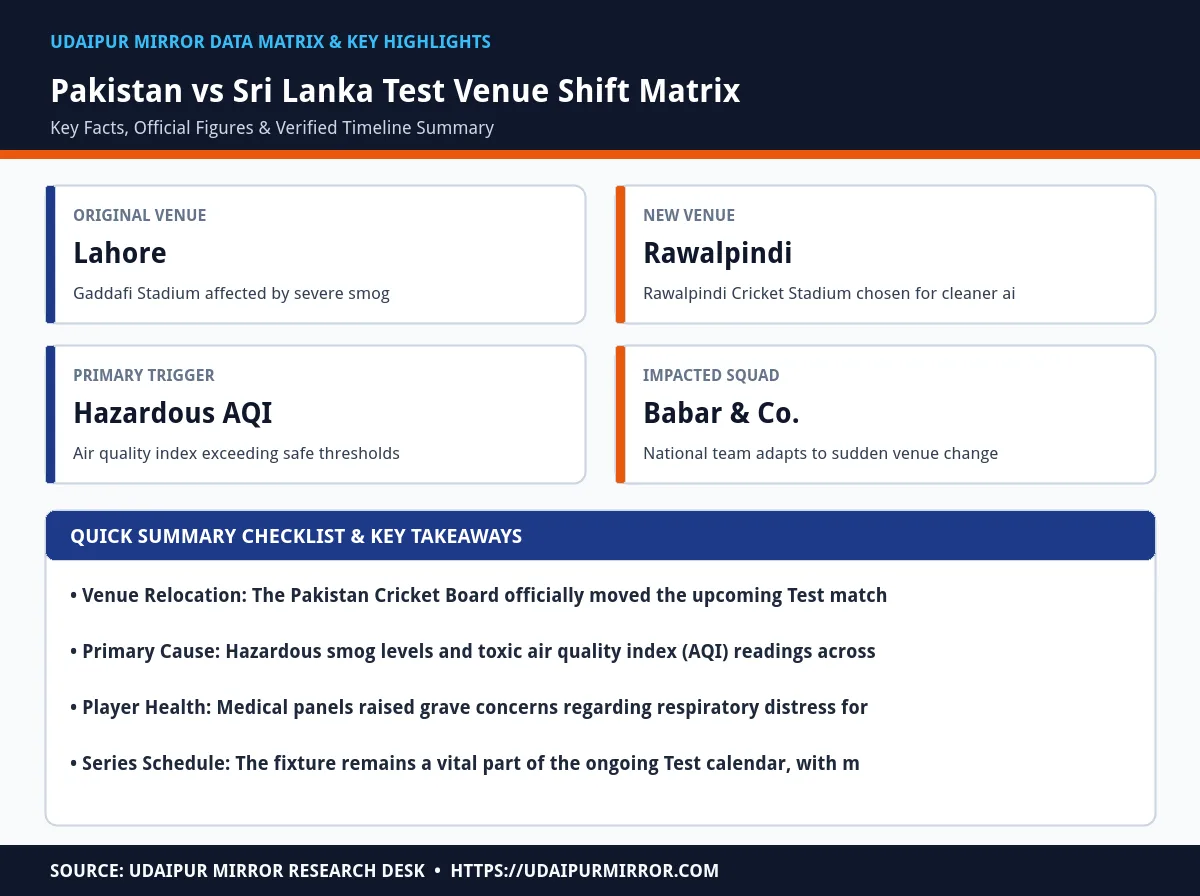
LAHORE / NEW DELHI: International cricket scheduling faces an unprecedented environmental crisis across South Asia as regional pollution levels peak. Following similar disruptions in neighboring cricket boards, the Pakistan Cricket Board (PCB) has officially confirmed the decision to shift test match from Lahore to Rawalpindi due to dangerously high smog concentrations enveloping Punjab. The deteriorating air quality, which has severely impacted visibility and health safety in major urban centers, left cricket administrators with no viable alternative but to relocate the fixture to ensure player welfare and unhindered match execution.
⚡ Quick Highlights: Pakistan Shifts Test Match to Rawalpindi Due to Smog
The decision to relocate the high-profile Test fixture comes in the wake of alarming meteorological reports from Pakistan’s Punjab province. Thick blankets of smog have severely reduced horizontal visibility and pushed Air Quality Index (AQI) numbers deep into the hazardous zone. Sports administrators, prioritizing the physical well-being of Babar Azam and the rest of the squad, recognized that hosting a five-day red-ball match under such toxic atmospheric conditions posed severe health risks.
Local governance bodies have implemented stringent anti-smog measures, yet the persistent weather inversion trapping pollutants near the surface necessitated immediate sporting intervention. Fans looking at broader regional updates can also explore related community developments such as grassroots administrative shifts to understand how administrative bodies adapt to local crises.
“Player safety and optimal playing conditions remain non-negotiable pillars of our scheduling policy when extreme weather strikes.” — PCB Official Spokesperson
Environmental challenges, including heavy smog, unseasonal rain, and extreme weather phenomena, have increasingly dictated international cricket schedules across the subcontinent. The table below outlines recent fixture alterations affecting major series.
| Series / Tour | Original Venue | Relocated Venue | Primary Disruption Factor |
|---|---|---|---|
| Pakistan vs Sri Lanka Test | Lahore | Rawalpindi | Severe Smog & Toxic Air |
| India vs New Zealand ODI | Hamilton | Abandoned | Heavy Rainfall & Washout |
| Domestic Ranji Fixtures | North India Hubs | Rescheduled | Low Visibility / Smog |
| Champions Trophy Prep | Various | Under Review | Climatic Variations |
International cricket has witnessed an unprecedented string of weather-related interruptions in recent weeks. While northern India and Pakistan grapple with hazardous smog envelopes choking daily life and sporting fixtures alike, other regions contend with unseasonal downpours. Cricket boards are increasingly forced to maintain flexible itinerary frameworks to accommodate sudden environmental shifts without compromising tournament integrity.
As cricket enthusiasts track these scheduling adjustments, educational and administrative domains similarly experience weather and operational transitions, comparable to tracking changes like academic hall ticket schedules during regional shifts.
“Modern cricket scheduling must factor in environmental realities; climate patterns are no longer predictable.” — Senior Cricket Analyst
Shifting the match to Rawalpindi introduces a fresh tactical dynamic for the coaching staff and team management. Rawalpindi pitches typically offer different bounce and wear characteristics compared to Lahore’s Gaddafi Stadium, prompting potential changes to the playing XI composition. Captain Babar Azam and the team analysts have begun reviewing bowling combinations and batting orders tailored specifically to the Rawalpindi surface.
Furthermore, domestic developments within the broader sports ecosystem, including women’s leadership milestones in regional governance, highlight a period of widespread structural adaptation across various societal pillars.
“We must adapt quickly to the new conditions in Rawalpindi; focus remains entirely on executing our red-ball strategy.” — Babar Azam, Pakistan Test Captain
The match was shifted due to severe smog and hazardous air quality index (AQI) levels in Lahore, which posed significant health and visibility risks to players.
The Pakistan Cricket Board (PCB) officially confirmed the venue relocation after consulting with medical and meteorological experts.
The team must quickly adapt their tactical approach and playing XI selection to suit the pitch conditions and atmospheric environment of Rawalpindi.
Yes, international cricket across the subcontinent has experienced frequent interruptions due to both heavy smog in northern hubs and unseasonal rain washouts.
Add Udaipur Mirror as a preferred source on Google to see more of our travel guides in your AI overviews.