Office Address
14, Residency Road, Udaipur, Rajasthan 313001
Office Address
14, Residency Road, Udaipur, Rajasthan 313001


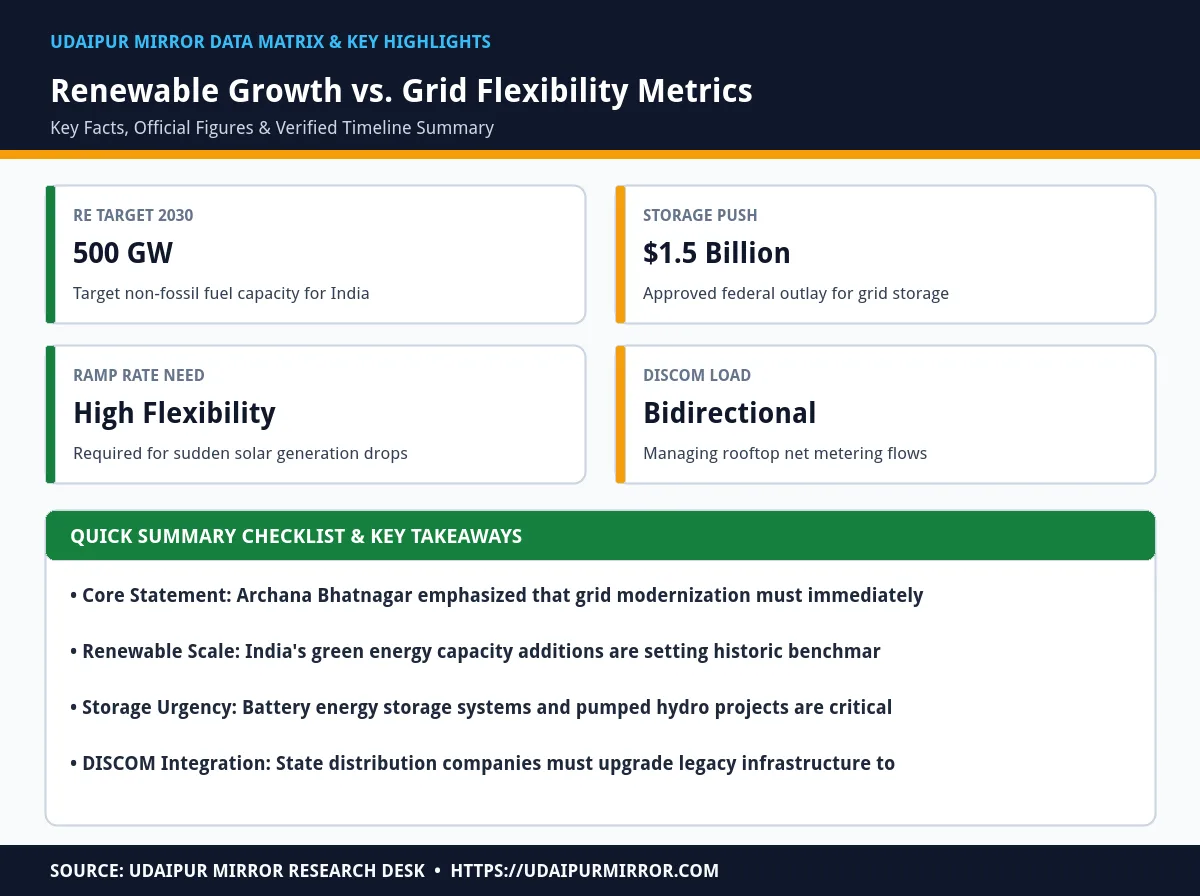
NEW DELHI: NEW DELHI — As India continues its aggressive march toward massive clean energy integration, industry leaders are raising critical operational flags. Manufacturing expert and voice of industrial transformation Archana Bhatnagar has asserted that grid flexibility renewable growth must move in tandem to prevent severe transmission bottlenecks, system overloads, and supply intermittency across regional power corridors.
⚡ Quick Highlights: Grid Flexibility Must Keep Pace with Renewable Growth: Bhatnagar
India’s transition toward an electrostate model, moving away from petro-dependency, is proceeding at an unprecedented pace. However, industrial voices like Archana Bhatnagar point out that generating clean electrons is only half the battle. Without robust transmission corridors and intelligent dispatch systems, massive solar parks in the Thar desert and sprawling rooftop installations will overwhelm traditional substations.
Market dynamics across commodities and industrial metals remain volatile, as evidenced by recent trends where investors closely monitor gold and silver price movements on the MCX alongside green tech funding. Yet, the capital allocation toward clean energy infrastructure demands absolute precision and long-term regulatory backing.
“Grid flexibility must keep pace with renewable growth, or we risk stranded green assets and localized power curtailments that stifle industrial momentum.” — Archana Bhatnagar, Manufacturing Today India
To understand how localized rooftop adoption under schemes like PM Surya Ghar interacts with broader grid architecture, consumers and planners evaluate various system tiers. Below is a detailed breakdown of 1kW to 5kW residential solar configurations, estimated benchmark installation costs, central government subsidies, and typical monthly electricity savings.
| System Capacity | Benchmark Cost (INR) | Govt Subsidy (INR) | Avg Monthly Savings (INR) |
|---|---|---|---|
| 1 kW System | Rs 60,000 | Rs 30,000 | Rs 1,200 – Rs 1,500 |
| 2 kW System | Rs 1,20,000 | Rs 60,000 | Rs 2,500 – Rs 3,000 |
| 3 kW System | Rs 1,80,000 | Rs 78,000 | Rs 4,000 – Rs 4,500 |
| 5 kW System | Rs 3,00,000 | Rs 78,000 (Max Cap) | Rs 6,500 – Rs 7,500 |
At the regional level, state distribution companies face the uphill task of integrating decentralized rooftop solar systems while maintaining base load stability. Net metering frameworks across western and northern states require automated data logging to prevent reverse power surges that can damage distribution transformers.
Grassroots empowerment is also transforming local communities, much like how dedicated civic leaders and social workers have reshaped rural governance structures, highlighted recently in stories celebrating grassroots rural leadership milestones in Rajasthan. Similarly, modernizing village electrical sub-grids requires community-level awareness and technical compliance.
“Modernizing DISCOM operations is no longer optional; it is the core prerequisite for achieving India's 500 GW non-fossil fuel target.” — Senior Power Sector Analyst, New Delhi
The sun does not shine constantly, and wind patterns fluctuate unpredictably. To bridge the generation gap between peak solar hours and evening demand spikes, large-scale battery energy storage systems (BESS) and pumped hydro storage are being deployed nationwide. The recent federal approval of a $1.5 billion grid storage push underscores the government’s resolve to stabilize the national grid.
Without adequate storage, unmanaged green power surges force grid operators to curtail renewable generation, leading to financial losses for developers and inefficient resource utilization. Experts agree that pairing large utility-scale solar farms with dedicated storage facilities is the only viable pathway forward. (Also read: भाणा की माटी का सपूत: कैलाश कुमावत के जनसेवा के तप से मातुश्री अंछी देवी बनीं सरपंच, राजसमंद के भाणा में रचा गया ऐतिहासिक जनादेश | Kailash Kumawat Bhana).
“Storage is the shock absorber of the modern electrical grid, ensuring that clean energy generated at noon powers households at midnight.” — Renewable Energy Policy Forum
As India solidifies its position as a global leader in green technology, the dialogue must shift from mere capacity installation to system-wide operational efficiency. Policymakers, DISCOM executives, and manufacturing leaders must collaborate to establish strict grid codes, dynamic pricing models, and fast-track clearance for transmission line expansions.
Ultimately, Archana Bhatnagar’s timely caution serves as a strategic roadmap for the nation. By aligning physical infrastructure investments with clean energy targets, India can successfully navigate its historic transition into a secure, resilient electrostate.
“Our future economic sovereignty depends entirely on how intelligently we manage our power grid through this renewable revolution.” — Industrial Tech Summit Convener
Archana Bhatnagar emphasized that grid flexibility must keep pace with renewable growth to prevent transmission bottlenecks and ensure systemic stability.
Grid flexibility is essential because renewable sources like solar and wind are intermittent. Without flexible infrastructure, sudden generation surges can overload legacy grids and cause power curtailment.
Battery energy storage systems (BESS) store surplus clean energy generated during peak sunlight hours and discharge it during evening demand spikes, stabilizing the power supply.
State distribution companies (DISCOMs) manage net metering approvals, upgrade local distribution transformers, and ensure bidirectional power flows safely without disrupting local voltage levels.
Add Udaipur Mirror as a preferred source on Google to see more of our travel guides in your AI overviews.