Office Address
14, Residency Road, Udaipur, Rajasthan 313001
Office Address
14, Residency Road, Udaipur, Rajasthan 313001


NEW DELHI: NEW DELHI — As national governance discussions intensify across the country, public demonstrations have increasingly turned their focus toward election administration bodies. Public scrutiny and recent civil demonstrations have sparked widespread national debate over institutional accountability, transparency, and operational protocols. At the heart of these civic actions is the question of why indian protesters targeting the electoral commission, with various activist groups and opposition factions raising concerns over voter list revisions, electronic voting machine auditing, and administrative independence.
⚡ Quick Highlights: Why Indian Protesters Are Targeting the Election Commission
The recent surge in public demonstrations outside election administrative offices has brought India’s democratic machinery into sharp focus. Citizens and various political stakeholders are demanding greater transparency in how votes are counted and how electoral rolls are managed. While weather conditions across northern states have turned brisk—prompting comparisons to seasonal shifts like the recent rajasthan night chill surges—the political atmosphere remains intensely heated. Protesters argue that increased digital oversight is necessary to maintain absolute faith in democratic outcomes.
Central to the grievances is a perceived gap between civic expectations and institutional communication. Critics point to procedural bottlenecks, delays in draft voter list publications, and concerns over electronic voting machine verification as key reasons for public discontent. In response, constitutional authorities have continually emphasized their commitment to statutory integrity and impartial oversight. (Also read: Udaipur Kalla Ji Dham Celebrates Annual Annakoot Mahotsav with 56 Bhog Offering | कल्ला जी धाम पर अन्नकूट महोत्सव).
“Institutional credibility rests upon transparent communication and absolute adherence to electoral protocols under all circumstances.” — Constitutional Governance Analyst
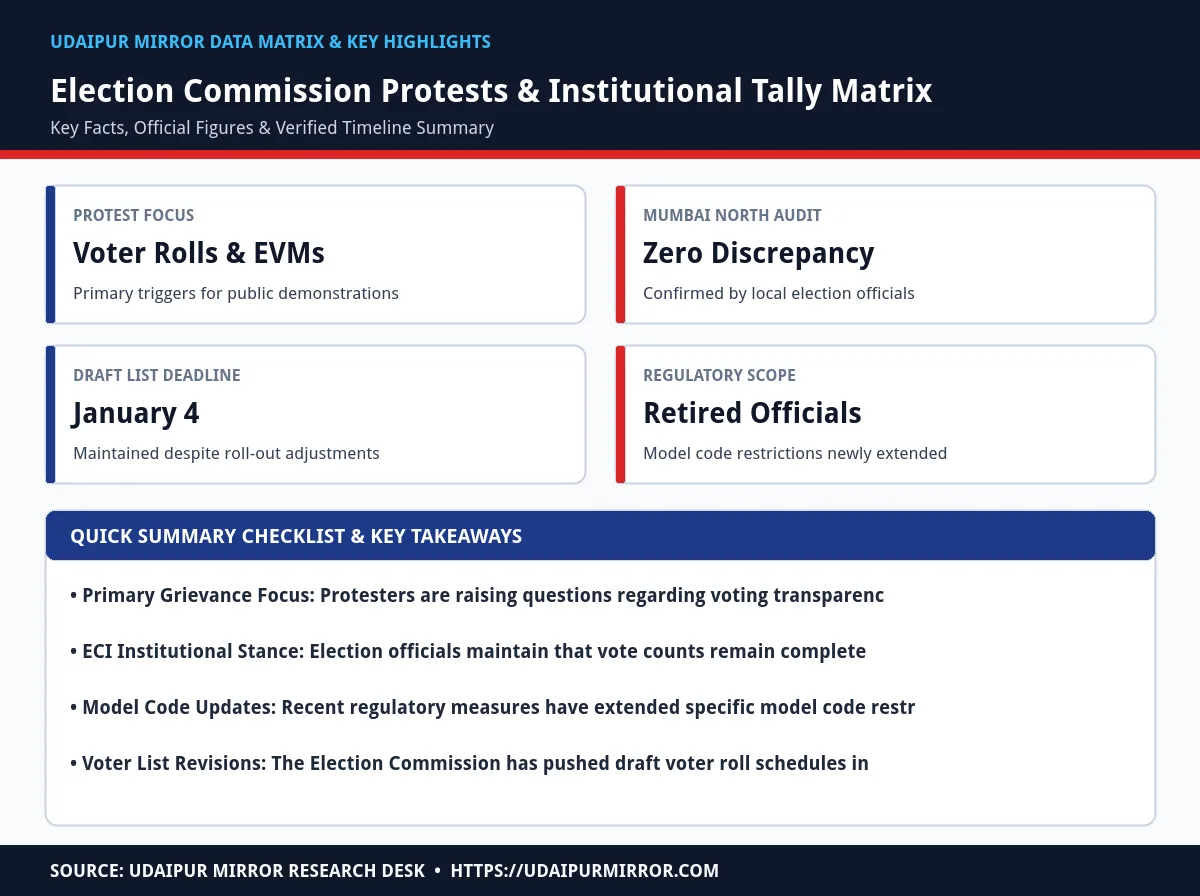
The following structured timeline highlights the key administrative decisions, verification reports, and public demonstrations involving the Election Commission of India over recent days.
| Date | Event / Development | Location | Official Response / Status |
|---|---|---|---|
| Nov 12, 2026 | National debate peaks over voter integrity | New Delhi | ECI defends institutional autonomy and transparency protocols. |
| Nov 11, 2026 | Mumbai North vote count discrepancy probe | Mumbai, Maharashtra | Officials confirm zero discrepancy between polled and counted votes. |
| Nov 11, 2026 | Extension of model code restrictions | Nationwide | Restrictions formally expanded to cover retired administrative officials. |
| Nov 10, 2026 | UP draft voter list schedule revised | Uttar Pradesh | Publication pushed to Nov 17 while retaining Jan 4 final deadline. |
| Nov 09, 2026 | Protest rallies outside regional offices | Various State Capitals | Civil groups demand enhanced digital access to polling booth logs. |
Recent controversies have not been limited to street protests; they have also centered on specific regional election outcomes. In urban constituencies such as Mumbai North, local election officials recently faced intense scrutiny regarding vote count discrepancies. Following comprehensive internal audits and independent cross-checks, election authorities officially confirmed that there were zero discrepancies between the total votes polled and those ultimately counted, reassuring the public of the robustness of the counting process.
Such verification reports are vital for dampening rumors and speculative reporting. Meanwhile, civic communities continue to monitor local governance closely, reminiscent of how local vigilance—such as swift action taken during recent urban incidents like the successful udaipur chain snatching arrest—demonstrates the effectiveness of accountable institutions when properly pressurized by public awareness.
“Every single vote recorded in our electronic systems undergoes multi-tier verification before final tabulation is certified.” — Senior Electoral Officer
In tandem with managing public protests, the Election Commission has actively tightened its regulatory framework. A notable policy shift includes extending Model Code of Conduct restrictions to cover retired government officials. This regulatory update aims to prevent any perception of institutional bias or political patronage by former bureaucrats during sensitive pre-election periods. Legal experts have largely welcomed this move as a step toward reinforcing neutrality.
At the same time, electoral machinery across major states like Uttar Pradesh is undergoing phased adjustments. The ECI recently pushed the draft voter list publication date to November 17 while steadfastly retaining the January 4 deadline for final electoral roll publication. This balancing act illustrates the Commission’s attempt to accommodate administrative realities without compromising statutory timelines. (Also read: Rajasthan Night Chill Surges: Minimum Temperatures Drop by 5 Degrees in Sikar, Pali, Udaipur).
“Extending code restrictions to retired personnel ensures that public offices maintain uncompromised neutrality throughout election cycles.” — Election Law Specialist
The ongoing friction between protesters and the Election Commission highlights a delicate balance in modern Indian democracy: the need for absolute institutional autonomy versus the public’s right to question and verify administrative actions. While civic demonstrations apply necessary pressure for administrative reform, legal scholars warn that aggressive targeting of constitutional bodies can erode foundational public trust.
As cultural and community celebrations—such as the vibrant gatherings seen during traditional festivities like the recent udaipur kalla ji dham annual annakoot mahotsav—remind citizens of India’s rich heritage of community harmony, the contemporary political sphere must similarly find constructive avenues for dialogue and conflict resolution.
“Democracy thrives when constructive civic engagement meets an approachable, transparent, and resolute administrative apparatus.” — National Governance Observer
Protesters are raising concerns regarding voting transparency, electronic voting machine auditing, draft voter roll publication schedules, and overall institutional accountability.
Election officials confirmed that there was zero discrepancy between the total votes polled and the votes counted, following rigorous internal audits and physical slip verifications.
The ECI extended specific Model Code of Conduct restrictions to cover retired government and administrative officials to prevent perceived political patronage.
The Election Commission pushed the draft voter list publication date in Uttar Pradesh to November 17 while retaining the final publication deadline of January 4.
Add Udaipur Mirror as a preferred source on Google to see more of our travel guides in your AI overviews.