Office Address
14, Residency Road, Udaipur, Rajasthan 313001
Office Address
14, Residency Road, Udaipur, Rajasthan 313001


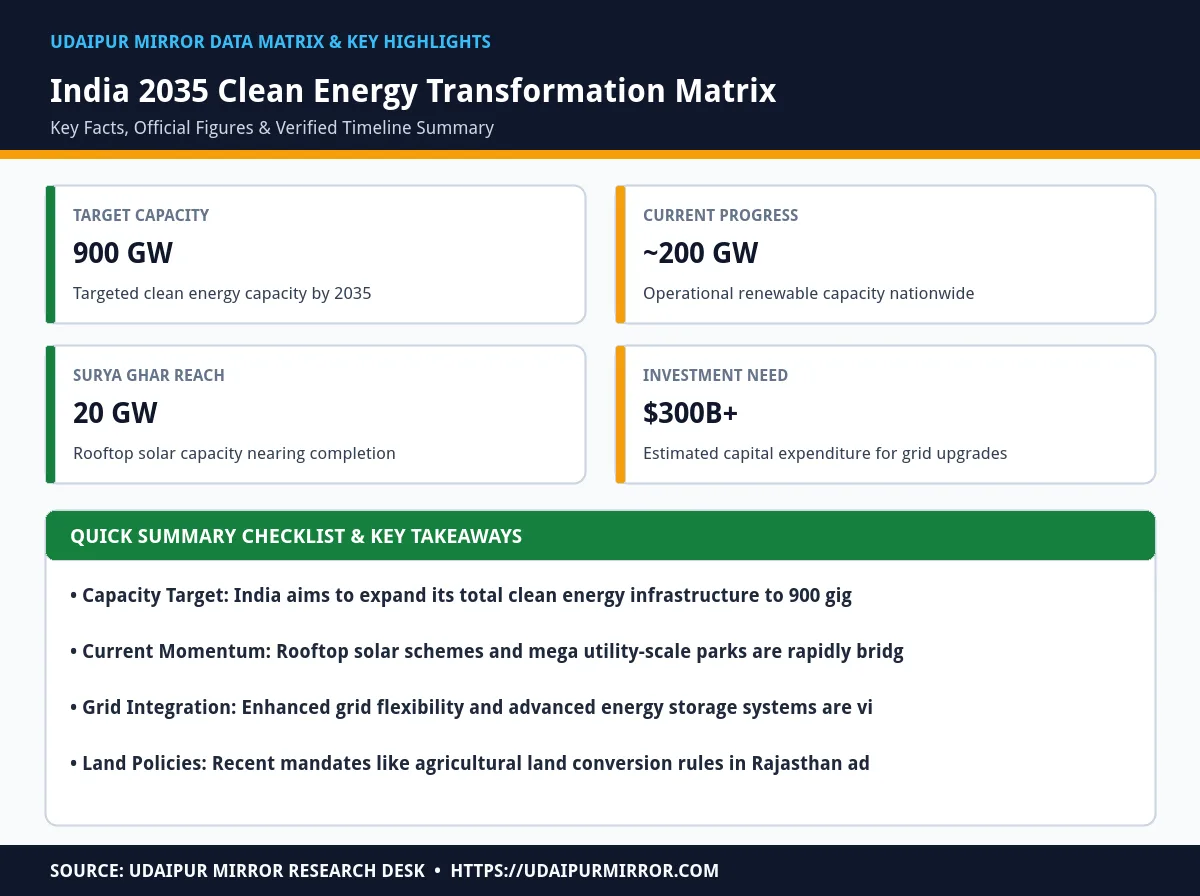
NEW DELHI: NEW DELHI — Setting a bold benchmark for the global energy transition, India has announced an accelerated framework that seeks to triple its clean energy capacity to 900 gigawatts by the year 2035. As energy ministers, DISCOM operators, and renewable developers convene this week, the strategic blueprint highlights the nation’s unstoppable momentum in green technology, anchored by massive solar parks in western Rajasthan and expanding rooftop photovoltaic deployments. However, energy analysts warn that achieving this monumental scale requires overcoming persistent systemic hurdles, ranging from transmission bottlenecks and grid flexibility deficits to stringent agricultural land conversion norms. While recent policy rollouts like the PM Surya Ghar Muft Bijli Yojana continue to drive grassroots adoption, institutional lenders and corporate infrastructure giants must navigate complex regulatory landscapes to ensure seamless capital deployment.
⚡ Quick Highlights: India Targets 900 GW Clean Energy Capacity by 2035
The strategic vision to reach 900 gigawatts by 2035 represents one of the most aggressive decarbonization commitments in the developing world. As coal-reliant states transition toward wind, solar, and hybrid energy parks, policy planners are emphasizing decentralized generation to reduce transmission losses. In parallel, educational stakeholders and administrative bodies are reviewing foundational policies, much like how academic assessment structures undergo periodic refinements to ensure transparency and preparedness for future challenges.
Western Rajasthan, spearheaded by the expansive Bhadla solar park and Thar desert installations, serves as the geographic anchor for utility-scale solar generation. However, scaling up requires synchronous investments in transmission corridors, high-capacity battery storage systems, and advanced forecasting technologies to stabilize regional grids against erratic weather patterns. (Also read: NMMS Uttar Pradesh 2026-27: Provisional Answer Key Out, Cut Off and Result Updates).
“Tripling our clean energy capacity to 900 gigawatts is not merely an environmental aspiration; it is an economic imperative that secures India's energy sovereignty for the next century.” — Senior Ministry of New and Renewable Energy Official
To support households in achieving energy independence under national green mandates, the government provides structured subsidies across various system capacities. Below is the comprehensive financial breakdown for 1kW to 5kW residential rooftop installations, detailing benchmark costs, central financial assistance, and estimated monthly electricity savings.
| System Capacity | Average Benchmark Cost | Government Subsidy | Estimated Monthly Savings |
|---|---|---|---|
| 1 kW | ₹50,000 – ₹60,000 | ₹30,000 | ₹800 – ₹1,200 |
| 2 kW | ₹95,000 – ₹1,10,000 | ₹60,000 | ₹1,800 – ₹2,500 |
| 3 kW | ₹1,40,000 – ₹1,60,000 | ₹78,000 | ₹3,000 – ₹4,000 |
| 5 kW | ₹2,30,000 – ₹2,60,000 | ₹78,000 (Max Cap) | ₹5,000 – ₹6,500 |
Despite robust policy backing, major hurdles continue to threaten project timelines. Grid flexibility remains a critical bottleneck, as legacy distribution networks struggle to absorb sudden surges in photovoltaic generation during peak sunlight hours. Furthermore, regulatory bottlenecks such as Rajasthan’s recent mandate requiring agricultural land conversion for renewable energy projects have added compliance layers for developers.
Industry leaders note that streamlining bureaucratic clearances is just as important as securing hardware financing. Drawing parallels to how technology incubation hubs optimize operational efficiency through targeted project management, the renewable sector requires dedicated administrative units to fast-track land approvals and environmental clearances.
“Land availability and grid congestion are the two primary friction points that could slow down our march toward 900 gigawatts if left unaddressed.” — Renewable Energy Infrastructure Analyst
At the consumer level, the PM Surya Ghar Muft Bijli Yojana has emerged as a transformative catalyst, rapidly approaching its target capacity with substantial financial outlays. Homeowners across northern and western states are leveraging online DISCOM portals—such as those managed by JVVNL, AVVNL, and JdVVNL in Rajasthan—to apply for rooftop subsidies and net metering approvals seamlessly.
This bottom-up green revolution empowers urban and semi-urban households to offset escalating electricity tariffs while contributing directly to national carbon reduction goals. With transparent subsidy disbursements directly linked to Aadhaar-verified bank accounts, consumer confidence in solar investments has reached unprecedented highs. (Also read: KPMG Launches Bengaluru Sports Tech Hub to Power India's Billion Sports Industry by 2030).
“The synergy between central subsidies and streamlined state-level DISCOM approvals is making rooftop solar a household standard across India.” — State Power Distribution Executive
India aims to triple its clean energy capacity to reach 900 gigawatts by 2035, driven by solar, wind, and hybrid renewable energy projects.
Primary hurdles include transmission grid congestion, the need for advanced battery storage, and complex regulatory requirements such as agricultural land conversion for renewable projects.
The scheme offers substantial central financial assistance (subsidies) up to ₹78,000 for residential rooftop solar installations, combined with simplified online DISCOM application and net metering processes.
State DISCOMs like JVVNL, AVVNL, and JdVVNL process online rooftop applications, conduct technical feasibility assessments, and install net meters to facilitate clean energy integration.
Add Udaipur Mirror as a preferred source on Google to see more of our travel guides in your AI overviews.