Office Address
14, Residency Road, Udaipur, Rajasthan 313001
Office Address
14, Residency Road, Udaipur, Rajasthan 313001


JALGAON: Jalgaon, Maharashtra, has emerged as a powerhouse in the green energy transition, recording the rooftop solar system installation jalgaon in 96,655 homes across three districts as of Monday, November 16, 2026. This surge in residential solar adoption reflects the aggressive push under the PM Surya Ghar Muft Bijli Yojana, significantly reducing carbon footprints while providing substantial electricity bill relief to residential consumers. As the nation eyes a triple clean energy capacity by 2035, Jalgaon’s decentralized model serves as a blueprint for other regions, including Rajasthan, to accelerate their rooftop solar targets through streamlined DISCOM approvals and robust subsidy disbursements.
⚡ Quick Highlights: Jalgaon Rooftop Solar: 96,655 Homes Go Green in 2026
The achievement of 96,655 installations in Jalgaon marks a significant pivot toward decentralized energy. By leveraging the rooftop solar system installation jalgaon framework, the administration has successfully bridged the gap between policy and implementation. The three districts involved have shown a remarkable adoption rate, particularly in the 3kW segment, which offers the maximum subsidy efficiency for middle-class households.
This surge is supported by a streamlined vendor ecosystem and rapid technical feasibility reports from local DISCOMs. As investors look toward the green sector, evidenced by the Sembcorp Green Infra IPO receiving SEBI nod for INR 3,750 crore, the focus on residential rooftop solar remains the most direct way to achieve energy independence at the grassroots level. (Also read: Rajasthan Warns Hospitals Against Bypassing Aadhar-Based Verification Under Ayushman Scheme).
“Jalgaon's success is a testament to the synergy between central subsidies and local execution, proving that residential solar is no longer a luxury but a household necessity.” — Senior Energy Analyst, Maharashtra State Electricity Board
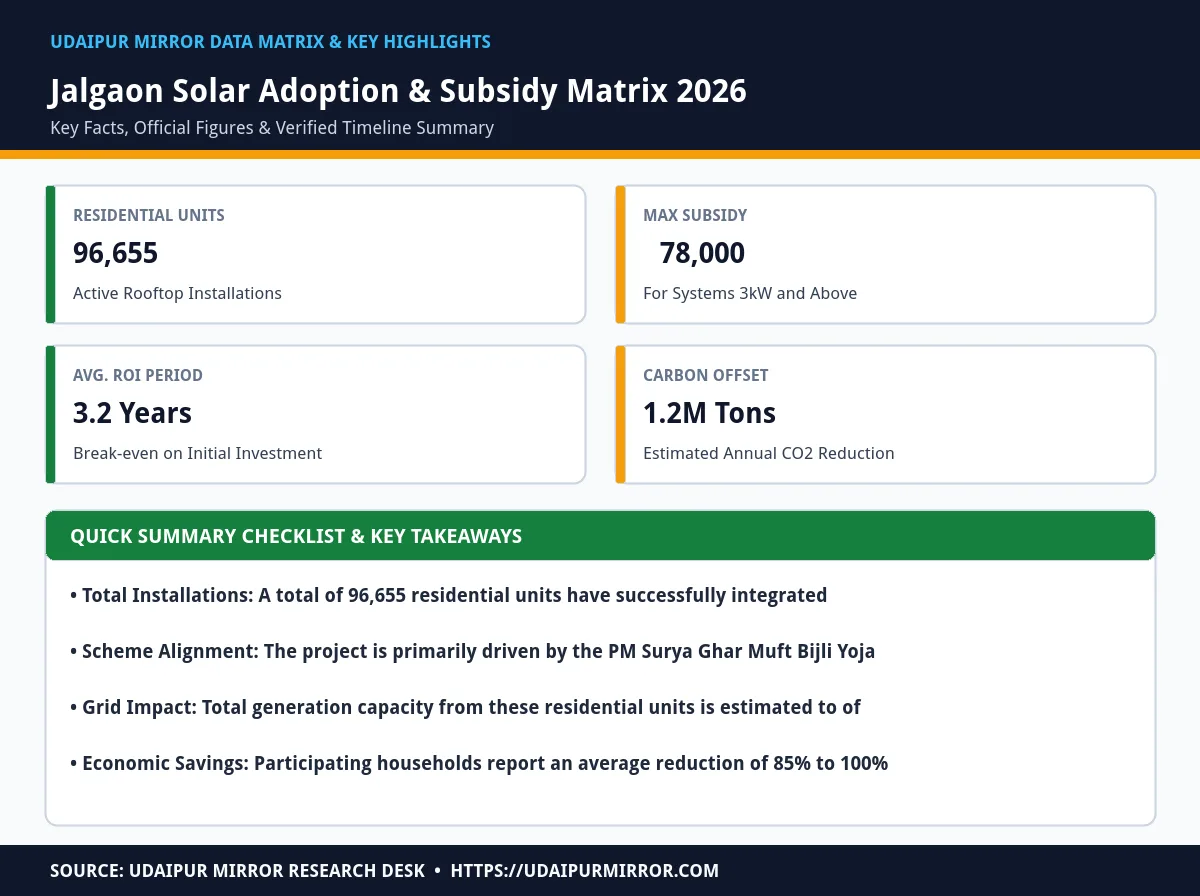
The following table outlines the financial breakdown for various rooftop solar capacities under the current 2026 guidelines. These figures include the standard MNRE subsidy slabs and estimated monthly savings for a typical household.
| System Capacity | Approx. Total Cost | Govt. Subsidy (CFA) | Monthly Savings (Est.) | Net Consumer Cost |
|---|---|---|---|---|
| 1 kW | ₹65,000 | ₹30,000 | ₹900 – ₹1,100 | ₹35,000 |
| 2 kW | ₹1,15,000 | ₹60,000 | ₹1,800 – ₹2,200 | ₹55,000 |
| 3 kW | ₹1,70,000 | ₹78,000 | ₹2,800 – ₹3,500 | ₹92,000 |
| 5 kW | ₹2,60,000 | ₹78,000 | ₹4,800 – ₹5,500 | ₹1,82,000 |
| 7 kW | ₹3,50,000 | ₹78,000 | ₹6,500 – ₹7,500 | ₹2,72,000 |
| 10 kW | ₹4,80,000 | ₹78,000 | ₹9,500 – ₹11,000 | ₹4,02,000 |
While Jalgaon celebrates this milestone, Rajasthan remains a critical player in the solar revolution. The state, home to the Bhadla Solar Park, is now focusing on replicating Jalgaon’s success in urban centers like Udaipur and Jaipur. For residents under JVVNL, AVVNL, and JdVVNL, the process of rooftop solar system installation jalgaon serves as a case study in efficient net metering. Also read: Rajasthan Jan Aadhaar 2.0 Guide 2026 for details on how digital identity is being used to verify subsidy eligibility.
The Rajasthan Renewable Energy Corporation Limited (RRECL) has recently updated its net metering guidelines to ensure that excess power generated by residential rooftops is credited at competitive rates, mirroring the Maharashtra model. This is essential for maintaining a high ROI for consumers who invest in 5kW and 10kW systems.
Despite the success in Jalgaon, the rapid expansion of renewable power is outpacing the grid. India faces connection delays and unused generation as the infrastructure struggles to keep up with the influx of decentralized power. To mitigate this, the CERC has recently amended the Deviation Settlement Mechanism (DSM) to ensure grid stability. Also read: Rajasthan Warns Hospitals Against Bypassing Aadhar-Based Verification Under Ayushman Scheme, highlighting the government’s strict stance on identity verification which is also being applied to solar subsidy applicants to prevent fraud.
In Jalgaon, local transformers are being upgraded to handle the reverse flow of electricity during peak sunlight hours. This technical reinforcement is crucial for preventing local grid failures and ensuring that the 96,655 homes can consistently export power without interruption. (Also read: Rajasthan NEET PG Admission 2026: Round 2 Registration Started, Choice Filling and Seat Allotment Details).
“The grid must evolve from a one-way street to a multi-lane highway capable of handling millions of small-scale generators.” — Grid Management Expert, CERC
The financial viability of rooftop solar system installation jalgaon is the primary driver for its mass adoption. For a standard 3kW system, the initial investment of approximately ₹1.70 lakh is offset by a ₹78,000 subsidy, bringing the net cost down to ₹92,000. With monthly savings of nearly ₹3,500, the system pays for itself in less than three years.
Beyond electricity, the green tech revolution is expanding into solar water heating. The Solar Water Heater Manufacturing Plant Setup Cost in India has become a point of interest for local entrepreneurs in Jalgaon, looking to capitalize on the growing demand for comprehensive solar thermal and PV solutions.
As Jalgaon nears the 100,000 installation mark, the focus shifts to the mega-scale projects in Western Rajasthan. The Thar desert is becoming the epicenter of India’s solar ambition, with Bhadla and upcoming parks in Bikaner aiming to push the national capacity toward the 900 GW goal by 2035. However, the success of the rooftop solar system installation jalgaon proves that residential participation is equally vital.
The synergy between mega solar parks and millions of rooftop systems will create a resilient energy web. For the residents of Jalgaon and Udaipur alike, the message is clear: the roof above your head is now a productive asset capable of powering the future while protecting the planet.
Residents must register on the National Portal for Rooftop Solar (pmsuryaghar.gov.in), select their DISCOM, and choose an empanelled vendor. After installation and inspection by the DISCOM, the subsidy is released directly to the consumer’s bank account.
Under the PM Surya Ghar Muft Bijli Yojana, the subsidy is capped at ₹30,000 per kW for the first 2 kW and ₹18,000 for the third kW. The maximum total subsidy for any residential system 3kW or larger is ₹78,000.
Yes, net metering is mandatory for all solar installations under the current Maharashtra state policy. This allows consumers to export excess power to the grid during the day and offset their consumption during the night.
Based on current electricity tariffs and the ₹78,000 subsidy, most 3kW systems in Jalgaon achieve a Return on Investment (ROI) within 3 to 3.5 years, depending on sunlight exposure and household consumption patterns.
Add Udaipur Mirror as a preferred source on Google to see more of our travel guides in your AI overviews.




[…] Plant Setup Cost in India: 2026 Investment Guide and Subsidy Benefits 5 seconds ago ⚡ Economy Jalgaon Leads Solar Revolution: 96,655 Rooftop Systems Installed Across Three Districts 14 … Articles Udaipur Kachori Trail 2026: Shastri Circle, Delhi Gate & Bapu Bazaar Iconic Street […]