Office Address
14, Residency Road, Udaipur, Rajasthan 313001
Office Address
14, Residency Road, Udaipur, Rajasthan 313001

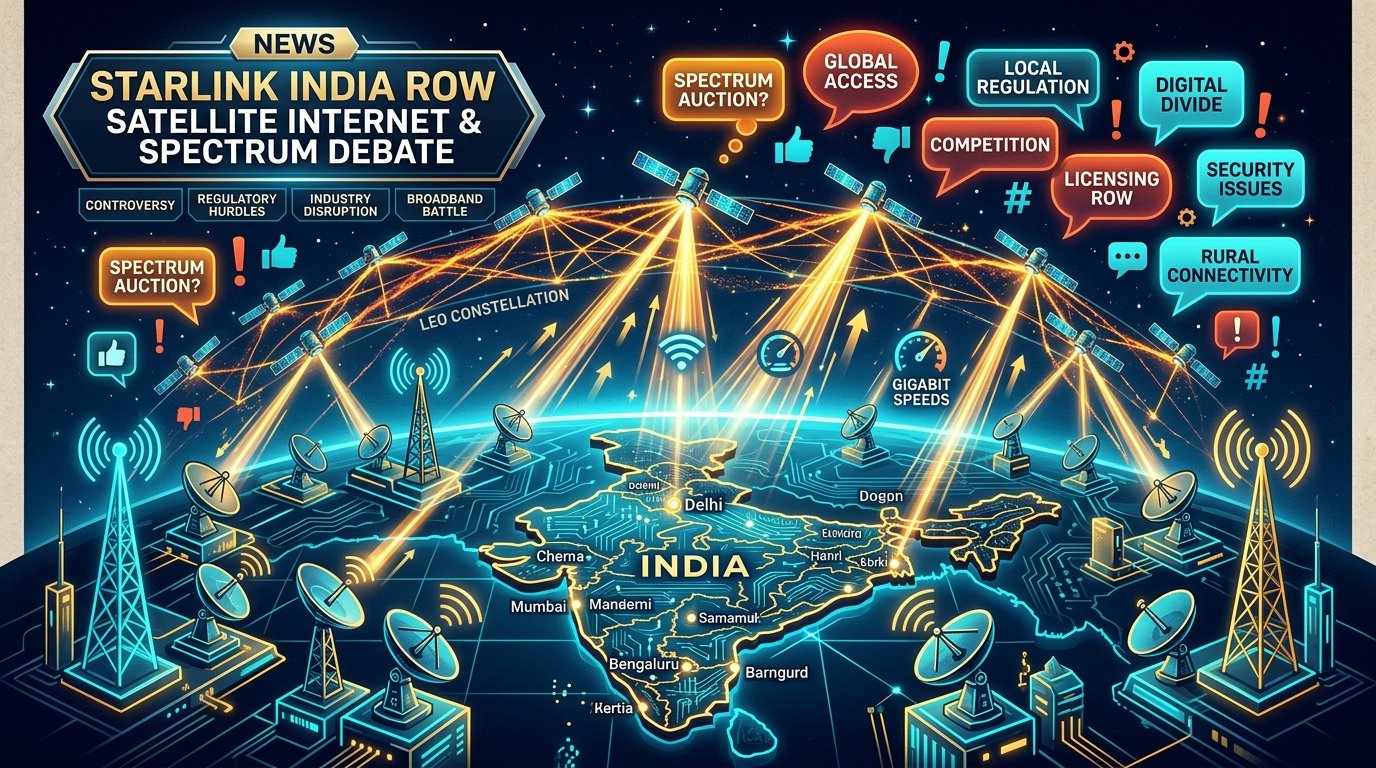
New Delhi: The high-stakes battle for India’s emerging satellite broadband frontier has escalated into an explosive corporate and geopolitical standoff following sharp, provocative statements by tech billionaire Elon Musk. In a series of viral posts on social media platform X (formerly Twitter), the SpaceX and Starlink founder alleged that “certain oligarchs” are actively blocking Starlink’s commercial entry into India to preserve a “monopolistic chokehold” over the nation’s 1.4 billion citizens. The incendiary remarks prompted an immediate and categorical rebuttal from the Ministry of Communications, which dismissed Musk’s claims as “baseless, misconceived, and unfounded,” reaffirming that India’s regulatory framework remains entirely sovereign, transparent, and non-discriminatory.
The controversy erupted when Elon Musk responded to an online discussion highlighting the stark digital divide in India’s remote, mountainous, and rural hinterlands—areas where conventional terrestrial cellular towers and fiber-optic cables struggle with geographical bottlenecks.
Musk launched an uncharacteristically direct offensive, posting:
“Starlink is being blocked by certain oligarchs who wish to retain their monopolistic chokehold over the people of India. This is a crime against the people of India who deserve access to high-speed internet.”
— Elon Musk on X
Musk escalated the rhetoric further by directly naming Indian industrial titan Mukesh Ambani, asking his followers whether Ambani was the “real boss of India.” He highlighted that Starlink is currently licensed and providing seamless low-Earth orbit (LEO) internet connectivity in over 165 nations worldwide, noting that the company has already built 20 gateway earth stations within India and formulated India-specific security protocols. The exchange drew national political attention when Leader of the Opposition Rahul Gandhi chimed in on corporate monopolies, to which Musk replied characterizing the situation as “indeed troubling.”
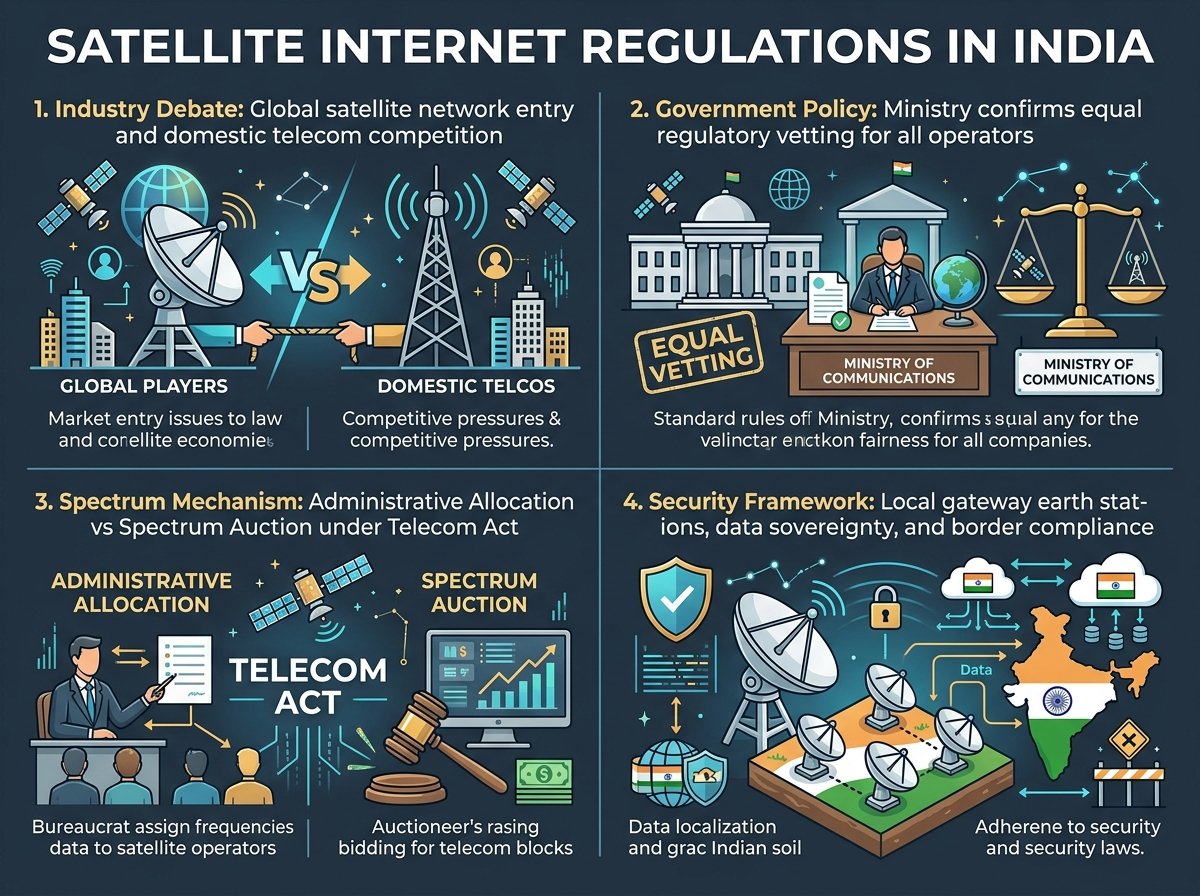
Refusing to let the billionaire’s assertions go unchallenged, India’s Ministry of Communications and Union Minister Jyotiraditya Scindia issued a point-by-point clarification dismantling the monopoly narrative.
In an official rejoinder, the government emphasized three foundational realities:
To understand the friction between Starlink and domestic telecom giants, one must examine the fierce multi-year policy war over how satellite radio spectrum should be distributed:
Reliance Jio and Bharti Airtel strongly lobbied for satellite spectrum to be auctioned competitively, arguing that because terrestrial telecom providers have poured billions of dollars into buying 4G and 5G spectrum frequencies, handing satellite spectrum administratively creates an unfair competitive advantage. They argued that if a satellite company can deliver retail broadband directly to homes and enterprises, it must compete under the exact same auction parameters to ensure a level playing field.
Conversely, Starlink, Amazon Kuiper, and global satellite coalitions argued that satellite spectrum is classified by the International Telecommunication Union (ITU) as shared, non-exclusive orbital spectrum. Unlike terrestrial spectrum—where a frequency block is dedicated exclusively to one cellular provider in a specific circle—satellite frequencies are shared dynamically across multiple constellations. Starlink maintained that auctioning satellite frequencies would be an unprecedented global aberration that would inflate connectivity costs for rural communities.
The Union Government ultimately resolved this fundamental debate in favor of global standards by including satellite communication in the First Schedule of the Telecommunications Act 2023, legally confirming that satellite spectrum will be distributed through administrative allocation. The Telecom Regulatory Authority of India (TRAI) is currently holding open consultations to determine the pricing formulas and spectrum usage charges (SUC).
While Starlink received an in-principle Global Mobile Personal Communication by Satellite (GMPCS) license, security agencies have laid down strict national security prerequisites before commercial authorization is issued:
| Entity | Parent / Promoters | Constellation Type | Current Regulatory Status |
|---|---|---|---|
| Starlink | SpaceX (Elon Musk) | Low-Earth Orbit (LEO) | GMPCS licensed; undergoing MHA security clearance & spectrum pricing |
| JioSpaceFiber | Reliance Jio & SES | Medium-Earth Orbit (MEO) / LEO | GMPCS licensed; awaiting final security validation & spectrum rollout |
| Eutelsat OneWeb | Bharti Enterprises & Eutelsat | Low-Earth Orbit (LEO) | GMPCS & IN-SPACe authorized; awaiting final administrative spectrum allocation |
Elon Musk claimed on social media platform X that “certain oligarchs” are blocking Starlink’s launch in India to protect a “monopolistic chokehold” on the telecom market, questioning whether Mukesh Ambani was the “real boss of India.”
The Ministry of Communications rejected Musk’s statements as “baseless and misconceived,” clarifying that all three satellite operators—Starlink, Reliance Jio, and Eutelsat OneWeb—are at the exact same regulatory stage undergoing standard national security clearance.
Under the Telecommunications Act 2023, satellite broadband spectrum will be allocated administratively rather than through competitive auction, aligning with global ITU standards. The Telecom Regulatory Authority of India (TRAI) is formulating pricing parameters.
Domestic telcos argued that since they invested tens of thousands of crores in terrestrial spectrum auctions, providing satellite spectrum administratively creates an unlevel playing field for retail broadband services.
Starlink must comply with complete domestic data localization (terminating all traffic at Indian gateway earth stations), lawful interception monitoring capabilities, border geo-fencing, and full declaration of beneficial ownership.
Add Udaipur Mirror as a preferred source on Google to see more of our travel guides in your AI overviews.