Office Address
14, Residency Road, Udaipur, Rajasthan 313001
Office Address
14, Residency Road, Udaipur, Rajasthan 313001

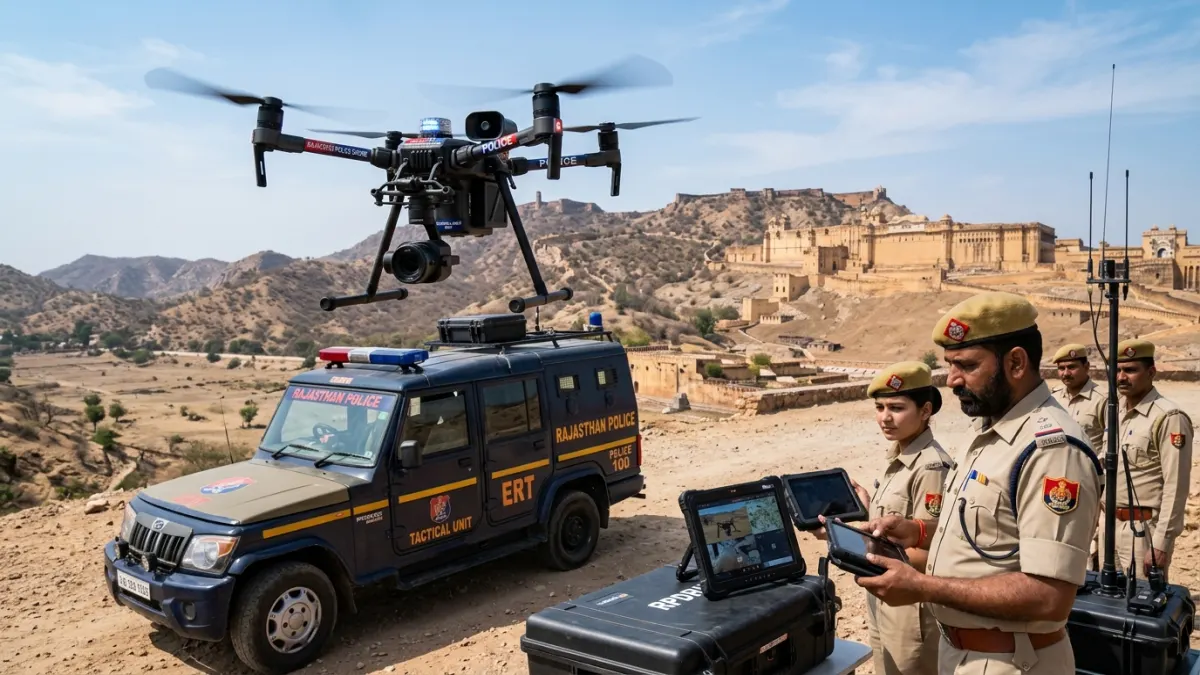
JAIPUR: In a landmark technological leap aimed at transforming law enforcement and border surveillance across the desert state, Rajasthan Police is preparing to roll out a specialized fleet of weaponized and tactical drones equipped with tear-gas dropping mechanisms, high-decibel warning sirens, and 24×7 thermal night-tracking optics. In a first-of-its-kind joint military-police initiative, 17 state police personnel—ranging from constables to Deputy Superintendents of Police (DySP)—have completed an intensive three-week tactical integration program conducted by the Indian Army at the Sapta Shakti Drone Training School (SSDTS) in Sri Ganganagar, marking a paradigm shift toward aerial law enforcement.
The state-wide aerial policing overhaul aligns with heightened technology integration across Rajasthan’s urban and rural ranges. For instance, in southern Rajasthan, local forces have simultaneously launched the Udaipur Police Shakti Suraksha Abhiyan to enforce strict ground-level vigilance during festive congregations. The new drone capabilities will provide an overarching aerial umbrella to these ground operations.
According to Additional Director General of Police (Law and Order) V.K. Singh, the primary goal of the collaboration is to institutionalize drone warfare and surveillance doctrine directly into daily policing. Rather than treating drones as ad-hoc video recording gadgets for single events, Rajasthan Police is establishing structured, mission-driven aerial response units.
Course Coordinator RPS Praveen Kumar shared that the curriculum extended far beyond basic joystick maneuvering. Officers underwent rigorous training modules including:
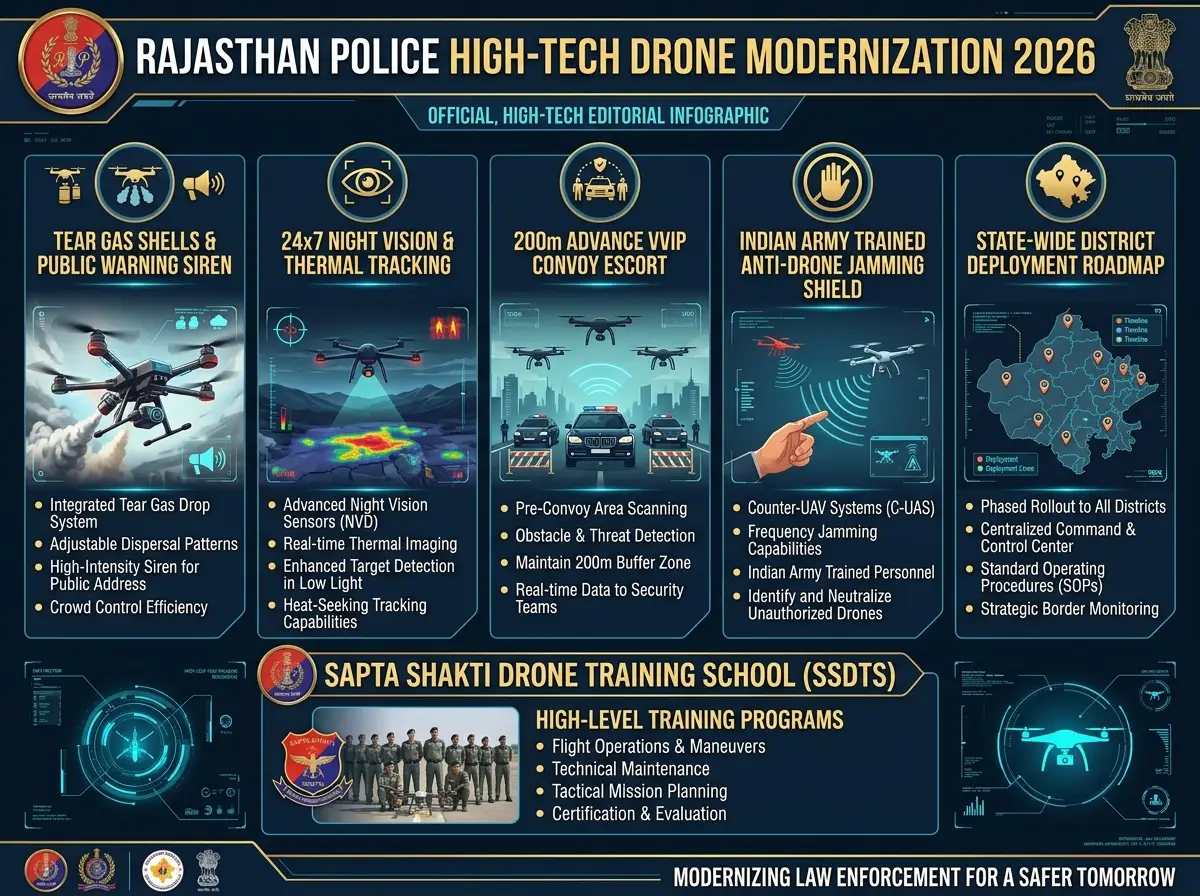
One of the most consequential advancements in the new drone fleet is non-lethal crowd dispersion. During communal clashes, unlawful road blockades, or stone-pelting incidents, police ground teams frequently face severe physical hazards when advancing on foot.
Specially engineered heavy-lift hexacopters and quadcopters will carry automated dispenser canisters capable of releasing precision tear smoke shells directly over targeted riot epicenters from a safe altitude. Concurrently, high-decibel onboard megaphones and directional sirens can broadcast legal dispersal warnings under Section 163 of the Bharatiya Nagarik Suraksha Sanhita (BNSS), minimizing physical contact and preventing collateral injury.
Criminal gangs, illicit liquor syndicates, and cross-border smugglers frequently exploit darkness and rugged terrain—such as the Chambal ravines, Aravalli hill tracts, and Thar desert dunes—to evade capture. The new police UAVs feature dual-sensor gimbal payloads combining high-definition 4K visual zoom with radiometric Forward Looking Infrared (FLIR) thermal sensors.
Crucially, the force is also acquiring Anti-Drone Counter-UAS Systems. Given Rajasthan’s 1,048-kilometer international border with Pakistan, hostile drones have repeatedly been intercepted dropping narcotics, arms, and counterfeit currency. The Army-trained police teams have been instructed in:
| Defense Stage | Technical Action | Operational Objective |
|---|---|---|
| 1. Detection & Tracking | Radio Frequency (RF) scanners & acoustic radar sensors. | Identify incoming unauthorized UAVs up to 3 to 5 km away. |
| 2. Frequency Jamming | Directional electronic countermeasure guns. | Sever communication links between rogue drone and operator. |
| 3. Forced Neutralization | Protocol spoofing & fail-safe override. | Force rogue drone to hover, land safely, or return to launch point for forensics. |
In high-profile dignitary and VVIP movements, security protocols are being rewritten to mandate a continuous 200-meter advance aerial escort. Tactical drones will cruise 200 meters ahead of motorcades, transmitting live telemetry and video feeds directly into the trailing command control vehicle.
This advance aerial screen was recently field-tested with high precision during the Rajasthan tour of Bageshwar Dham head Dhirendra Shastri, where drones cleared overhead flyovers, railway overbridges, and congested arterial crossroads before the official motorcade passed. In the event of interstate travel disruptions or transit diversions, such as recent railway blockades, authorities can rapidly adapt logistics. Dancers and travelers navigating regional corridors can also review our guide on Udaipur to Delhi Travel Alternatives & Highway Corridors.
Director General of Police (Rajasthan) Rajiv Kumar Sharma emphasized that modern technology is the ultimate force multiplier for law enforcement:
“The efficiency and responsiveness of Rajasthan Police are being systematically upgraded through state-of-the-art technological adoption. Drones are no longer secondary tools; they have emerged as the primary eyes and ears of tactical commanders during ground operations, major public festivals, and border surveillance.”
— Rajiv Kumar Sharma, Director General of Police, Rajasthan
Following final state government clearance of the comprehensive Drone Modernization Roadmap, specialized Drone Command Cells will be established at every district headquarters. Phase 1 prioritizes international border districts (Sri Ganganagar, Bikaner, Jaisalmer, Barmer) and major metropolitan clusters (Jaipur, Jodhpur, Udaipur, Kota), before cascading to all 50 police districts across Rajasthan.
The 17 police personnel underwent an intensive 3-week tactical course conducted jointly with the Indian Army at the Sapta Shakti Drone Training School (SSDTS) located in Lalgarh Jatan, Sri Ganganagar.
Tactical drones will be equipped with specialized payload releases to discharge tear smoke shells over violent mobs and feature high-decibel acoustic sirens to issue public dispersal warnings without putting foot personnel in harm’s way.
Under the new security protocol, tactical drones will fly approximately 200 meters ahead of VVIP motorcades to inspect flyovers, rooftops, and traffic intersections, transmitting live video feeds directly to the trailing police escort team.
An Anti-Drone system detects, tracks, and jams radio frequencies of unauthorized or rogue enemy UAVs, forcing them to lose control and land safely, which is particularly vital for preventing cross-border smuggling along Rajasthan’s border.
Add Udaipur Mirror as a preferred source on Google to see more of our travel guides in your AI overviews.