Office Address
14, Residency Road, Udaipur, Rajasthan 313001
Office Address
14, Residency Road, Udaipur, Rajasthan 313001

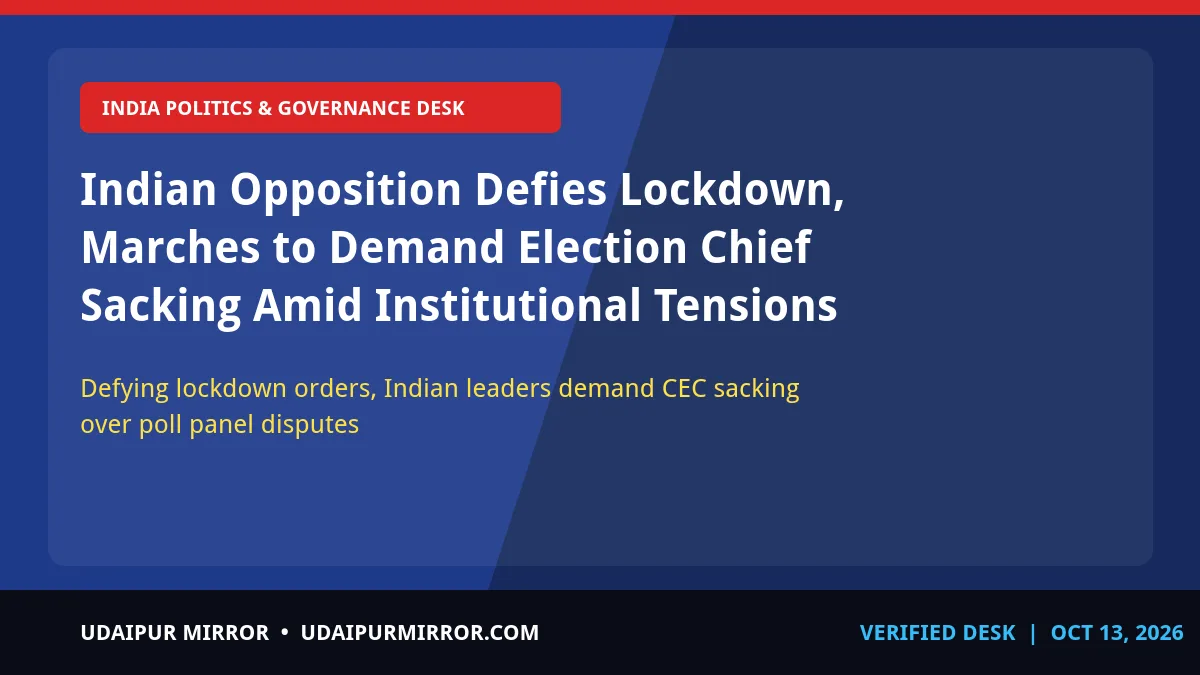
NEW DELHI: NEW DELHI — In a dramatic escalation of political and institutional tensions across the nation, indian opposition defies lockdown restrictions as thousands of political leaders, parliamentarians, and party workers take to the streets of the national capital. The high-stakes protest march comes directly on the heels of mounting controversies surrounding the Election Commission of India (ECI), internal dissent within the poll body, and recent high-profile electoral adjustments. As demonstrators clashed with security cordons, the unified opposition front formally submitted a memorandum demanding the resignation and sacking of the top election official, citing alleged systematic bias and administrative overreach during recent state election preparations and voter roll revisions.
⚡ Quick Highlights: Indian Opposition Defies Lockdown to Demand Election Chief Sacking
The decision by coalition opposition leaders to march through the barricaded streets of New Delhi marks a watershed moment in contemporary Indian parliamentary politics. By choosing to move forward despite official lockdown notifications and heavy police deployments, the political alliance signaled an aggressive posture against what it terms executive encroachment into independent constitutional bodies. Protesters waved party flags and shouted slogans demanding structural transparency within the Election Commission of India.
As economic discussions continue to ripple through the financial markets—such as traders tracking the silver rate today in Udaipur alongside broader corporate earnings—the political capital of the nation remains firmly transfixed on New Delhi’s street demonstrations. Political analysts note that direct confrontation with the election watchdog is a rare and severe tactic, usually reserved for irreconcilable breakdowns in institutional trust.
“Our constitutional democracy relies entirely on the perceived and absolute neutrality of independent umpires. When that trust is fractured, peaceful street protest becomes an unavoidable civic duty.” — Senior Opposition Floor Leader
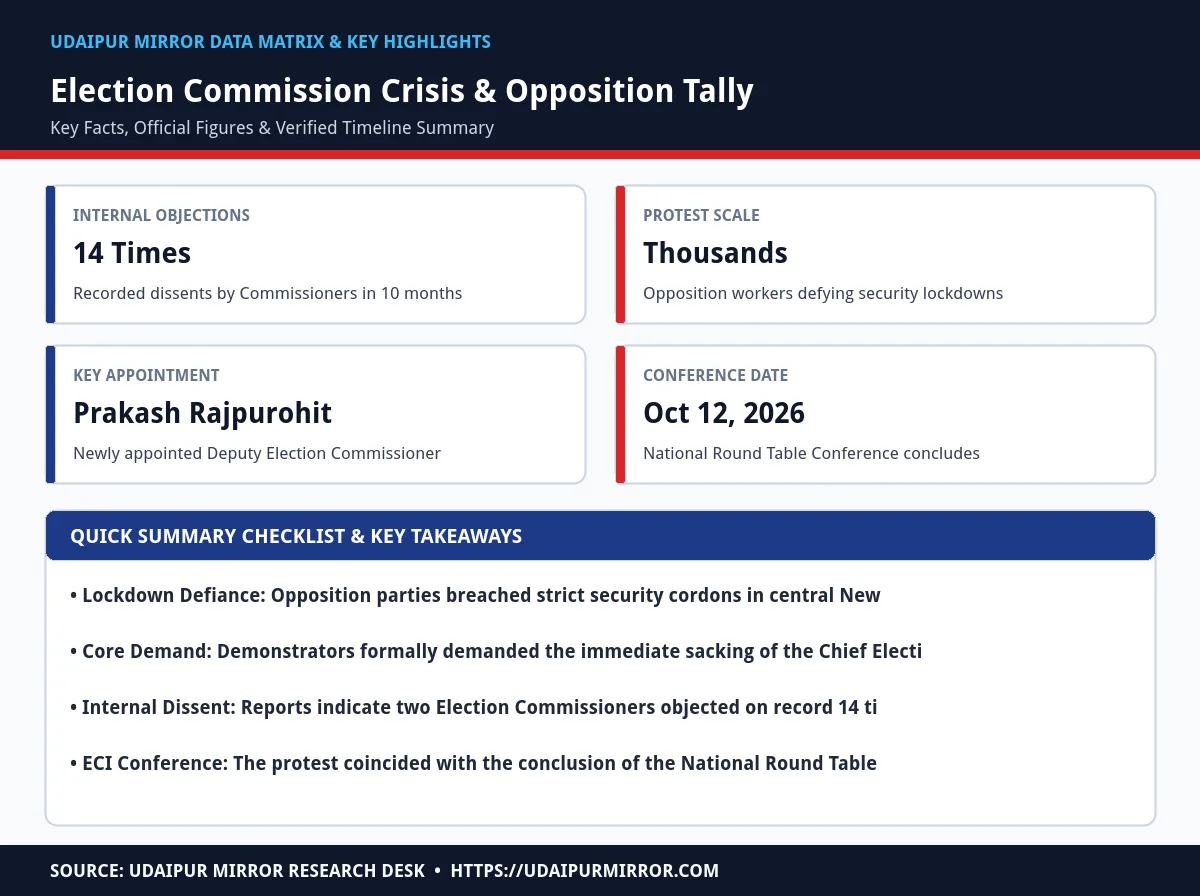
The unfolding institutional crisis at the Election Commission of India involves a series of high-level administrative decisions, recorded internal dissents, and escalating political confrontations culminating in the nationwide opposition protests.
| Date / Period | Event Description | Key Stakeholders | Impact / Significance |
|---|---|---|---|
| Early 2026 | Systemic Voter Roll Revisions | ECI & State Electoral Officers | Triggered widespread debates over digital voter purges and exclusion. |
| Past 10 Months | Recorded Dissent by Commissioners | Two Election Commissioners | Objected on record 14 times regarding controversial poll panel steps. |
| October 12, 2026 | Appointment of Deputy EC | Prakash Rajpurohit & ECI | Drew intense scrutiny from opposition parties regarding administrative neutrality. |
| October 12, 2026 | National Round Table Concludes | ECI & State Election Commissioners | Discussed electoral reforms and uniformity in poll management in New Delhi. |
| October 12, 2026 | Opposition Lockdown March | Unified Opposition Front | Demanded the immediate sacking of the Chief Election Commissioner. |
The immediate catalyst for the opposition’s aggressive stance stems from explosive reports revealing internal friction within the Election Commission itself. According to administrative disclosures, two Election Commissioners recorded formal objections on record no fewer than 14 times over the span of just ten months regarding various poll panel directives, scheduling decisions, and regulatory steps.
This unprecedented level of internal discord has provided the opposition with substantial ammunition. While infrastructural developments continue nationwide—ranging from major industrial milestones like those seen when PM Modi inaugurates projects worth Rs 1.06 lakh crore in Rajasthan to local administrative polls—the credibility of election administration remains the central talking point among civic groups.
“Disagreements in a multi-member commission are healthy, but 14 recorded dissents in ten months point toward a deep structural schism in how India's elections are being steered.” — Constitutional Law Expert
Even as demonstrations intensified on the streets, official business continued inside conference halls. The National Round Table Conference, bringing together the ECI and various State Election Commissioners, successfully concluded its deliberations in New Delhi. The conference focused on streamlining electoral rolls, managing upcoming multi-phase regional polling schedules, and harmonizing digital infrastructure across state boundaries.
Adding to the administrative focus was the recent appointment of Deputy Election Commissioner Prakash Rajpurohit. Legal analysts and political commentators have dissected the posting, examining its timing and implications for upcoming state assembly elections. The government maintains that all administrative appointments and conference agendas are routine measures designed to strengthen India’s sprawling democratic apparatus. (Also read: Silver Rate Today in Udaipur 13th October 2026: 1 KG Price and Market Trends).
“Administrative appointments and round table conferences must be matched with genuine outreach to political stakeholders to restore faith in the system.” — Former Election Commissioner Advisor
Beyond the immediate protests and administrative appointments, the controversy has touched off a broader academic and political debate concerning digital governance. Critics and tech policy watchdogs have pointed toward recent Systematic Electoral Roll (SIR) voter purges as examples of digital authoritarianism in action. Opponents argue that algorithmic and bulk deletions of voter names, executed without adequate physical verification or public notice, disenfranchise marginalized urban and rural communities.
Civil rights organizations have filed petitions demanding greater judicial oversight over automated electoral database management. As India moves further into a digitally integrated electoral ecosystem, the tension between administrative efficiency and citizen voting rights is expected to dominate both parliamentary debates and Supreme Court scrutiny in the coming months.
“Digital tools in democracy must empower the voter, not serve as silent mechanisms for unverified disenfranchisement.” — Digital Rights Advocate
Opposition parties defied lockdown restrictions to protest against the Election Commission of India and demand the immediate sacking of the Chief Election Commissioner.
Reports revealed that two Election Commissioners had recorded formal objections 14 times in 10 months regarding various poll panel steps and administrative decisions.
Prakash Rajpurohit was recently appointed as the Deputy Election Commissioner, an administrative placement that has drawn significant attention from political parties.
Civil society groups and tech policy watchdogs argued that recent Systematic Electoral Roll (SIR) purges show signs of digital authoritarianism and risk disenfranchising voters.
Add Udaipur Mirror as a preferred source on Google to see more of our travel guides in your AI overviews.