Office Address
14, Residency Road, Udaipur, Rajasthan 313001
Office Address
14, Residency Road, Udaipur, Rajasthan 313001

NATHDWARA / COIMBATORE: As millions of devotees across India and global spiritual centers observe the sacred autumn festival, the deep yogic philosophy behind sharad navratri 2026 sadhguru spiritual meaning provides seekers with an illuminating framework to channel cosmic feminine consciousness. Speaking on the metaphysical significance of the festival, spiritual leader Sadhguru emphasized that Navratri is fundamentally structured around the alchemy of human transformation—moving intentionally from inertia to dynamic action, and ultimately arriving at meditative stillness and liberation.
⚡ Quick Highlights: Sharad Navratri 2026: Sadhguru Explains Spiritual Meaning
According to Sadhguru, physical creation is governed by three fundamental qualities or gunas: Tamas, Rajas, and Sattva. Rather than viewing Tamas as inherently evil or dark, yogic lore recognizes it as the indispensable foundational element of gravity, mass, and rest. Without Tamas, physical forms cannot hold together. During the first three nights dedicated to Durga, spiritual practitioners are encouraged to anchor their physical existence, transform sheer inertia into unwavering resolve, and master survival mechanisms.
The transition into the middle triad shifts consciousness toward Rajas, embodied by Lakshmi. Rajas represents passion, fire, desire, and vigorous creation. If unmanaged, Rajas burns an individual through reckless ambition; when consecrated, it builds prosperous societies and focused internal discipline. Devotees tracking classical Muhurats alongside their spiritual sadhana can refer to the Navratri Day 4 2026 Muhurats: Puja Timings for India, US NRI Zones & Shreenathji Nathdwara Darshan Schedule to harmonize daily household worship with sacred planetary windows.
“Tamas is the nature of the earth; Rajas is the nature of passion; Sattva is the nature of dissolution. Navratri is the natural ladder to rise through all three and become victorious.” — Sadhguru
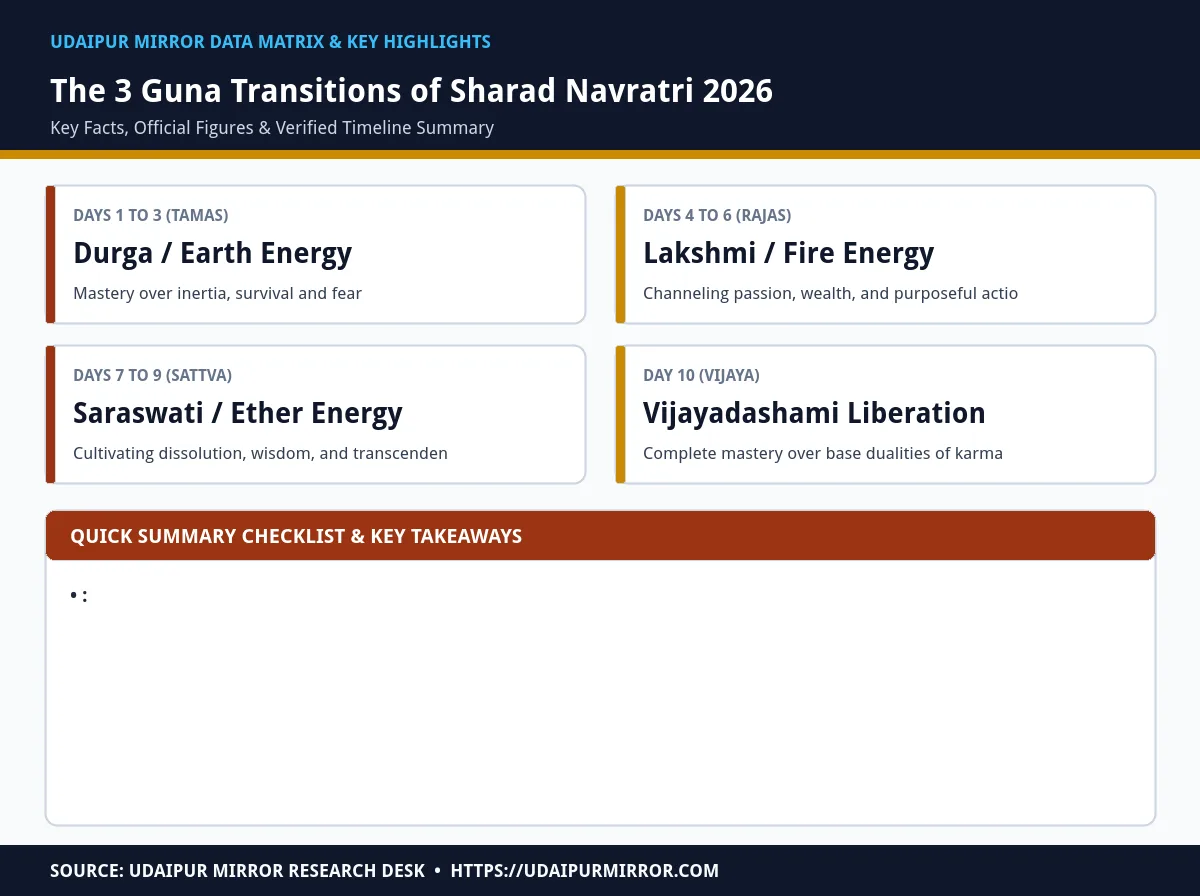
The nine days of Navratri represent a structured ascension of consciousness through the primary qualities of nature. Here is the detailed breakdown according to ancient yogic sciences and classical scriptural alignment:
| Navratri Phase | Associated Form | Governing Guna | Yogic & Energetic Focus |
|---|---|---|---|
| Nights 1 to 3 | Maa Durga / Kali | Tamas (Inertia) | Rooting prana, overcoming physical lethargy, confronting fundamental survival fears |
| Night 4 to 5 | Maa Lakshmi | Rajas (Action) | Creative expression, wealth of character, purposeful enterprise without desire |
| Night 6 | Maa Katyayani | Rajas to Sattva | Harnessing intense warrior resolve to dissolve stubborn mental ego blocks |
| Night 7 to 8 | Maa Kalaratri & Mahagauri | Sattva (Purity) | Deep introspection, burning of deep-seated karmas, awakening subtle intuition |
| Night 9 | Maa Siddhidatri | Shuddha Sattva | Full integration of knowledge, cosmic alignment, dissolution into pure awareness |
| Day 10 | Vijayadashami | Trigunatita | State of non-dual victory, transcendence of nature, celebration of liberation |
The concluding three nights belong to Goddess Saraswati, signifying Sattva—a state of luminous purity, boundless clarity, and effortless dissolution. Sadhguru highlights that unlike modern interpretations that treat knowledge as intellectual accumulation, Saraswati signifies the shedding of personal pride so that true cosmic knowing can flow unobstructed. The practitioner moves from being a doer to becoming an empty conduit for divine intelligence.
In traditional Rajasthan and Mewar spiritual traditions, this final triad converges with solemn vows, night-long bhajans, and temple pradakshina. Across rural and urban shrines—echoing practices documented in local reports such as how the Untala Sheetla Mata Mandir in Vallabhnagar Celebrates Shardiya Navratri 2026: 9-Day Nirahar Penance, Shobhayatra on October 18 & Maha Havan on October 19—the penance culminates in sacred homams that symbolize the burning away of the ego before the arrival of Vijayadashami.
“If you remain stuck in action, life remains an exhausting wheel. Saraswati teaches the art of dissolving the actor so that pure wisdom illuminates life.” — Isha Foundation Discourse
While Shaiva and Shakta traditions emphasize the fierce and ascetic dimensions of the Devi, Pushtimarg tradition in nearby Nathdwara reflects this exact feminine essence through Bhavatmak Bhakti and the compassionate embrace of divine mother Yashoda and Radha Rani. The eight daily darshans at the Shreenathji Temple during Navratri mirror this ascending sequence of devotion—from the quiet awakening of Mangla to the royal fulfillment of Rajbhog and the serene rest of Shayan.
Sadhguru points out that human culture has for centuries overemphasized masculine conquest, leading to ecological and emotional depletion. Navratri stands as a vital reminder that devotion, intuition, patience, and nurture—core attributes of the sacred feminine—are the essential balancing forces required to preserve life on earth. When the feminine is celebrated consciously, power ceases to be tyrannical and becomes nurturing. (Also read: Panchang Today, October 13, 2026: Shukla Paksh Tritiya, Vishakha Nakshatra, Shubh Muhurat and Rahu Kaal).
“Devi is not an abstract concept living in the sky; she is the sheer pulse of creation within every cell of your living body.” — Sadhguru
The culmination of Navratri on the tenth day—Vijayadashami—is universally celebrated as the victory of Good over Evil. Yet, in yogic philosophy, this victory is deeply psychological and spiritual rather than merely external. The demon Mahishasura symbolizes the unbridled animalistic tendencies, base instincts, and stubborn obstinacy within the human mind. The sword of Devi represents awakened awareness severing the roots of ignorance.
For spiritual seekers, crossing these nine nights means stepping into the tenth day untethered from past karmic compulsions. Sadhguru notes that once a person consciously navigates Tamas, Rajas, and Sattva, they arrive at the state of Trigunatita—one who stands unaffected by the fluctuations of time, circumstance, or sensory attachment.
“Vijayadashami means you have conquered the fundamental dualities of life and emerged victorious over your own psychological drama.” — Sadhguru
Sadhguru explains that Navratri is a yogic process of conscious evolution across the three gunas: moving through Tamas (inertia and stability) during the first three days, Rajas (active passion and enterprise) during the middle three days, and Sattva (refinement, knowledge, and dissolution) during the final three days, culminating in total liberation on Vijayadashami.
The feminine represents intuition, life-giving nourishment, receptivity, and inclusion. Yogic wisdom teaches that while masculine energy is focused on conquest and structure, life cannot flourish without the balance of feminine fluidity, devotion, and compassion.
Durga addresses survival, physical rooting, and the conquest of base fear (Tamas). Lakshmi governs purposeful creation, resource generation, and focused passion (Rajas). Saraswati guides dissolution of personal ego into pure knowledge and universal consciousness (Sattva).
Seekers are encouraged to maintain a sattvic diet, observe silence (mauna) or meditation during twilight hours, perform conscious physical sadhana, and focus on inner receptivity rather than material acquisition, preparing oneself for the awakening of Vijayadashami.
Add Udaipur Mirror as a preferred source on Google to see more of our travel guides in your AI overviews.