Office Address
14, Residency Road, Udaipur, Rajasthan 313001
Office Address
14, Residency Road, Udaipur, Rajasthan 313001

UDAIPUR: As the spiritual fervor of Sharad Navratri 2026 envelops the Mewar region, a significant calendar alignment has led to discussions regarding the exact maha ashtami and maha navami 2026 dates. According to the Hindu Panchang and expert astrological observations, the transition of the Ashtami and Navami Tithis will occur between October 18 and October 20, 2026. For devotees planning their visit to the Shreenathji Temple in Nathdwara or the Eklingji Temple near Udaipur, understanding these specific timings is crucial for performing Kanya Pujan and Sandhi Puja. The alignment of the lunar cycle this year suggests that while the eighth day of the moon cycle begins on the 18th, the overlap with the ninth day requires careful attention to the Udaya Tithi and local sunrise timings in Rajasthan.
⚡ Quick Highlights: Maha Ashtami and Maha Navami 2026: Dates & Muhurat
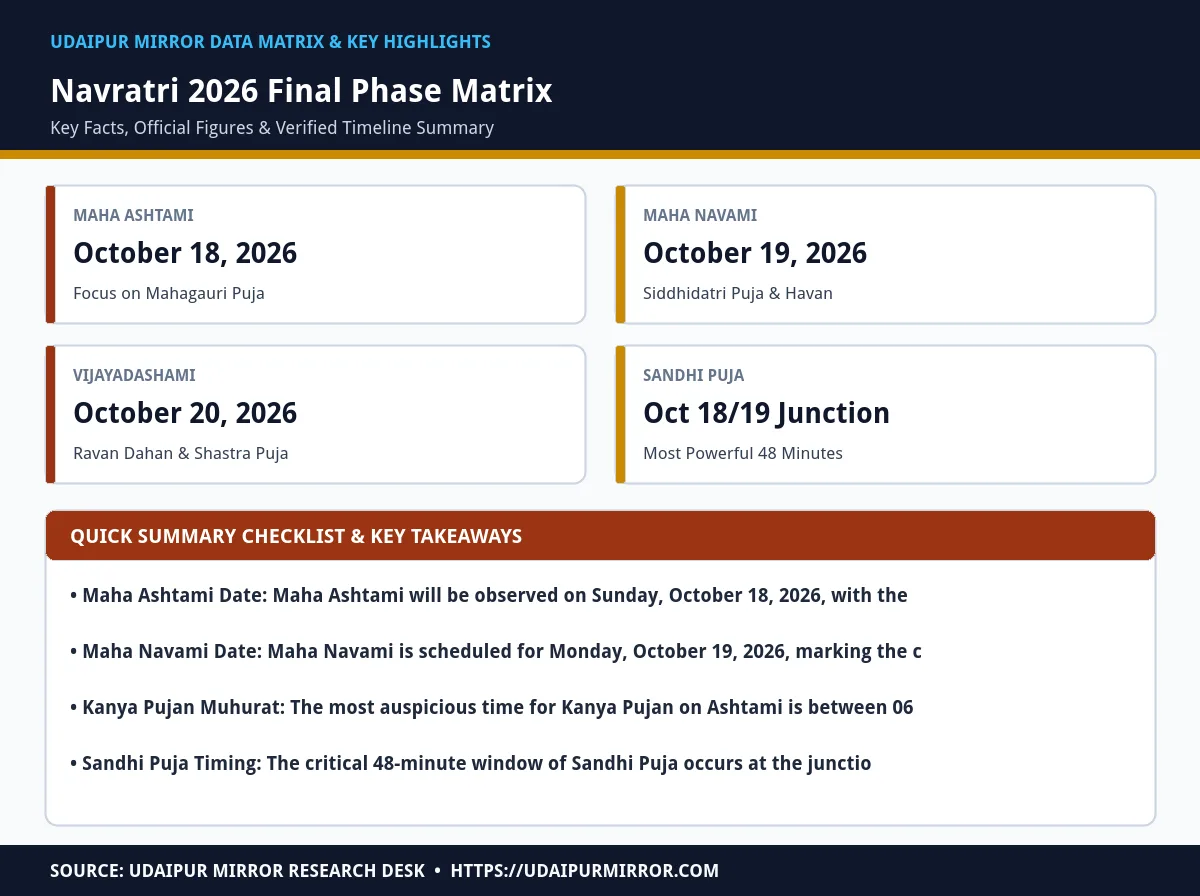
The confusion surrounding the maha ashtami and maha navami 2026 dates stems from the lunar calendar’s intricate movements. Pt. Pawan Kaushik has highlighted that families should pay close attention to the Tithi end times to ensure rituals like Kanya Pujan are performed during the Shubh Muhurat. In 2026, the Ashtami Tithi is expected to begin on the evening of October 17 and conclude on the morning of October 18. Consequently, the Udaya Tithi (sunrise tithi) on October 18 marks it as the primary day for Maha Ashtami celebrations.
For those following the strict Vedic calculations, the Maha Navami Tithi will commence immediately after Ashtami ends on the 18th and will prevail throughout October 19. This makes October 19 the designated day for worshipping Goddess Siddhidatri. It is essential for devotees in Udaipur to synchronize their fast-breaking (Parana) with the conclusion of Navami Tithi on the morning of October 20, just before the Vijayadashami celebrations begin. (Also read: Diwali Celebration in Udaipur 2026: Dates, Lakshmi Pujan Muhurat, 5-Day Festivities, and Lake City Illuminations).
“The alignment of the stars in 2026 suggests a powerful transition during Sandhi Puja, where the energy of Chamunda is most potent between the 18th and 19th of October.” — Pt. Pawan Kaushik, Vedic Astrologer
Devotees traveling from Udaipur to Nathdwara for the Maha Ashtami and Maha Navami celebrations should adhere to the following daily darshan schedule at the Shreenathji Temple. Please note that timings may vary slightly based on specific Pushtimarg Utsav rituals.
| Darshan Name | Approx. Timing | Significance | Ritual Detail |
|---|---|---|---|
| Mangla | 05:15 AM – 06:00 AM | First Darshan | Waking the Lord |
| Shringar | 07:15 AM – 07:45 AM | Adornment | Special Navratri Jewels |
| Gwal | 09:15 AM – 09:30 AM | Cowherd Time | Mid-morning snack |
| Rajbhog | 11:15 AM – 12:15 PM | Main Feast | Grand Aarti & Offering |
| Utthapan | 03:45 PM – 04:00 PM | Awakening | Afternoon Darshan |
| Bhog | 04:45 PM – 05:00 PM | Evening Meal | Fruit & Sweet Offerings |
| Aarti | 05:15 PM – 05:45 PM | Evening Light | Deep Daan Rituals |
| Shayan | 06:30 PM – 07:00 PM | Rest | Final Darshan of the Day |
Maha Ashtami is dedicated to Goddess Mahagauri, symbolizing purity and serenity. In Udaipur, the tradition of Kanya Pujan involves inviting nine young girls, representing the nine forms of Durga, for a ceremonial feast. This year, the most auspicious window for this ritual falls on the morning of October 18. Devotees are encouraged to offer ‘Halwa, Puri, and Chana’ as Prasad to the young deities.
As part of the broader spiritual journey, many practitioners look toward deeper meanings during these nine nights. For instance, in Sharad Navratri 2026: Sadhguru Decodes the Nine Nights of Feminine Energy, Three Gunas, and Inner Mastery, the focus shifts from mere ritual to the mastery of the three gunas—Tamas, Rajas, and Sattva—which reach their peak during the transition from Ashtami to Navami.
Maha Navami, occurring on October 19, 2026, is the final day of the Navratri battle between Goddess Durga and the demon Mahishasura. The most critical ritual of this day is Sandhi Puja, which takes place during the last 24 minutes of Ashtami and the first 24 minutes of Navami. In the Mewar region, this is often observed with the lighting of 108 lamps and the offering of ‘Bali’ (symbolic sacrifice of a pumpkin or sugarcane) at local Devi temples.
Following the Navami rituals, the city of Udaipur begins its preparations for the grand festival of lights. You can also read about the upcoming Diwali Celebration in Udaipur 2026: Dates, Lakshmi Pujan Muhurat, 5-Day Festivities, and Lake City Illuminations to plan your post-Navratri travel and shopping schedule. The transition from the feminine power of Navratri to the victory of light on Diwali marks the most auspicious period of the Hindu calendar.
“Navami is not just the end of a fast, but the beginning of the realization of Siddhi or spiritual perfection.” — Traditional Mewari Proverb
While Rajasthan celebrates with Garba and temple darshans, other parts of India observe Navratri with unique cultural depth. In Kerala, Maha Navami is a celebration of divine power and knowledge, culminating in ‘Vidyarambham’ on Vijayadashami, where children are initiated into the world of letters. This focus on learning aligns with the worship of Goddess Saraswati during the final three days of the festival.
Conversely, the Santhal community continues its struggle to preserve its distinct culture during these mainstream festivals. Their traditions often emphasize the harmony between nature and the divine, providing a stark contrast to the urban celebrations seen in cities like Udaipur. Understanding these diverse perspectives enriches the collective experience of the maha ashtami and maha navami 2026 dates, reminding us of the pluralistic fabric of Indian spirituality.
For those staying in Udaipur, a trip to Nathdwara for Shreenathji’s darshan during Ashtami or Navami is a must. The 48-kilometer journey via NH58 usually takes about an hour. During the peak days of October 18 and 19, it is advised to leave Udaipur by 4:00 AM to catch the Mangla Darshan. Private taxis and Rajasthan State Road Transport Corporation (RSRTC) buses operate frequently from Udiapole bus stand.
Parking near the Nathdwara temple can be challenging during Navratri. Devotees are suggested to use the designated parking lots near the ‘Statue of Belief’ (Vishwas Swaroopam) and use local shuttle services. Additionally, ensure you check the ‘Shayan’ timings if you plan to stay for the evening Aarti, as the temple doors close early on the transition night to Dussehra.
In 2026, Maha Ashtami is primarily observed on Sunday, October 18, based on the Udaya Tithi. While the Tithi may begin on the 17th, the rituals and Kanya Pujan are most auspicious on the morning of the 18th.
The best time for Kanya Pujan is during the Ashtami Tithi on October 18, 2026, specifically during the Shubh Choghadiya timings between 7:30 AM and 10:45 AM.
On Maha Navami (October 19, 2026), Shreenathji darshan begins with Mangla at 5:15 AM and concludes with Shayan at approximately 6:30 PM. Special Navami Shringar is a highlight of the Rajbhog darshan at 11:15 AM.
The Navratri Parana should be done on Tuesday, October 20, 2026, after the Navami Tithi ends and before the Dashami Tithi (Dussehra) rituals begin.
Add Udaipur Mirror as a preferred source on Google to see more of our travel guides in your AI overviews.





[…] Because of this overlapping astrological calculation, families conducting traditional Kanya Pujan (revering nine young girls representing Navdurga) are advised to complete their morning rituals during the Abhijit Muhurat between 11:43 AM and 12:28 PM to receive the combined blessings of Goddess Mahagauri and Goddess Siddhidatri. (Also read: Maha Ashtami and Maha Navami 2026: Exact Dates, Shubh Muhurat, and Shreenathji Darshan Timings). […]