Office Address
14, Residency Road, Udaipur, Rajasthan 313001
Office Address
14, Residency Road, Udaipur, Rajasthan 313001


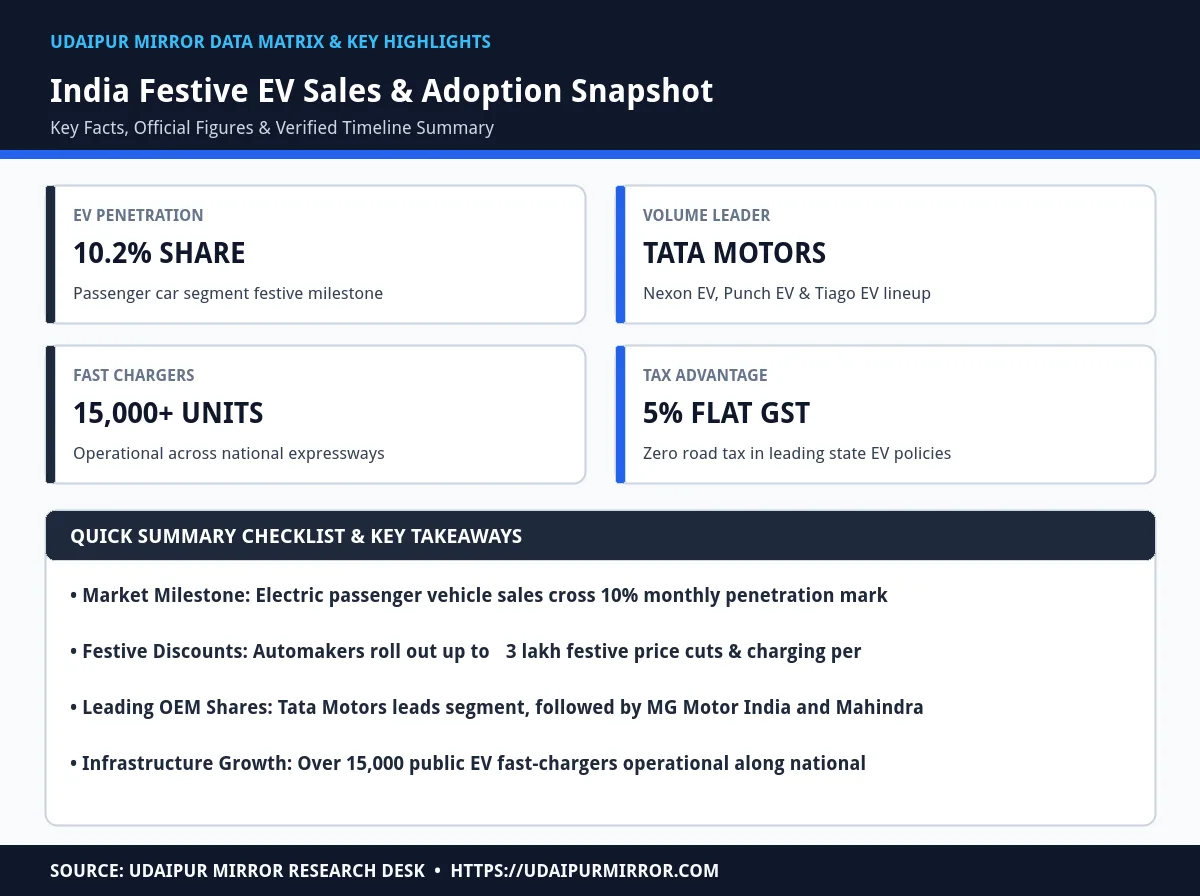
New Delhi: In the latest India EV Sales Surge Festive Season, the country’s electric mobility ecosystem has achieved a historic milestone as monthly electric passenger vehicle retail volumes crossed the double-digit penetration barrier, capturing over 10.2% of total new car deliveries amidst unprecedented festive season demand.
⚡ Quick Highlights: India EV Sales Surge in Festive Season: Car Adoption Hits 10%
Automobile dealerships across major metropolitan centers and Tier 2 cities have registered a strong acceleration in customer bookings for battery electric vehicles (BEVs). Industry analysts attribute this seasonal spike to aggressive price rationalization by leading manufacturers, parity in total cost of ownership (TCO), and expansive festive consumer discount campaigns.
Major original equipment manufacturers (OEMs)—spearheaded by Tata Motors, JSW MG Motor India, and Mahindra & Mahindra—have rolled out festival offers featuring direct cash rebates up to ₹3 lakh, complimentary home AC wallbox charger installations, and multi-year public charging credit packages, drastically lowering entry barriers for first-time electric car buyers. (Also read: Tesla Showcases Next-Gen Roadster Mid-Air Flip Using SpaceX Rocket Thrusters in Texas Test).
“Crossing the 10% penetration milestone in passenger vehicles demonstrates that electric mobility has transitioned from an early-adopter niche to a mainstream consumer preference across India.” — Society of Indian Automobile Manufacturers (SIAM) Analyst Desk
Explore the most sought-after electric vehicles currently commanding showroom footfall and delivery waiting lists during the October 2026 festive season:
| Model & Manufacturer | Starting Price (Ex-Showroom) | Claimed Range (MIDC) | Festive Advantage |
|---|---|---|---|
| Tata Punch EV | ₹9.99 Lakh | 315 – 421 km | Free 3.3 kW AC fast charger + ₹40,000 festive bonus |
| MG Windsor EV | ₹13.49 Lakh (or BaaS ₹9.99L) | 331 km | Battery-as-a-Service model + 1 yr free public charging |
| Tata Nexon EV | ₹12.49 Lakh | 325 – 489 km | Festive price cut up to ₹3 Lakh on long-range trims |
| Mahindra XUV400 | ₹15.49 Lakh | 375 – 456 km | Exclusive exchange bonus and 8-year battery warranty |
| MG Comet EV | ₹6.99 Lakh | 230 km | Lowest entry price point for urban electric runabout |
The central government’s proactive policy backing has played a catalytic role in driving electrification. While internal combustion engine (ICE) vehicles continue to attract Goods and Services Tax (GST) rates of up to 28% alongside variable compensation cesses, electric cars remain shielded under a preferential 5% GST bracket.
Furthermore, several progressive state governments—including Delhi, Uttar Pradesh, Maharashtra, and Rajasthan—continue to offer full road tax and registration fee waivers on electric four-wheelers. Coupled with the rollout of the central PM E-DRIVE initiative focusing on high-density fast-charging corridors, range anxiety among prospective buyers has diminished significantly.
A cornerstone of the 2026 festive EV surge is the rapid maturation of interstate charging infrastructure. Collaborative initiatives between state power distribution utilities, oil marketing companies (OMCs), and private charge point operators (CPOs) have expanded the operational tally of highway fast chargers beyond 15,000 dual-gun DC units.
Key high-traffic pilgrimage and tourism arterial corridors—such as the Delhi-Mumbai Expressway, Delhi-Jaipur Highway, Mumbai-Pune Expressway, and Udaipur-Ahmedabad stretch—now feature charging hubs spaced every 40 to 60 kilometers, giving interstate travelers complete operational confidence during festive road trips. (Also read: Honda 0 Alpha Electric SUV India Debut: Affordable EV SUV Launch Details and Range Confirmed).
Sales are driven by significant price cuts of up to ₹3 lakh by major automakers, competitive 5% GST rates, road tax exemptions in multiple states, and the expansion of highway fast-charging networks.
Electric vehicles in India are taxed at a flat GST rate of 5% with no additional compensation cess, compared to up to 28% plus cess on petrol and diesel cars.
Tata Motors continues to lead India’s electric passenger vehicle segment, followed by JSW MG Motor India and Mahindra & Mahindra.
Add Udaipur Mirror as a preferred source on Google to see more of our travel guides in your AI overviews.





[…] Furthermore, Rajasthan’s clean mobility policy offers substantial concessions on motor vehicle taxes and road tax at the Udaipur Regional Transport Office (RTO RJ-27), ensuring that the initial on-road acquisition cost remains highly competitive against equivalent petrol or diesel automatic models. (Also read: India EV Sales Surge in Festive Season as Electric Car Adoption Crosses 10% Market Share Milestone). […]