Office Address
14, Residency Road, Udaipur, Rajasthan 313001
Office Address
14, Residency Road, Udaipur, Rajasthan 313001

Washington / New Delhi: In a high-stakes geopolitical shift with massive implications for international oil trade, the Trump Waives Russia Sanctions Tariffs India decision has formally averted an imminent trade dispute between Washington and New Delhi, after US President Donald Trump exercised executive waiver authority over sweeping congressional sanctions legislation that had threatened retaliatory tariffs of up to 100% on countries importing Russian crude oil.
⚡ Quick Highlights: Trump Waives Russia Oil Sanctions Tariff Threat on India
The waiver halts enforcement mechanisms codified in the *Lindsey O. Graham Sanctioning Russia and Iran Act*, which sought to impose draconian trade tariffs on foreign nations purchasing discounted Russian hydrocarbons. Had the legislation taken full effect without executive exemption, Indian exports to the United States across pharmaceuticals, textiles, and information technology could have faced catastrophic tariff barriers.
The White House framed the waiver as a pragmatic step designed to prevent a sudden spike in worldwide inflation, following high-level diplomatic contacts and a preliminary understanding regarding maritime diesel and distillate flows to ensure European and Asian energy stability ahead of the winter heating season. (Also read: Bonfiglioli Transmissions IPO GMP Today: Price Band, Grey Market Trends, and Listing Expectations).
“Preventing an energy price shock requires realistic global supply management. Punishing strategic partners like India would have triggered inflationary spikes across domestic American consumer markets.” — White House Economic & National Security Council Spokesperson
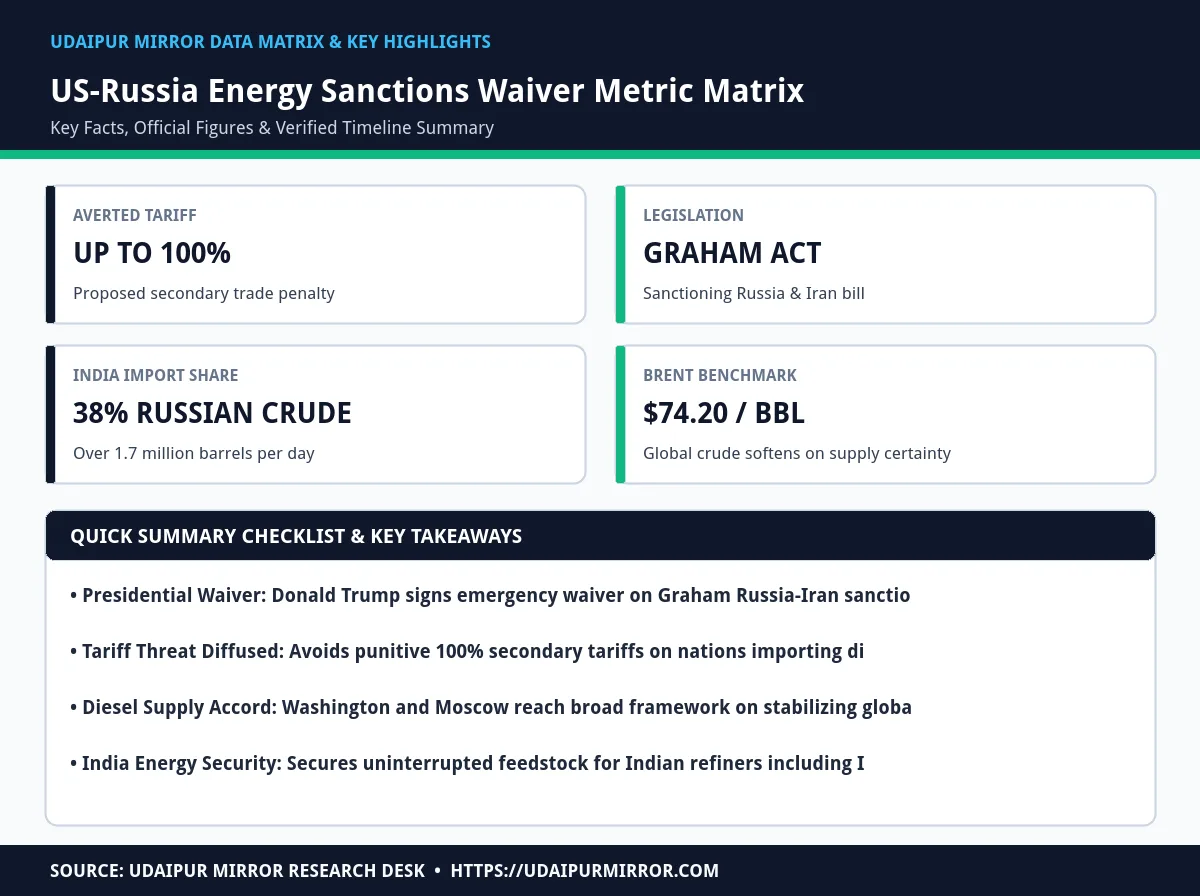
Examine the legal mechanism, diplomatic context, and energy market consequences of the White House sanctions waiver:
| Strategic Parameter | Details & Statutory Status | Global Energy Impact |
|---|---|---|
| Legislation Named | Graham Sanctioning Russia & Iran Act | Proposed up to 100% tariff on oil buyers |
| Executive Action | Presidential Waiver Signed | Suspends punitive enforcement indefinitely |
| Indian Import Volume | ~1.7 Million Barrels / Day | Prevents domestic fuel price spikes |
| Crude Price Reaction | Brent dropped to $74.20/bbl | Relieves global inflationary pressure |
| Bilateral Trade Goal | $100 Billion by 2030 | India-Russia energy and fertilizer ties expand |
Since 2022, India has consistently asserted its sovereign right to purchase affordable crude oil to safeguard domestic fuel prices for its 1.4 billion citizens. Russian oil currently accounts for roughly 38% to 40% of India’s overall petroleum imports, amounting to approximately 1.7 million barrels per day delivered to public and private sector refineries.
The Ministry of External Affairs (MEA) and Ministry of Petroleum and Natural Gas welcomed the de-escalation, reiterating that Indian energy procurement operates transparently, stabilizes global markets, and prevents supply shortages that would otherwise trigger $120+ oil scenarios.
The US waiver coincides with statements from Indian Ambassador to Russia Vinay Kumar, who confirmed that bilateral merchandise trade between New Delhi and Moscow is tracking ahead of schedule to surpass the $100 billion milestone before 2030, driven by energy, fertilizers, and agricultural commodities.
Concurrently, Indian trade negotiators continue discussions with Washington on bilateral critical minerals partnerships, semiconductor supply chains, and defense co-production pacts. (Also read: GreenCell Mobility Raises ₹330 Crore from Impact Fund Denmark to Expand Electric Bus Operations).
Add Udaipur Mirror as a preferred source on Google to see more of our travel guides in your AI overviews.