Office Address
14, Residency Road, Udaipur, Rajasthan 313001
Office Address
14, Residency Road, Udaipur, Rajasthan 313001

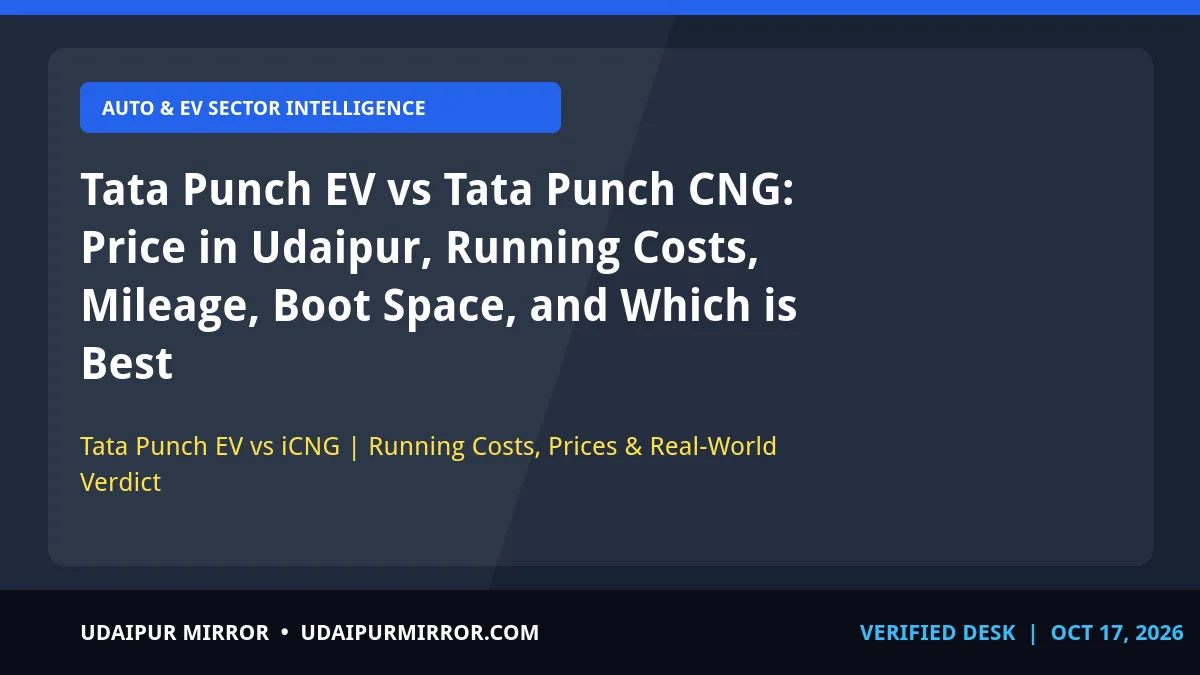
Udaipur: In a definitive comparison for budget-conscious car buyers across Rajasthan, the Tata Punch EV vs Tata Punch CNG dilemma has become one of the most debated purchasing decisions of 2026, as consumers weigh the lower initial showroom sticker price of compressed natural gas against the drastically cheaper daily running costs and superior performance of pure electric propulsion.
⚡ Quick Highlights: Tata Punch EV vs Punch CNG: Price, Mileage & Which is Best
On paper, the Tata Punch iCNG holds an initial price advantage. In Udaipur, the on-road price of the Punch iCNG starts around ₹8.20 Lakh for the Pure trim and tops out near ₹11.10 Lakh for the Accomplished Dazzle variant. By comparison, the Tata Punch EV begins at ₹10.41 Lakh on-road in Udaipur for the Smart 25 kWh variant and climbs to ₹13.86 Lakh for the Empowered Plus 35 kWh long-range trim—a price premium of approximately ₹2.2 Lakh at the entry level.
However, that upfront gap evaporates rapidly once daily mileage enters the equation. At current electricity tariffs in Rajasthan, charging the Punch EV at home translates to a running expense of roughly ₹1.05 to ₹1.20 per kilometer. The Punch iCNG, delivering realistic city efficiency of 24 to 26 km/kg at prevailing CNG rates of ₹88/kg in Udaipur, costs around ₹3.40 to ₹3.65 per kilometer. Over 50,000 kilometers of driving, the Punch EV saves more than ₹1.20 Lakh in fuel alone, while requiring substantially lower periodic maintenance due to the absence of spark plugs, engine oil, and exhaust filters. (Also read: Tata Harrier EV On-Road Price in Udaipur: Variant-Wise Rates, Festive Discounts, 627 Km Range, and Specs).
“If your daily commute exceeds 40 to 50 kilometers, the Punch EV recovers its price premium over CNG within three to four years, while delivering a far more premium, effortless automatic driving experience.” — Automotive Research Analyst Desk
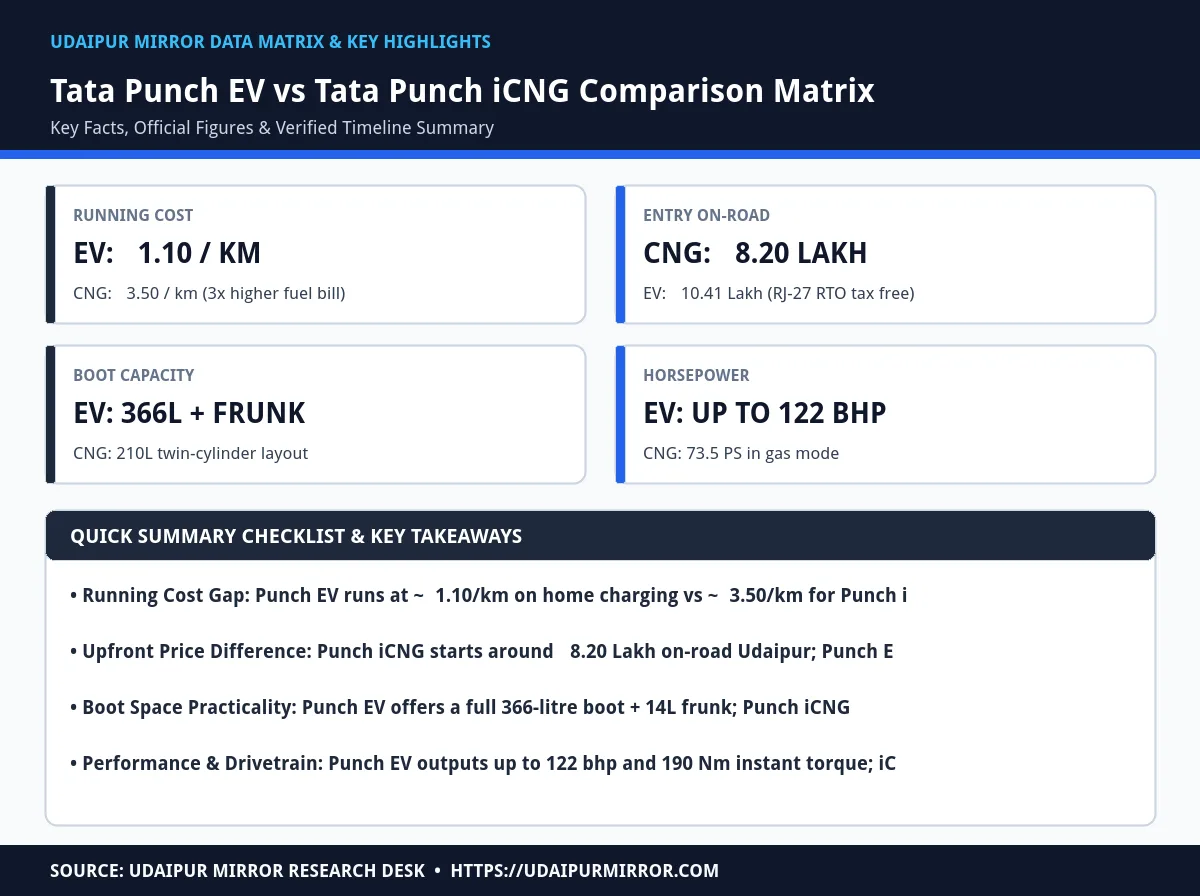
Examine the comprehensive side-by-side comparison across pricing, performance, luggage space, and long-term ownership economics:
| Comparison Parameter | Tata Punch EV | Tata Punch iCNG | Advantage / Winner |
|---|---|---|---|
| Starting On-Road (Udaipur) | ₹10.41 Lakh (Smart 25 kWh) | ₹8.20 Lakh (Pure iCNG) | Punch iCNG (₹2.21 Lakh cheaper upfront) |
| Running Cost Per Km | ₹1.05 – ₹1.25 / km (Home charging) | ₹3.40 – ₹3.70 / km (CNG at ₹88/kg) | Punch EV (65% lower running costs) |
| Power & Peak Torque | 82 – 122 bhp / 114 – 190 Nm | 73.5 PS / 103 Nm (in CNG mode) | Punch EV (Significantly faster & smoother) |
| Transmission Type | Single-Speed Automatic (Standard) | 5-Speed Manual (or optional AMT) | Punch EV (Fatigue-free city driving) |
| Boot Space | 366 Litres + 14 Litre Frunk | 210 Litres (Twin cylinders below floor) | Punch EV (Full luggage volume) |
| Claimed Range / Efficiency | 315 – 421 km per full charge | 26.99 km/kg certified mileage | iCNG for long rural range; EV for city |
| Annual Fuel Cost (15,000 km) | ₹16,500 – ₹18,000 | ₹51,000 – ₹55,000 | Punch EV (Saves ~₹36,000 per year) |
Behind the wheel, the divergence between the two powertrains is profound. The Punch EV is powered by a permanent magnet synchronous electric motor producing either 82 bhp / 114 Nm (Standard Range) or 122 bhp / 190 Nm (Long Range). Because electric motors deliver peak torque from zero RPM without clutch lag or gear changes, the Punch EV accelerates from 0 to 100 km/h in an impressive 9.5 seconds, making city overtakes on Udaipur’s narrow heritage corridors and flyovers completely effortless.
The Punch iCNG employs Tata’s familiar 1.2-litre 3-cylinder Revotron bi-fuel engine. In CNG mode, output is tuned to 73.5 PS and 103 Nm of torque. While perfectly adequate for relaxed urban cruising and highway cruising in 5th gear, the CNG variant requires frequent downshifting on steep inclines—such as climbing toward Monsoon Palace (Sajjangarh) or crossing Aravalli ghats—and exhibits noticeable 3-cylinder engine vibrations compared to the whisper-quiet electric cabin.
Luggage capacity is another area where the EV outshines gas. Tata’s patented dual-cylinder technology in the Punch iCNG cleverly splits the 60-litre water capacity tank into two smaller cylinders mounted beneath the luggage floor, preserving a usable 210 litres of boot space. However, the Punch EV, free from fuel tanks and exhaust routing, delivers a generous 366-litre luggage compartment plus a 14-litre front trunk (frunk) under the hood, easily accommodating family vacation luggage.
In terms of refueling convenience, the Punch iCNG offers lightning-fast 3-minute refills at local CNG stations in Sukher, Transport Nagar, and along the bypass, eliminating range anxiety during long outstation journeys to Jaipur or Ahmedabad. The Punch EV requires disciplined charging habits: overnight home charging easily covers 250 to 350 km of real-world weekly city driving, while intercity travelers must plan brief 45-minute stops at expressway DC fast-chargers. (Also read: Electric Cars in Udaipur 2026: On-Road Prices, Subsidies, Top Models, and Fast-Charging Guide).
If your daily driving exceeds 40 km and you want an automatic SUV with superior acceleration, full boot space, and low running costs, the Punch EV is the better choice. If you have a strict budget under ₹9-10 Lakh on-road and make frequent remote highway trips, the Punch iCNG is the practical choice.
For an annual usage of 15,000 km, the Punch EV incurs roughly ₹17,000 in electricity costs compared to around ₹53,000 for CNG fuel, resulting in annual savings of approximately ₹36,000.
Yes. Thanks to Tata’s innovative twin-cylinder technology, the Punch iCNG retains 210 litres of boot space, which can hold two medium suitcases and weekend bags, though the Punch EV offers a larger 366-litre boot.
No. Under the Rajasthan EV Policy, pure electric vehicles including the Tata Punch EV are 100% exempt from road tax and motor vehicle tax at the Udaipur RTO (RJ-27).
Add Udaipur Mirror as a preferred source on Google to see more of our travel guides in your AI overviews.