Office Address
14, Residency Road, Udaipur, Rajasthan 313001
Office Address
14, Residency Road, Udaipur, Rajasthan 313001

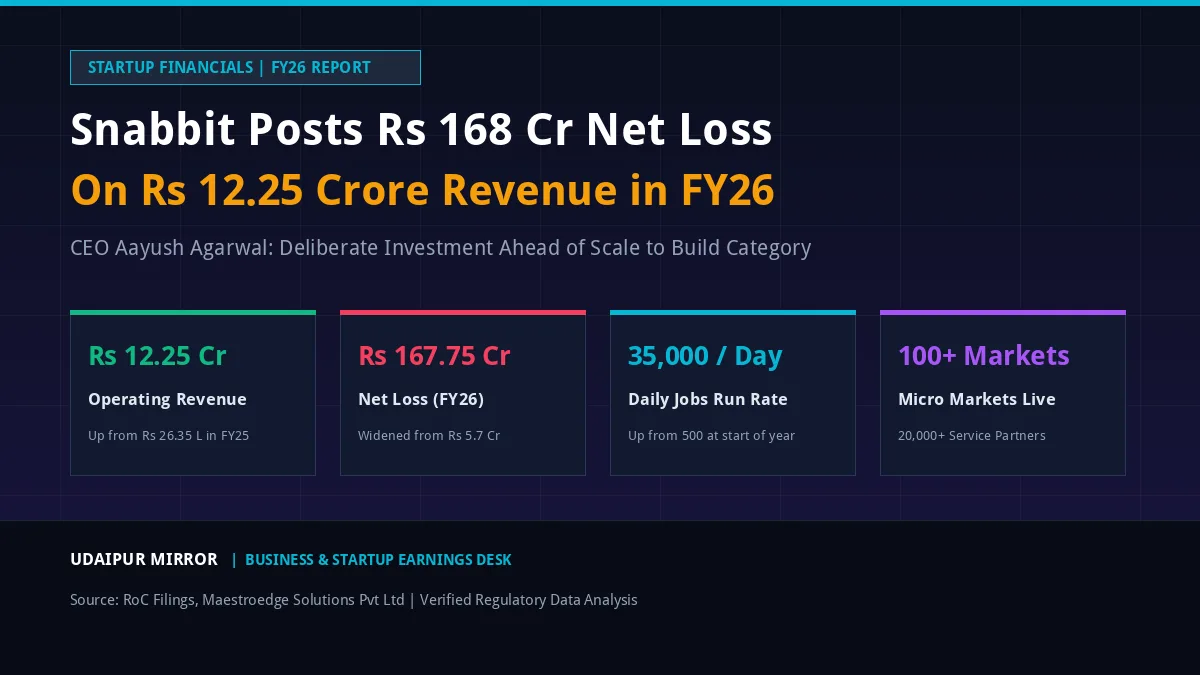
New Delhi / Bengaluru: On-demand quick home-services startup Snabbit (operated by Maestroedge Solutions Pvt Ltd) witnessed a sharp surge in its operational scale during the financial year ended March 31, 2026 (FY26). However, this rapid top-line expansion came accompanied by heavy red ink. According to the company’s regulatory filings accessed from the Registrar of Companies (RoC), Snabbit reported an operating revenue of ₹12.25 crore in FY26, alongside a net loss widening to ₹167.75 crore (approximately ₹168 crore).
The performance marks the platform’s first full financial year of commercial operations, compared to FY25 when the fledgling venture recorded modest operational revenue of ₹26.35 lakh and a net loss of ₹5.7 crore. To generate ₹12.25 crore in operational revenue in FY26, Snabbit incurred total expenses of ₹194.76 crore—translating to a burn multiple where the platform spent roughly ₹16 for every single rupee earned in revenue.
The exponential rise in revenue and parallel ballooning of operational expenses illustrates the capital-intensive nature of launching a hyper-local, 10-to-15-minute home chores service from scratch across Tier-1 metropolitan hubs.
| Financial Metric | FY25 (Initial Phase) | FY26 (First Full Year) | YoY Growth / Change |
|---|---|---|---|
| Operating Revenue | ₹26.35 Lakh | ₹12.25 Crore | +4,548% (46.5x) |
| Other Income | ₹14.20 Lakh | ₹14.76 Crore | Treasury & Investment Yields |
| Total Revenue | ₹40.55 Lakh | ₹27.01 Crore | +6,561% |
| Total Expenses | ₹6.10 Crore | ₹194.76 Crore | +3,092% |
| Net Loss | ₹5.70 Crore | ₹167.75 Crore | Widened ~29.4x |
| Daily Job Run-Rate | ~500 Jobs / Day | 35,000 Jobs / Day | 70x Scale |
| Active Micro Markets | 8 Clusters | 100+ Clusters | 12.5x Geographical Footprint |
A granular look at Maestroedge Solutions’ statutory filings reveals that field service delivery, gig-worker incentives, marketing blitzes, and software engineering consumed the bulk of the platform’s capital reserves:
This high-spend framework mirrors the early playbook seen across Indian consumer tech ventures, such as fitness giant Cult.fit as it streamlined unit economics ahead of its IPO, as well as emerging retail concepts like quick-service food startup Banaraswala scaling regional distribution networks.
Responding to industry scrutiny regarding the ₹168 crore loss against ₹12 crore in revenue, Snabbit Founder and Chief Executive Officer Aayush Agarwal publicly defended the company’s financial posture, terming the burn a deliberate and necessary capital allocation to establish an entirely unorganized category.
“FY26 was Snabbit’s very first full year of operations. We made a conscious, strategic decision to invest ahead of scale to define, build, and anchor an entirely new consumer habit: 10-to-15 minute on-demand home tasks. You cannot establish service reliability, trained workforce liquidity, and sub-15-minute response times without aggressive upfront infrastructure.”
— Aayush Agarwal, Founder & CEO, Snabbit
Agarwal highlighted several key operational milestones achieved during the fiscal year:
Snabbit’s emergence comes at a pivotal inflection point for India’s hyper-local economy. Having accustomed urban households to 10-minute grocery and electronics delivery via Blinkit, Zepto, and Swiggy Instamart, consumer expectations around instant gratification have naturally bled into household maintenance.
The quick-chores model addresses spontaneous domestic friction points—such as post-party dishwashing, emergency bathroom sanitation, quick clothes ironing, or emergency faucet repairs—which legacy home-service aggregators like Urban Company traditionally serviced on 2-to-4 hour lead schedules.
However, the competitive landscape is shifting rapidly:
For extensive business coverage, startup funding insights, and corporate earnings analysis, explore the Udaipur Mirror Business Desk and our dedicated Technology & Startups Hub.
Snabbit (operated by Maestroedge Solutions Pvt Ltd) is an Indian on-demand quick home-services platform. It specializes in delivering trained professionals within 10 to 15 minutes for routine domestic tasks including kitchen cleaning, dishwashing, house dusting, laundry assistance, and basic handyman chores.
Snabbit was founded by Aayush Agarwal, an entrepreneur and alumnus who serves as the company’s Chief Executive Officer (CEO).
According to its RoC filings, Snabbit clocked an operating revenue of ₹12.25 crore in FY26, alongside other income of ₹14.76 crore. However, steep investments in service partners, marketing, and engineering led to a net loss of ₹167.75 crore (~₹168 crore) on total expenses of ₹194.76 crore.
By the end of FY26, Snabbit reported scaling to a run-rate of 35,000 daily jobs across more than 100 micro-markets, supported by over 20,000 onboarded service partners and nearly 1 million acquired customers.
Add Udaipur Mirror as a preferred source on Google to see more of our travel guides in your AI overviews.





[…] Today, that mindset has undergone a generational paradigm shift. High-net-worth cultural figures are leveraging their personal balance sheets and market influence to negotiate equity stakes, convertible notes, and founder-share participation. By tying their personal wealth to a company’s operational trajectory, celebrity angels participate in capital appreciation, secondary buyout events, and public market listings. (Also read: Snabbit Posts ₹168 Crore Loss on ₹12.25 Crore Revenue in FY26: CEO Aayush Agarwal Defends Blitzs…). […]