Office Address
14, Residency Road, Udaipur, Rajasthan 313001
Office Address
14, Residency Road, Udaipur, Rajasthan 313001

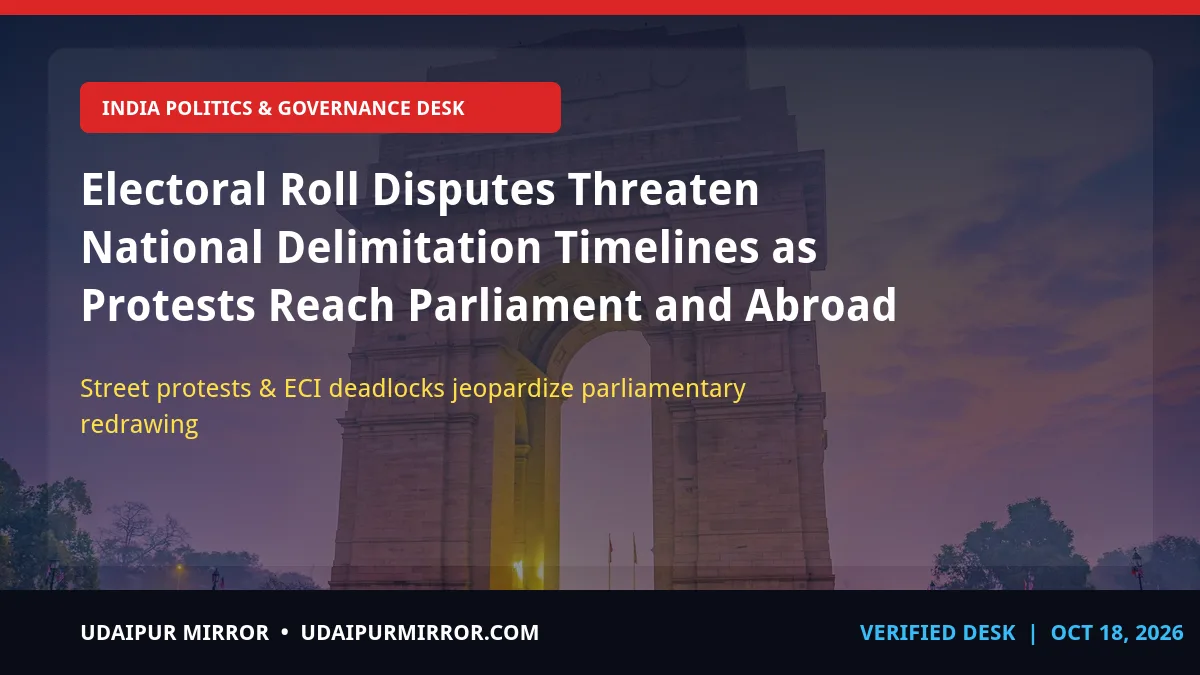
NEW DELHI: The escalating political friction over the electoral roll battle delimitation connection has spilled from street protests and international diplomatic corridors straight into Parliament, threatening the scheduled execution of India’s post-2026 parliamentary boundary redrawing exercise. With opposition parties raising alarm over alleged voter roll deletions during Special Intensive Revision (SIR) drives and government defenders asserting institutional impartiality, the conflict reached international visibility as student groups targeted Chief Election Commissioner (CEC) Gyanesh Kumar in London over the weekend.
⚡ Quick Highlights: Electoral Roll Battle Delimitation Timeline Impact 2026
What began as localized ward-level objections against electoral roll updates has transformed into a high-visibility political contest spanning continents. Over the weekend, Indian student groups gathered outside high commission venues in London to protest against Chief Election Commissioner Gyanesh Kumar during his official delegation visit. Demonstrators alleged that the ongoing Special Intensive Revision (SIR) protocols disproportionately disenfranchised migrant workers and minority pockets through automated deletion algorithms.
In response, groups supporting the Union government held counter-demonstrations, emphasizing that the Election Commission of India (ECI) operates under strict judicial oversight and Constitutional mandates. The clash highlights how administrative updates to electoral rolls have acquired intense political polarization ahead of the mandatory post-2026 national delimitation exercise. (Also read: Rajasthan CM Announces Housing Schemes for Journalists and Launches Four Major Urban Residential Projects).
“Electoral rolls are the foundational bedrock of representative democracy. Any flaw in the voter baseline directly corrupts the legitimacy of future constituency boundaries.” — Senior Parliamentary Policy Analyst, New Delhi
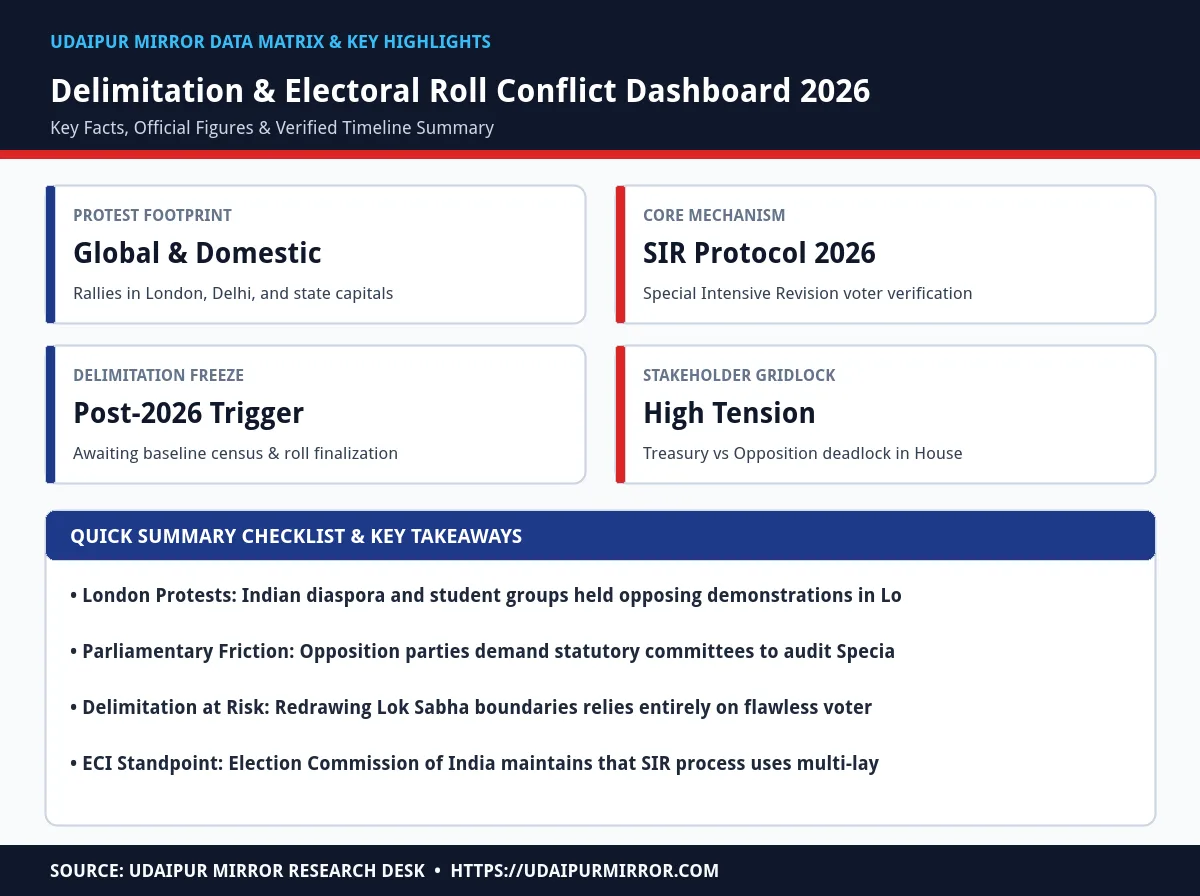
The table below outlines the critical milestones in the ongoing voter list revision drive, institutional responses, and the projected impact on the national delimitation schedule.
| Timeline | Event / Milestone | Primary Location | Status & Delimitation Impact |
|---|---|---|---|
| Q1 2026 | Special Intensive Revision (SIR) Rollout | Nationwide (All States/UTs) | Initiated field updates; sparked opposition scrutiny over mass purges. |
| Mid October 2026 | London Diaspora Demonstrations | London, United Kingdom | Protests against CEC Gyanesh Kumar; counter-protests held by supporters. |
| October 18, 2026 | Parliamentary Strategy Meetings | New Delhi | Opposition blocs draft joint notice demanding statutory SIR audit. |
| Q4 2026 (Projected) | Final Publication of Revised Rolls | State Election Headquarters | Pre-requisite baseline verification before constitutional boundary freeze. |
| Early 2027 | Delimitation Commission Setup | Union Cabinet / Supreme Court | Risk of procedural delays if voter list litigation remains unresolved. |
The process of delimitation—redrawing the territorial boundaries of parliamentary and assembly constituencies—relies on precise demographic and voter density data. If the underlying voter lists suffer from artificial inflation or systemic omissions, the physical re-apportionment of legislative seats risks shifting power away from legitimate population centers.
Political parties across the spectrum recognize that once delimitation boundaries are fixed based on updated voter counts, the structural distribution of Lok Sabha seats will remain unchanged for decades. Consequently, the ongoing battle over SIR voter lists is viewed as a pre-emptive struggle for the baseline numbers that will dictate India’s political map.
“Delimitation is not merely a geographic exercise; it is an allocation of sovereign political power among states and communities.” — Constitutional Law Expert, Supreme Court of India

With Parliament scheduled to convene for its upcoming session, opposition leaders have signaled that the electoral roll dispute will take center stage. Floor managers are preparing notices demanding a dedicated multi-day debate on ECI procedures and a bipartisan parliamentary review of automated roll-cleansing software.
Meanwhile, government officials maintain that political interference in independent constitutional bodies undermines public trust. Treasury benches argue that administrative updates to electoral rolls have been standard practice for decades and that standard judicial remedies exist for any aggrieved citizen.
This political friction parallels broader governance challenges across state and local administrations, where infrastructure planning and civic registries require clean administrative boundaries, much like how the Udaipur Development Authority Expands Jurisdiction by Adding 70 New Villages Across Badgaon, Girwa & Mavli: Total Reaches 206 to establish accurate local governance zones.
“Disrupting the functioning of constitutional institutions through public agitations undermines public trust in democratic outcomes.” — Union Minister for Parliamentary Affairs
The friction surrounding national voter databases also underscores the administrative complexity of synchronizing civil registries across India’s federal structure. As state machinery coordinates large-scale drives, public awareness and transparent communication remain pivotal to maintaining public trust during major policy transitions.
From targeted welfare initiatives to civic infrastructure projects, state governments frequently launch targeted schemes requiring precise demographic tracking. For instance, initiatives like the Rajasthan CM Announces Housing Schemes for Journalists and Launches Four Major Urban Residential Projects demonstrate how local governance relies on verified beneficiary lists and transparent administrative frameworks.
Ensuring that citizen registries—whether for electoral rights, housing benefits, or utility grants—remain free of political contention is vital for sustaining institutional stability as the country approaches the post-2026 delimitation landmark.
“Clear, verified administrative data is essential not just for elections, but for equitable delivery of constitutional guarantees across all levels of government.” — Retired Election Commissioner
As India moves closer to the formal commencement of the delimitation process, political experts stress the urgent need for consensus between the ruling coalition and opposition parties. Without mutually accepted electoral rolls, any subsequent boundary decisions risk prolonged legal challenges in the Supreme Court.
The coming months will test the resilience of India’s electoral machinery. Whether through enhanced digital audit trails or structured parliamentary oversight, resolving the current standoff is imperative to ensure that the redrawing of parliamentary constituencies reinforces, rather than weakens, nation-wide democratic trust.
“Democracy thrives on political contestation, but the umpire and the rulebook must remain above suspicion.” — Political Scientist & Governance Fellow
The dispute centers on Special Intensive Revision (SIR) drives conducted by the Election Commission, with opposition parties alleging systematic voter omissions and the government defending ECI’s institutional integrity.
Delimitation relies on accurate demographic and voter numbers to redraw parliamentary seats post-2026. Faulty or disputed voter lists could corrupt seat allocation ratios and delay boundary finalizing timelines.
Indian student groups in London protested against Chief Election Commissioner Gyanesh Kumar during an official visit to highlight concerns over SIR voter deletions, prompting counter-protests from government supporters.
Voters can submit Form 6 for inclusion or Form 8 for corrections during the designated claims and objections period managed by District Election Officers across all states.
Add Udaipur Mirror as a preferred source on Google to see more of our travel guides in your AI overviews.