Office Address
14, Residency Road, Udaipur, Rajasthan 313001
Office Address
14, Residency Road, Udaipur, Rajasthan 313001

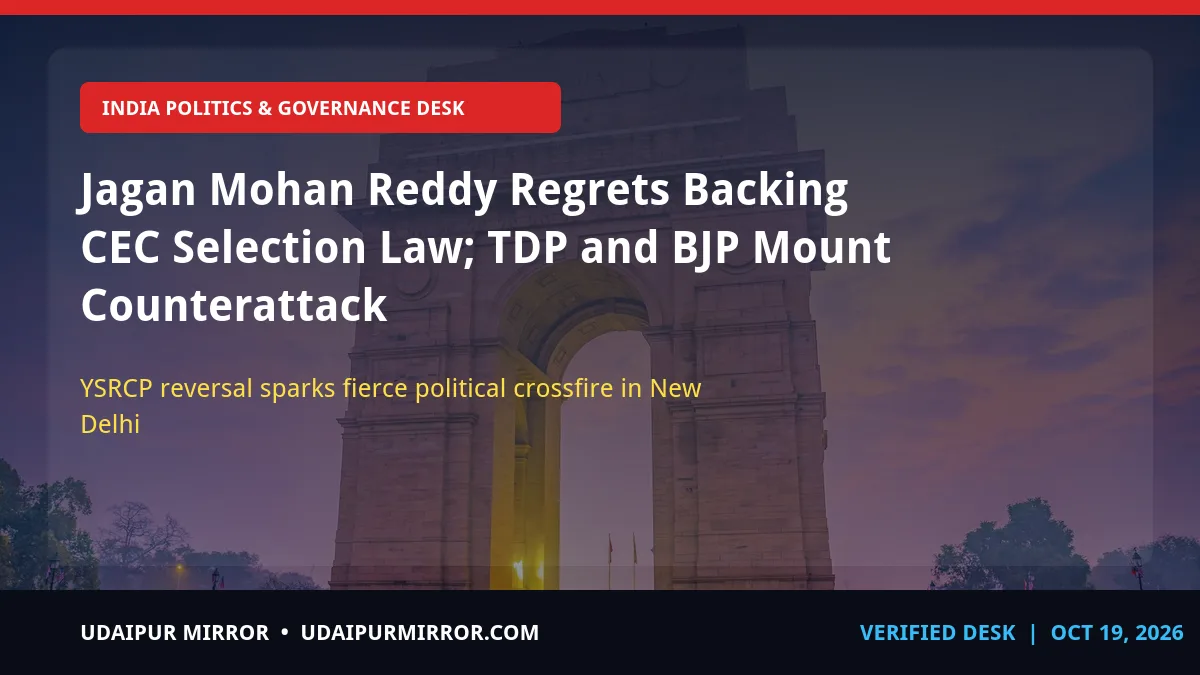
NEW DELHI: In a significant political pivot sending ripples across regional and national corridors, YSR Congress Party (YSRCP) chief YS Jagan Mohan Reddy has publicly expressed regret over his party’s previous parliamentary support for the controversial legislation governing the appointment of the Chief Election Commissioner (CEC) and Election Commissioners. The sudden reversal has intensified the cec appointment process controversy, drawing sharp rebuttals from the ruling Telugu Desam Party (TDP) in Andhra Pradesh and the Bharatiya Janata Party (BJP) at the Centre, while fueling ongoing opposition pushback against the institution of the Election Commission of India (ECI).
⚡ Quick Highlights: CEC Appointment Row: Jagan Regret Sparks TDP-BJP War
Addressing party cadres and the media, former Andhra Pradesh Chief Minister YS Jagan Mohan Reddy offered an unexpected mea culpa concerning his party’s parliamentary record. Jagan stated that supporting the legislation that altered the appointment mechanism for the Chief Election Commissioner was a significant tactical mistake, claiming that the institutional balance envisaged by the Constitution had been materially diluted.
Jagan maintained that the ground realities during recent assembly and general elections revealed procedural imbalances, which he attributed to an executive-tilted selection panel. His declaration comes at a critical juncture when national scrutiny on statutory appointments has intensified. Notably, while the judiciary has reinforced administrative accountability—as seen when the Jal Jeevan Mission Scam: Supreme Court Grants Bail, Rules Prolonged Pre-Trial Incarceration Unconstitutional ruling underscored limits on executive overreach—legislative debates on election integrity continue to polarize regional power centers.
“We supported the legislation in good faith hoping it would foster administrative stability, but experience has shown that removing judicial neutrality from the appointment process was an error that damaged institutional autonomy.” — YS Jagan Mohan Reddy, President, YSR Congress Party
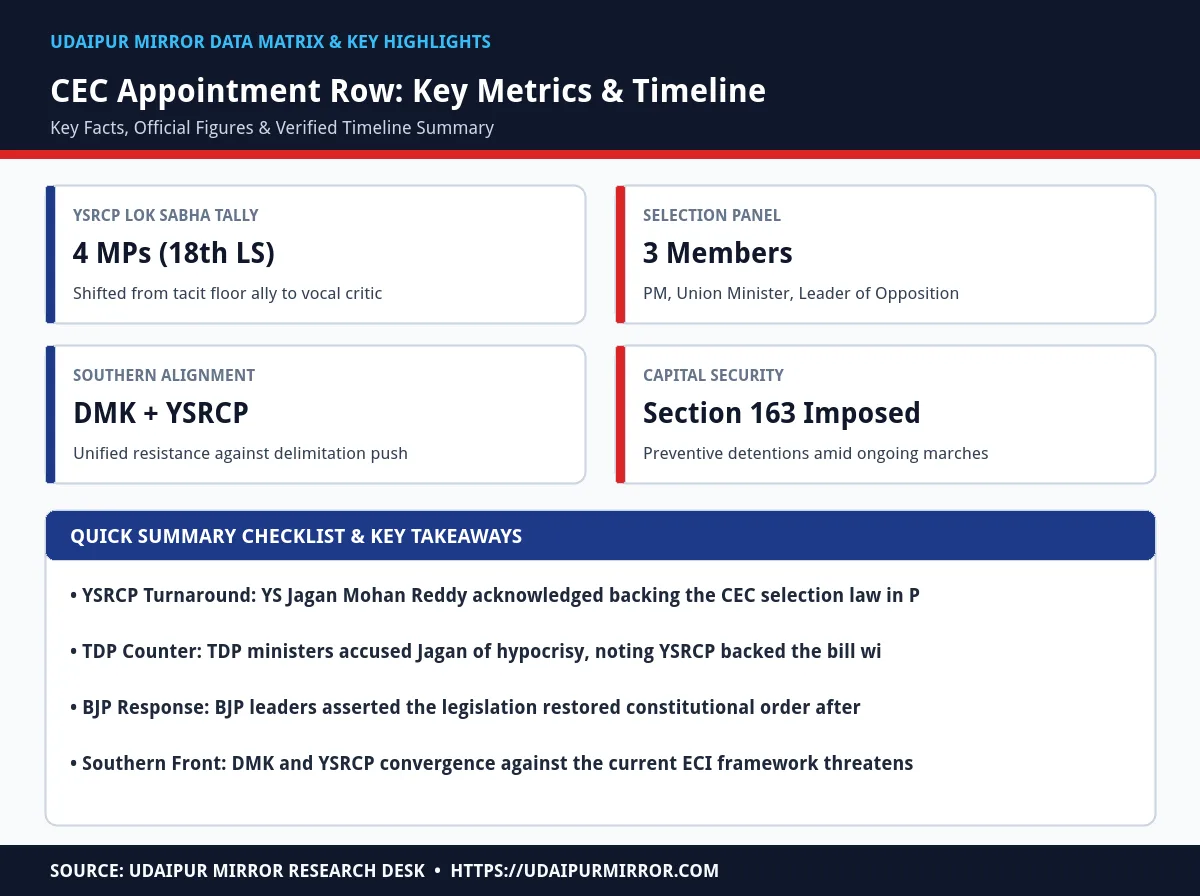
The parliamentary passage of the Chief Election Commissioner and other Election Commissioners (Appointment, Conditions of Service and Term of Office) Act has generated sustained constitutional debate. The table below delineates the shifting positions of key political parties and statutory milestones leading to the current showdown.
| Milestone / Event | Key Stakeholders | Original Position | Current October 2026 Stance |
|---|---|---|---|
| Supreme Court Ruling (Anoop Baranwal) | Five-Judge Constitution Bench | Mandated CJI on Selection Committee | Overridden by Parliament via 2023 Enactment |
| CEC Act Passage (Winter 2023) | Parliament / Union Govt | Replaced CJI with a Union Cabinet Minister | Defended by Centre as Constitutional Prerogative |
| YSRCP Legislative Vote | YS Jagan Mohan Reddy / YSRCP | Supported the Bill in Both Houses | Public Regret; Backing Independent Oversight |
| TDP Governance Standpoint | N. Chandrababu Naidu / TDP | Opposed YSRCP Alignment | Defends Law; Labels Jagan’s Shift Opportunistic |
| DMK Joint Offensive | MK Stalin / DMK | Voted Against Bill; Boycotted Process | Demanding Immediate Structural Overhaul & Removal |
| Delimitation Consensus Drive | Union Ministry of Parliamentary Affairs | Cross-Party Consultations Ongoing | Southern Blocs Threatening Delimitation Boycott |
The reaction from Andhra Pradesh’s governing Telugu Desam Party was swift and scathing. Senior TDP leaders pointed out that the YSRCP had systematically supported the treasury benches on crucial legislative bills throughout the 17th Lok Sabha, asserting that Jagan’s remorse is merely an outcome of electoral defeat rather than high-minded constitutional principle.
State cabinet ministers highlighted that the YSRCP leadership remained unperturbed by systemic safeguards until they were voted out of office in Amaravati. The TDP pointed out that genuine legal transgressions cannot be washed away by shifting political rhetoric, drawing parallels to how long-evaded responsibilities eventually catch up with actors, akin to situations where a 40-Year-Old Criminal Case Catches Up With Fugitive Who Rebuilt Life as Footballer and Family Man after decades of administrative inertia.
Concurrently, the BJP’s national spokespersons rejected the insinuation that the Election Commission operates under executive leverage. Defending the statute passed by Parliament, the party emphasized that Article 324 explicitly left the mechanism of election commissioner appointments to parliamentary legislation, asserting that the existing committee comprising the Prime Minister, a designated Union Cabinet Minister, and the Leader of the Opposition provides legitimate democratic oversight.
“When Jagan Mohan Reddy was enjoying power, he willingly endorsed every federal statute. Shedding crocodile tears now over constitutional propriety is the height of political opportunism.” — Spokesperson, Telugu Desam Party

Jagan’s posture aligns YSRCP closely with Tamil Nadu’s ruling DMK, which has sustained a vigorous national campaign demanding structural overhauls of the poll panel. DMK leaders have gone so far as to back motions seeking removal proceedings against election officials, citing grievances over transparency and operational neutrality.
This southern alignment poses a formidable hurdle for the Union Government, which is widely reported to be laying the groundwork for a special parliamentary session to address nationwide delimitation and electoral boundaries. Southern states fear that a population-weighted delimitation exercise could penalize progressive states that successfully curtailed population growth, diminishing their federal clout in the Lok Sabha.
With both the DMK and YSRCP actively attacking the selection architecture of the ECI, the Centre’s ability to manufacture a southern consensus ahead of census recalculations and boundary redrawings appears increasingly compromised. (Also read: 40-Year-Old Criminal Case Catches Up With Fugitive Who Rebuilt Life as Footballer and Family Man).
“An Election Commission constituted without multi-partisan confidence cannot impartially demarcate electoral boundaries or conduct federal delimitation.” — Senior DMK Floor Leader, New Delhi
The political sparring in Andhra Pradesh and New Delhi coincided with escalating ground agitation. In the national capital, civil rights groups and opposition frontal organizations organizing under the ‘People Against SIR’ banner called for nationwide protest marches, demanding comprehensive rollbacks of unilateral administrative reforms.
Delhi Police reinforced security deployment around the Parliament Street perimeter, India Gate, and Jantar Mantar, executing preventive detentions under Section 163 of the Bharatiya Nagarik Suraksha Sanhita (BNSS). Barricades and transit restrictions disrupted early morning commuters across Central Delhi, reflecting growing friction between civil society and administrative authorities over national governance frameworks.
“Law and order arrangements are strictly preventive to ensure public order is preserved in high-security diplomatic and legislative zones.” — Senior Officer, Delhi Police Headquarters
The controversy stems from the 2023 legislation that replaced the Chief Justice of India with a Union Cabinet Minister on the three-member selection panel alongside the Prime Minister and Leader of Opposition, giving the ruling executive an automatic 2-1 majority.
YSRCP chief Jagan Mohan Reddy stated that backing the law was a tactical mistake because, in his view, the absence of judicial neutrality compromised the Election Commission’s perceived impartiality during state and national elections.
The TDP termed Jagan’s shift hypocritical and opportunistic, noting YSRCP willingly supported the bill when in power. The BJP defended the statutory validity of the appointment committee, citing Parliament’s constitutional authority under Article 324.
Southern regional parties, including DMK and YSRCP, are raising questions about the fairness of any boundary delimitation conducted under an Election Commission whose appointment structure they contend lacks cross-partisan balance.
Add Udaipur Mirror as a preferred source on Google to see more of our travel guides in your AI overviews.