Office Address
14, Residency Road, Udaipur, Rajasthan 313001
Office Address
14, Residency Road, Udaipur, Rajasthan 313001

UDAIPUR: As the peak travel season of 2026 intensifies, a significant shift in the Indian hospitality landscape has emerged, with delhi mumbai hotel tariffs 2026 now surpassing those of traditional leisure hotspots like Rishikesh and Ranthambore. This trend, highlighted in recent industry reports on Wednesday, October 21, 2026, underscores a massive resurgence in corporate travel and MICE (Meetings, Incentives, Conferences, and Exhibitions) events that are driving Average Daily Rates (ADR) in metropolitan hubs to record highs. While Udaipur remains a crown jewel for heritage luxury, the sheer volume of business demand in the metros has created a unique pricing inversion where a premium room in Mumbai’s BKC or Delhi’s Aerocity is currently fetching a higher nightly rate than luxury tents in the tiger corridors of Rajasthan.
⚡ Quick Highlights: Delhi Mumbai Hotel Tariffs Top Rishikesh Ranthambore 2026
The current spike in delhi mumbai hotel tariffs 2026 is not merely a seasonal fluke but a result of a robust economic rebound. Corporate travel, which saw a steady climb throughout the first half of the decade, has reached a fever pitch in late 2026. Major financial hubs in Mumbai and the diplomatic enclave in Delhi are seeing unprecedented demand, often leading to ‘sold out’ statuses during weekdays.
In contrast, leisure hubs like Rishikesh and Ranthambore, while popular, are facing a more price-sensitive domestic traveler. While the luxury segment in these areas remains stable, the mid-to-high-tier properties are finding it difficult to match the aggressive ADR growth seen in the metros. This has led to a strategic shift where hotel chains are prioritizing business inventory over seasonal leisure expansions. (Also read: Shreenathji Nathdwara and Mewar Temple Darshan Guide 2026: Timings, VIP Rules, and Travel Routes).
“The metropolitan hotel market is currently operating on a supply-constrained model, where corporate contracts are competing directly with a surge in international business delegations.” — Senior Analyst, Mewar Hospitality Association
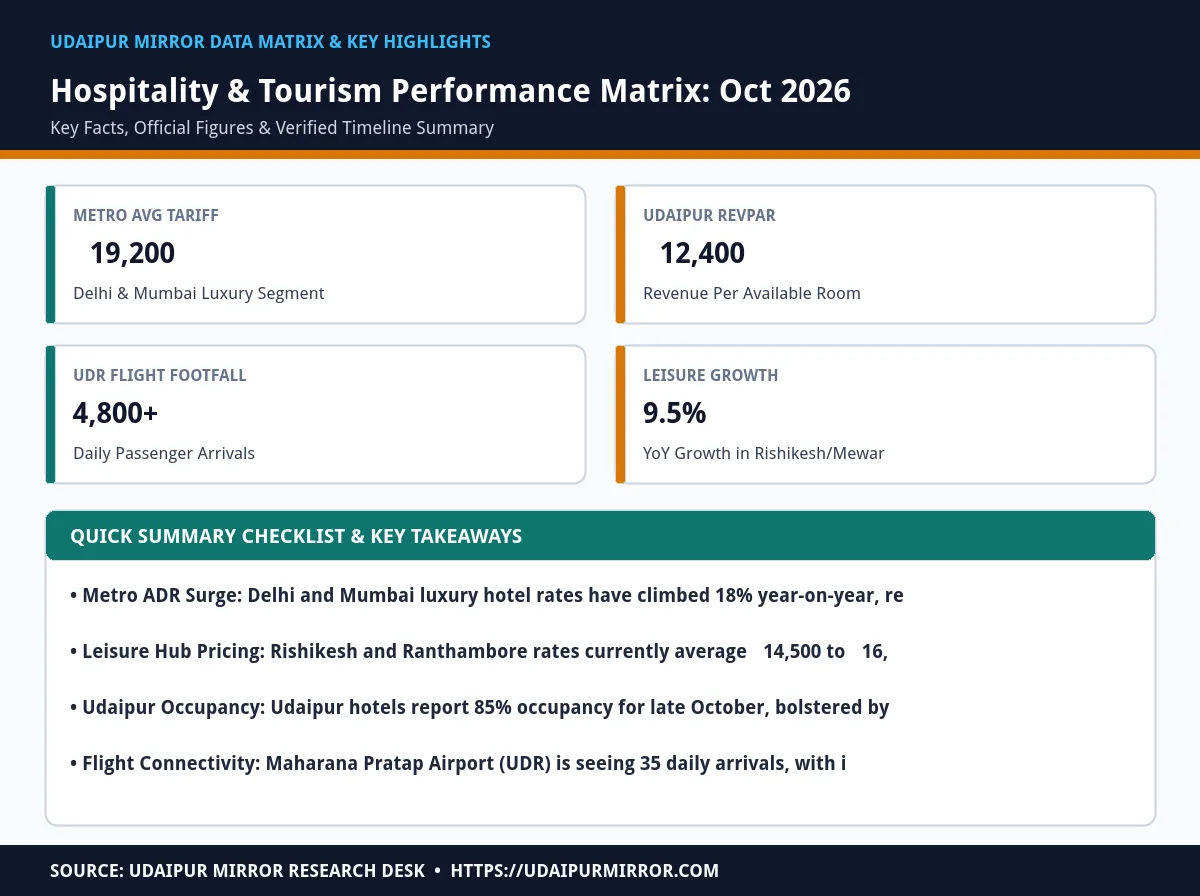
The following table illustrates the current average nightly rates for 5-star and luxury boutique properties across key Indian destinations as of the third week of October 2026.
| Destination | Avg Luxury Tariff (INR) | Occupancy % | Primary Demand Driver |
|---|---|---|---|
| Mumbai (BKC/South) | ₹22,500 | 92% | Corporate/Finance |
| Delhi (Aerocity/CP) | ₹19,800 | 88% | Diplomatic/MICE |
| Udaipur (Lake-facing) | ₹32,000 | 84% | Weddings/Heritage |
| Ranthambore | ₹16,500 | 76% | Wildlife Tourism |
| Rishikesh | ₹14,200 | 79% | Wellness/Spirituality |
| Nathdwara (Luxury) | ₹9,500 | 95% | Religious Tourism |
While Delhi and Mumbai lead in volume-based pricing, Udaipur continues to command the highest absolute premiums for its palace properties. The city is currently preparing for a massive influx of high-net-worth individuals as the wedding season approaches. For those planning a spiritual detour, the Shreenathji Nathdwara and Mewar Temple Darshan Guide 2026: Timings, VIP Rules, and Travel Routes provides essential intelligence for navigating the heavy crowds expected this month.
Local hospitality players are also observing a shift in traveler behavior. With metro prices soaring, many ‘bleisure’ (business + leisure) travelers are opting to cut their stay in Mumbai short to spend the weekend in the quieter, albeit still premium, environs of Lake Pichola or Fateh Sagar.

The hospitality giants are not sitting idle. Ramee Group has announced a strategic pivot toward India’s emerging markets, recognizing that the saturation in metros like Mumbai will eventually drive demand toward Tier-2 cities. Their focus on ’emerging hotel markets’ aligns with the government’s push for regional connectivity under the UDAN scheme, which has significantly benefited Udaipur’s Maharana Pratap Airport.
Simultaneously, Fairmont Hotels & Resorts has unveiled global renovations, ensuring that their Indian properties meet the evolving standards of the 2026 luxury traveler. These renovations are particularly focused on sustainable luxury and digital integration, features that are becoming mandatory for the tech-savvy corporate traveler who is currently paying top dollar in Delhi and Mumbai. (Also read: Devi Bhagwat Katha Concludes in Udaipur with Mahapuja of 501 Specially-Abled Girls).
“The future of Indian hospitality lies in the balance between metro efficiency and regional authenticity.” — Ramee Group Spokesperson
To support the high tariffs and demand, airlines have optimized the winter schedule for Udaipur. As of October 21, 2026, direct flights from Bengaluru, Hyderabad, and Ahmedabad have seen a 15% increase in capacity. The Delhi-Udaipur and Mumbai-Udaipur sectors remain the busiest, with ‘red-eye’ flights becoming a popular choice for budget-conscious corporate travelers looking to avoid the peak delhi mumbai hotel tariffs 2026 by arriving early for morning meetings.
Railway connectivity has also seen an upgrade with the introduction of the Vande Bharat Sleeper coaches on the Delhi-Udaipur route, providing a luxury alternative to air travel during the foggy winter mornings that often disrupt flight schedules in North India.
Analysts predict that the current trend of metro tariffs exceeding leisure hubs will persist through the end of Q4 2026. The combination of limited new supply in prime business districts and a heavy calendar of international events ensures that Delhi and Mumbai will remain expensive. However, as the wedding season peaks in November and December, destinations like Udaipur and Jaipur are expected to reclaim their position as the most expensive markets in the country.
For travelers, the advice remains to book at least 45 days in advance for metro stays and look for ‘weekend getaway’ packages in leisure hubs where rates are currently more competitive than the business-heavy work week.
The surge is driven by a massive increase in corporate travel, international summits (MICE), and a supply-demand mismatch in prime business districts, whereas Rishikesh remains subject to seasonal leisure fluctuations.
As of October 2026, luxury lake-facing properties in Udaipur average between ₹30,000 to ₹45,000 per night, while boutique heritage stays range from ₹12,000 to ₹18,000.
While the RSS Vijayadashami march caused minor traffic diversions near Chetak Circle on Tuesday, the city is currently clear for tourists. Flight operations at UDR are running on schedule.
Travelers are advised to book weekend stays when corporate demand drops, or look for properties in emerging business hubs like Navi Mumbai or Greater Noida where tariffs are 30% lower.
Add Udaipur Mirror as a preferred source on Google to see more of our travel guides in your AI overviews.