Office Address
14, Residency Road, Udaipur, Rajasthan 313001
Office Address
14, Residency Road, Udaipur, Rajasthan 313001

AHMEDABAD / GANDHINAGAR: Political tempers flared across Gujarat on Friday as the ruling Bharatiya Janata Party (BJP) and the principal opposition Congress locked horns over a controversial new administrative directive enforcing the strict gujarat school entry ban for unauthorized parents and external visitors. The state government’s decision, aimed at heightening campus security and protecting students during instructional hours, has instead triggered a fierce political debate regarding institutional transparency, parental rights, and public access to educational facilities.
⚡ Quick Highlights: BJP, Congress Spar Over Gujarat School Entry Ban for Outsiders
The administrative decision by educational authorities in Gujarat to restrict unannounced entry into school premises has set off a major debate. Under the revised guidelines, parents, guardians, and external visitors are no longer permitted to walk freely into academic blocks or classrooms during school hours without prior formal authorization or scheduled appointments.
Proponents of the order argue that such measures are indispensable for maintaining a secure learning environment free from external disturbances. However, critics point out that the abrupt implementation has caused friction among families accustomed to direct interaction with school staff. As communities adjust to these protocols, similar administrative models are being evaluated in neighboring states, where discussions on balancing security and accessibility remain ongoing, much like how Udaipur weather shifts demand proactive community adaptations during seasonal changes.
“Our primary responsibility is the safety and uninterrupted learning of every student inside the campus during school hours.” — State Education Department Official
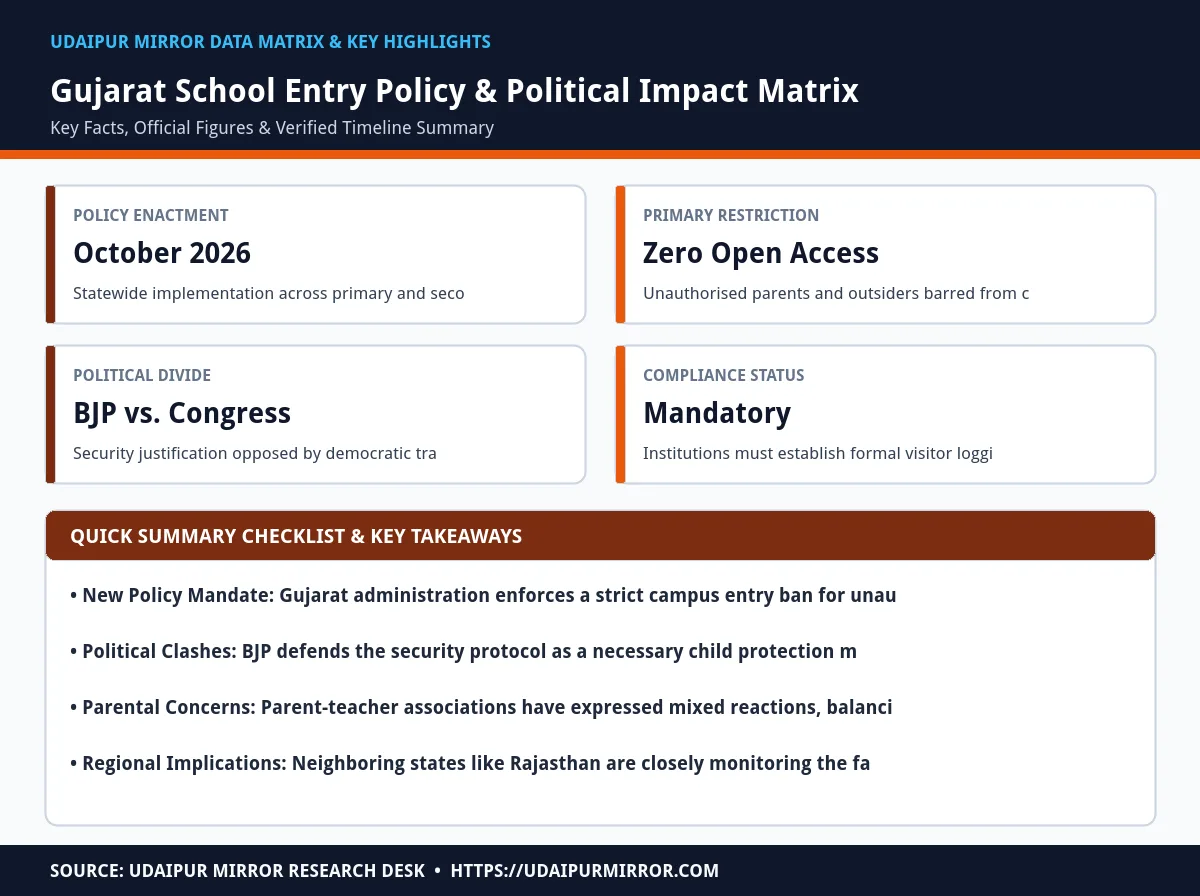
The following table outlines the key components of the new regulatory framework implemented in Gujarat, alongside the official positions taken by major political parties and educational stakeholders across the region.
| Regulatory Aspect | Official State Guideline | BJP Standpoint | Congress Standpoint | Impact on Stakeholders |
|---|---|---|---|---|
| Campus Access | Total ban on unannounced entry for parents and outsiders | Crucial for student safety and preventing disruptions | Creates an unnecessary wall between families and educators | Requires schools to build dedicated visitor holding areas |
| Visitor Verification | Mandatory prior appointments and digital entry logging | Ensures accountability and tracks all external movement | Burdens school administration with excessive bureaucracy | Extends check-in times for official meetings and inquiries |
| Parental Engagement | Limited to scheduled parent-teacher meetings (PTMs) | Protects instructional hours from frequent interruptions | Limits spontaneous feedback and parental oversight | Shifts communication channels to digital platforms |
| Security Enforcement | Strict penalties for institutions failing to comply | Upholds high standards of institutional discipline | Targets schools unfairly without providing state funding | Forces management to upgrade CCTV and guard deployment |
The political fallout was swift, with the ruling BJP defending the policy as a progressive step toward modernization and child safety. Party spokespersons emphasized that modern educational institutions require stringent perimeter and internal security to safeguard children from unauthorized elements. They noted that structured visitor protocols are standard practice in high-performing educational systems worldwide.
Conversely, the Congress party launched a scathing attack on the state government, terming the directive authoritarian and anti-democratic. Congress leaders argued that shutting school gates to parents alienates families from the educational process. They claimed the rule prevents guardians from verifying infrastructure standards and midday meal quality firsthand, drawing parallels to how environmental laws and industrial compliance require balanced oversight rather than blanket restrictions.
“Barring parents from schools under the guise of security is a cowardly attempt to hide administrative failures and stifle accountability.” — Congress State Spokesperson
For school managements, the new mandate requires an immediate upgrade in security infrastructure, including the establishment of visitor lounges, deployment of trained security personnel, and digitization of visitor logs. While administrative heads have welcomed the clarity, teachers have expressed concern over managing increased communication bottlenecks with parents who previously dropped off lunch boxes or books mid-day.
Parent-teacher associations are currently lobbying for flexible visitor hours and digitized communication apps to bridge the gap created by physical restrictions. Navigating these operational shifts requires careful institutional planning, similar to how local bodies handle civic adjustments during periods like panchayat electoral transitions where systematic coordination is paramount.
“We support enhanced security, but schools must be given adequate resources and digital tools to maintain seamless parent communication.” — School Principal Association Representative
The policy bars unauthorized parents, guardians, and outside visitors from entering school academic blocks and classrooms during school hours without prior formal appointments or registration.
The state administration introduced the rule to enhance campus security, protect students from unauthorized intrusions, and ensure uninterrupted learning time during instructional hours.
The ruling BJP has defended the policy as a vital child safety measure, while the opposition Congress party has criticized it as an authoritarian restriction that distances parents from educational institutions.
Parents can interact with teachers through scheduled parent-teacher meetings (PTMs), prior appointments cleared by the administration, or designated digital communication platforms.
Add Udaipur Mirror as a preferred source on Google to see more of our travel guides in your AI overviews.