Office Address
14, Residency Road, Udaipur, Rajasthan 313001
Office Address
14, Residency Road, Udaipur, Rajasthan 313001

NEW DELHI: NEW DELHI — In a significant development concerning institutional governance at the highest tier of Indian democracy, a recent Right to Information (RTI) disclosure has revealed that the Union Cabinet Secretariat declined to take direct administrative action after election commissioners complain against senior eci officer, choosing instead to forward the grievances to Chief Election Commissioner Gyanesh Kumar. The controversy, which has spotlighted internal friction within the Election Commission of India (ECI), centers on formal complaints lodged by two Election Commissioners regarding the conduct and administrative decisions of a senior poll panel official.
⚡ Quick Highlights: Cabinet Secretariat Declines Action on ECs Complaints Against ECI Officer
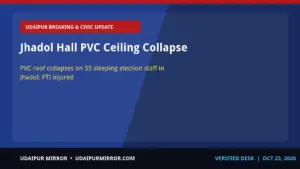
The rare and unprecedented administrative dispute surfaced when two Election Commissioners registered strong objections regarding the functional jurisdiction and professional conduct of a high-ranking officer within the Election Commission of India (ECI). Rather than resolving the issue through standard internal consultative meetings, the friction escalated into formal written complaints directed to central administrative authorities. As administrative challenges ripple across national institutions, other logistical concerns continue to make headlines, such as Udaipur Panchayat Election Duty Drama: PVC Ceiling Collapses on 35 Sleeping Staff in Jhadol Hall, PTI Officer Injured, highlighting the diverse operational pressures faced during electoral management.
Observers noted that internal discord among the top three constitutional authorities of the poll panel is exceptionally rare. The ECI functions as an independent constitutional body tasked with ensuring free and fair elections across the country, making any internal rift a matter of intense public and political interest. While political controversies occasionally mirror local administrative debates—similar to how BJP, Congress Spar as Gujarat Bars Unauthorised School Entry of Parents and Outsiders—the friction inside the ECI touches directly upon the institutional safeguards protecting India’s democratic framework.
“Any direct intervention by the executive branch into the internal administrative grievances of the Election Commission risks setting a dangerous precedent for institutional autonomy.” — Constitutional Law Expert
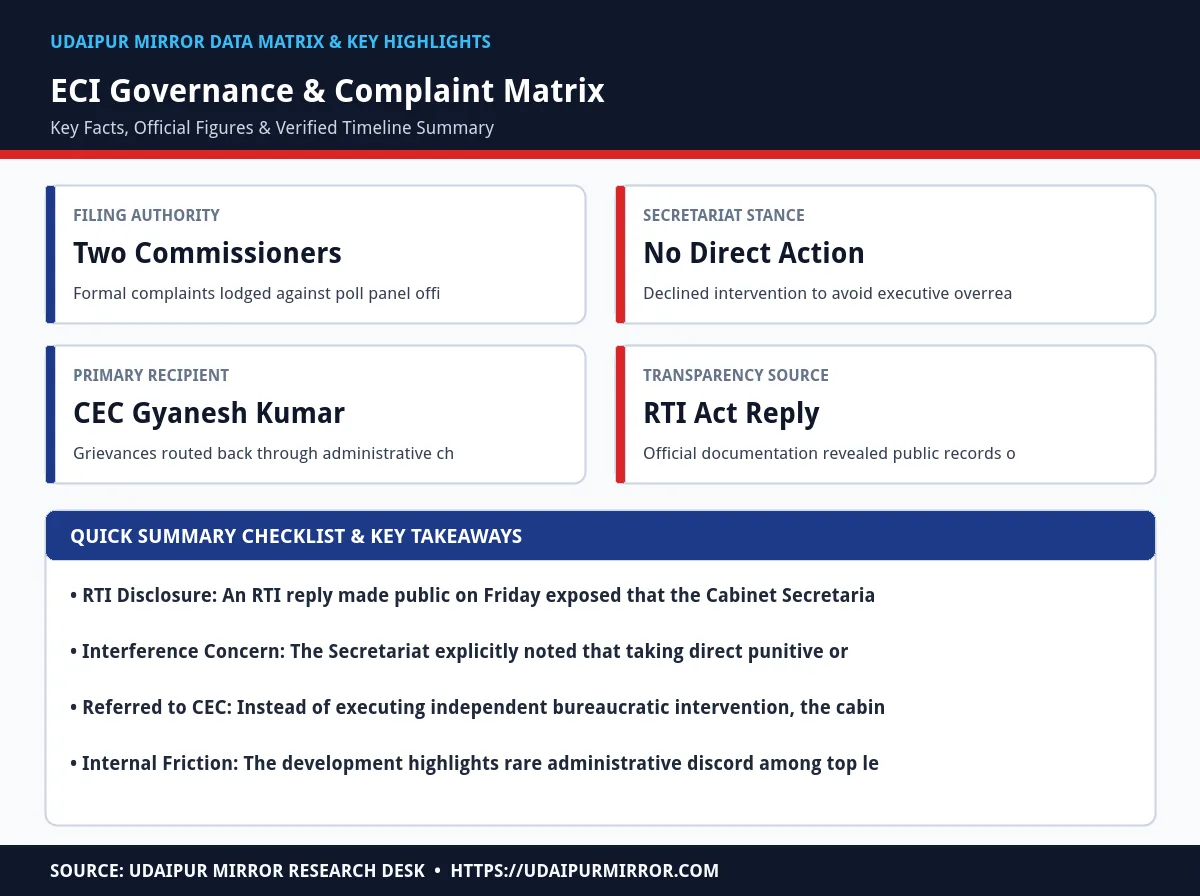
The following structured timeline outlines the key milestones, administrative decisions, and institutional responses surrounding the complaints filed by Election Commissioners against the senior poll panel officer.
| Date / Period | Stakeholder Involved | Action Undertaken | Administrative Outcome |
|---|---|---|---|
| Prior Weeks | Two Election Commissioners | Lodged formal grievances against senior ECI officer | Escalated to central government secretariats |
| October 23, 2026 | Cabinet Secretariat | Evaluated internal complaints under RTI framework | Concluded direct action constitutes interference |
| October 23, 2026 | Union Cabinet Body | Transferred complaint files directly to CEC | Referred jurisdiction back to internal ECI leadership |
| Ongoing | CEC Gyanesh Kumar | Reviewing procedural protocols and officer conduct | Awaiting formal institutional resolution |
| Present Day | Media & RTI Activists | Analyzing constitutional separation of powers | Heightened public scrutiny on poll body autonomy |
In response to RTI applications filed by transparency seekers, the Cabinet Secretariat clarified its legal and administrative rationale for declining to initiate punitive or remedial action against the accused official. The secretariat explicitly emphasized that taking direct disciplinary measures or stepping into the internal disciplinary matrix of the ECI could be interpreted as executive interference in an independent constitutional institution.
By refusing to take unilateral executive action, the government signaled a strict adherence to the doctrine of separation of powers. However, this hands-off approach also left the resolution of the internal dispute entirely within the domestic domain of the poll panel, placing the onus squarely on Chief Election Commissioner Gyanesh Kumar to address the concerns raised by his fellow commissioners.
“Taking administrative action on internal election commission complaints would be seen as interference in an autonomous body.” — Cabinet Secretariat RTI Reply
With the Cabinet Secretariat routing all complaint documentation back to the leadership of the ECI, Chief Election Commissioner Gyanesh Kumar faces the delicate task of mediating internal dissension. As the head of the three-member commission, the CEC holds the primary responsibility for maintaining administrative cohesion, morale, and operational efficiency within the poll panel.
Legal analysts point out that while the CEC possesses administrative oversight, resolving differences among senior commissioners requires a delicate balance of consensus-building and adherence to statutory norms. The handling of this grievance will serve as a critical benchmark for how future internal disputes within independent oversight bodies are managed without compromising public trust. (Also read: BJP, Congress Spar as Gujarat Bars Unauthorised School Entry of Parents and Outsiders).
“The Chief Election Commissioner must navigate this internal divergence with utmost transparency to preserve the sanctity of the electoral commission.” — Senior Parliamentary Analyst
The public disclosure of these complaints via the Right to Information Act underscores the growing demand for bureaucratic transparency in India. While internal governance disputes within autonomous bodies are traditionally kept behind closed doors, the RTI framework ensures that matters of institutional friction eventually come to light.
Civil society organizations and political watchdogs continue to monitor the situation, emphasizing that the integrity of election administration is paramount. As India prepares for various state electoral cycles and national governance tasks, the ability of the ECI to resolve internal friction swiftly and fairly remains essential to upholding democratic credibility.
“Transparency is the bedrock of constitutional democracy; public access to such RTI disclosures ensures accountability at every level.” — Transparency Rights Activist
The Cabinet Secretariat declined to act, noting that intervening in the internal affairs of the Election Commission could be construed as executive interference in an autonomous constitutional body.
The formal complaints were lodged by two Election Commissioners regarding the administrative conduct and decisions of a senior poll panel official.
In response to the grievances, the Cabinet Secretariat forwarded all relevant complaint documents directly to Chief Election Commissioner Gyanesh Kumar.
The details of the complaints and the government’s official stance were revealed publicly through a response filed under the Right to Information (RTI) Act.
Add Udaipur Mirror as a preferred source on Google to see more of our travel guides in your AI overviews.