Office Address
14, Residency Road, Udaipur, Rajasthan 313001
Office Address
14, Residency Road, Udaipur, Rajasthan 313001

NEW DELHI / UDAIPUR: Navigating the financial landscape of renewable energy adoption requires a clear understanding of the solar power plant cost in india as homeowners, commercial enterprises, and industrial operators scale up clean energy investments. With central and state governments aggressively driving rooftop solar (RTS) and utility-scale installations under frameworks like the PM Surya Ghar Muft Bijli Yojana, evaluating capital expenditure, land footprints, and payback periods has become essential for citizens and developers alike. Whether you are planning a residential rooftop setup in Rajasthan or evaluating major infrastructural investments, understanding the baseline pricing dynamics will safeguard your capital and optimize long-term energy savings. While planning long-term infrastructure investments across different regions, travelers and business owners often balance regional utility needs alongside broader transit planning, much like reviewing Udaipur to Mumbai Train & Flight Options for commercial mobility.
⚡ Quick Highlights: Solar Power Plant Cost in India 2026: Investment & ROI
Evaluating the solar power plant cost in india requires dissecting upfront capital expenditures into core components: photovoltaic modules, inverters, mounting structures, wiring, and labor. For residential rooftop systems, pricing typically hovers between ₹45,000 and ₹55,000 per kilowatt before accounting for central government subsidies. As system capacities scale into commercial and industrial (C&I) segments, economies of scale drive down the per-watt installation price significantly.
For utility-scale ground-mounted solar farms, capital requirements are measured in crores per megawatt, heavily influenced by land acquisition expenses, high-voltage transmission interconnects, and module technology choices such as mono-PERC or bifacial panels. Furthermore, financing costs and interest rates play a critical role in shaping the final levelized cost of electricity (LCOE) for developers and institutional investors. (Also read: Udaipur to Mumbai Train & Flight Options: Schedule, Timetable, Airfares & Rail Route Guide | उदयपुर से मुंबई ट्रेन व फ्लाइट्स).
“Strategic deployment of solar infrastructure not only slashes corporate and domestic utility overheads but also fortifies India's energy security framework.” — Renewable Energy Analyst, CEEW
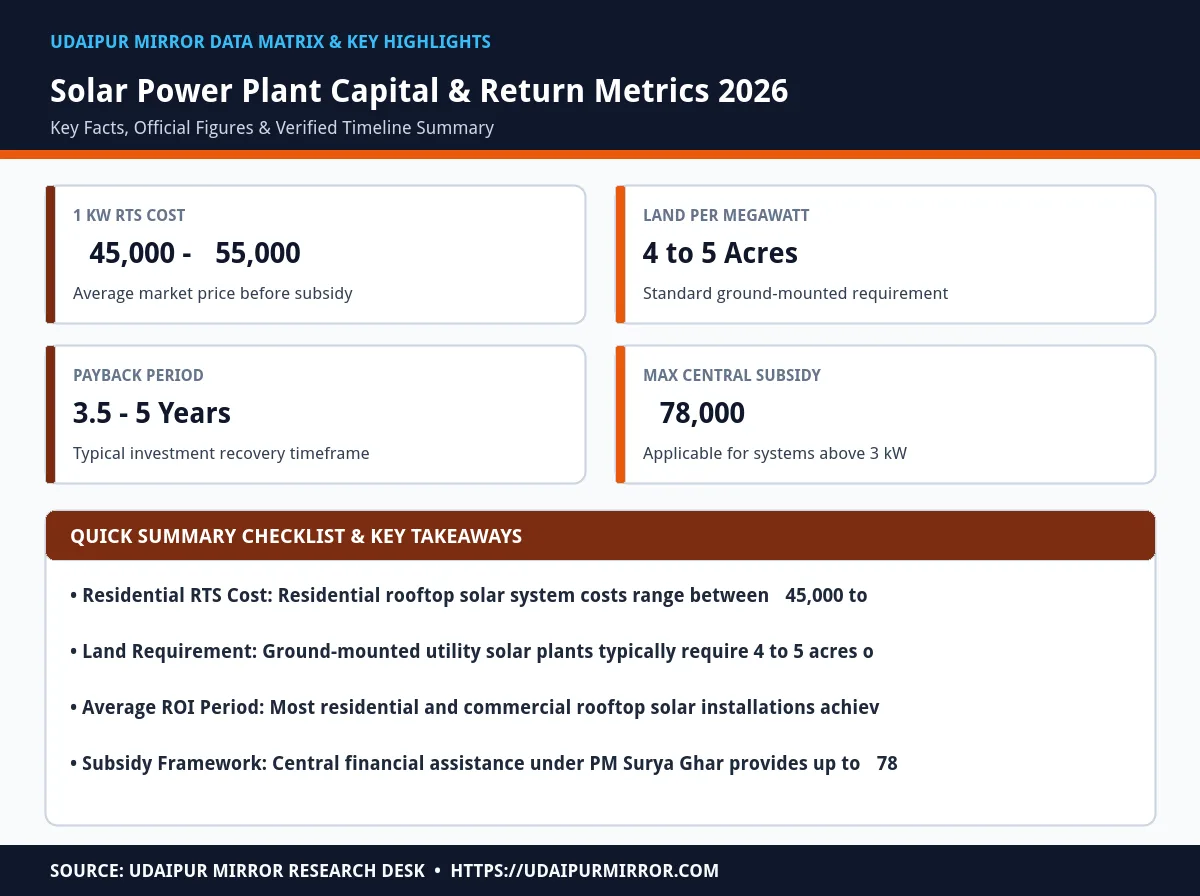
The following reference table outlines the estimated capital investment, roof or land footprint, and applicable central subsidy brackets across various solar power plant capacities in India for 2026.
| Plant Capacity | Estimated CapEx (₹) | Land / Roof Area | Max Subsidy | Estimated ROI (Years) |
|---|---|---|---|---|
| 1 kW (Residential) | ₹50,000 – ₹60,000 | 100 sq. ft. | ₹30,000 | 4.0 Years |
| 2 kW (Residential) | ₹95,000 – ₹1,10,000 | 200 sq. ft. | ₹60,000 | 3.8 Years |
| 3 kW to 10 kW | ₹1,40,000 – ₹4,50,000 | 300 – 1,000 sq. ft. | ₹78,000 | 3.5 Years |
| 50 kW (Commercial) | ₹22,00,000 – ₹26,00,000 | 5,000 sq. ft. | Nil (Tax Benefits) | 3.2 Years |
| 1 MW (Utility Scale) | ₹4,00,000,000+ | 4 to 5 Acres | Nil (PPA Model) | 4.5 Years |
Spatial planning is a primary determinant when calculating project feasibility. For urban homeowners and housing societies, rooftop solar installations require approximately 100 square feet of shadow-free surface area per kilowatt of installed capacity. Ensuring structural load-bearing capacity and unobstructed sunlight exposure throughout the day is critical for maximizing generation efficiency.
In contrast, utility-scale ground-mounted solar power plants require extensive acreage, averaging between 4 to 5 acres per megawatt of capacity depending on panel tilt angles and tracking technology. Acquiring flat, barren, or low-yield agricultural land near transmission substations helps minimize grid-connection expenses. As regional infrastructure expands, residents planning visits or heritage tours across Mewar often explore options like Udaipur to Shimla Train & Travel Alternatives for distant connectivity while managing local property assets.
“Optimizing land footprints through bifacial trackers ensures maximum energy yield per acre in high-insolation regions like Rajasthan and Gujarat.” — Solar Project Developer, SolarQuarter
Government subsidies and net metering policies significantly shorten the payback period for solar investments in India. Under the PM Surya Ghar Muft Bijli Yojana, residential consumers receive direct financial assistance of up to ₹30,000 for 1 kW systems, ₹60,000 for 2 kW systems, and a maximum of ₹78,000 for systems exceeding 3 kW capacity. These central grants, combined with state-level additions in regions like Gujarat and Rajasthan, make RTS adoption exceptionally lucrative.
When factoring in eliminated monthly electricity bills and surplus power feed-in tariffs via net metering, residential and commercial rooftop systems typically achieve complete return on investment (ROI) within 3.5 to 5 years. Given that quality solar panels carry performance warranties of 25 years, the remaining two decades translate into virtually free, clean electricity. (Also read: Udaipur Sightseeing & Itineraries 2026: Complete Lake Guides, Entry Fees & Timings).
“Subsidies paired with net metering have transformed rooftop solar from an ecological choice into a financially superior investment asset.” — State Discom Financial Advisor
A standard 3 kW residential rooftop solar system typically costs between ₹1,40,000 and ₹1,60,000 before subsidies. After factoring in the maximum central government subsidy of ₹78,000 under the PM Surya Ghar scheme, the net out-of-pocket investment drops to around ₹62,000 to ₹82,000.
A 10 MW ground-mounted solar power plant generally requires between 40 to 50 acres of contiguous, flat, and shadow-free land, depending on the efficiency of the photovoltaic modules and whether single-axis trackers are deployed.
For most residential and commercial rooftop solar installations in India, the payback period ranges between 3.5 to 5 years, driven by high grid electricity tariffs and government subsidies.
Net metering allows your bidirectional smart electricity meter to record both electricity imported from the discom grid and surplus solar power exported back to the grid. Consumers receive credits on their utility bills for the excess energy fed into the grid.
Add Udaipur Mirror as a preferred source on Google to see more of our travel guides in your AI overviews.






[…] से गोवा फ्लाइट्स व ट्रेन 47 minutes ago ⚡ Articles Solar Power Plant Cost in India: Investment, Land Requirement & ROI 1 hour ago ⚡ Flights Udaipur to Mumbai Train & Flight Options: Schedule, Timetable, Airfares & Rail […]