Office Address
14, Residency Road, Udaipur, Rajasthan 313001
Office Address
14, Residency Road, Udaipur, Rajasthan 313001

UDAIPUR: UDAIPUR — In an alarming waste of public infrastructure and green mobility resources, udaipur electric buses running empty across major urban corridors have become a daily sight over the past two months. Despite offering luxurious, air-conditioned travel with a nominal base fare of just Rs 10, the city’s ambitious fleet of eco-friendly buses is failing to attract daily commuters. Commuters continue to crowd dilapidated diesel city buses and auto-rickshaws, completely bypassing the modern fleet due to pervasive confusion regarding ticket pricing, a total absence of promotional campaigns, and ill-conceived route planning executed without preliminary passenger traffic surveys.
⚡ Quick Highlights: Udaipur Electric Buses Running Empty: Routes & Fare Issues
The introduction of modern electric air-conditioned buses in Udaipur was heralded as a milestone toward achieving a carbon-neutral urban landscape, reducing vehicular congestion, and upgrading public mobility standards. However, institutional oversight and a staggering failure in public outreach have turned a progressive civic initiative into a cautionary tale of resource misallocation. Citizens across major residential and commercial sectors remain entirely uneducated about the route maps, ticketing structures, and economic viability of these green vehicles.
A major contributor to this public disconnect is the glaring omission of physical rate boards and fare lists on the exterior of the buses. Gleaming modern chassis and tinted windows have inadvertently backfired; lower-income and middle-class daily commuters automatically assume that luxury amenities translate to exorbitant ticket prices. Rather than stepping inside to inquire, residents continue to cram into older, exhaust-spewing diesel city buses or negotiate inflated fares with auto-rickshaw drivers. In the meantime, related administrative updates continue across other municipal sectors, mirroring broader systemic shifts akin to the recent policy adjustments noted in Udaipur Panchayat Elections administrative preparations.
Ground audits reveal that these battery-operated transport units operate at near-total capacity only during narrow, predictable windows—specifically between 9:00 AM and 11:00 AM, and again in the evening from 4:00 PM to 6:00 PM when office workers and students commute. Throughout the remaining hours of the day, particularly during the grueling afternoon heat, these massive vehicles cruise empty through Udaipur’s thoroughfares, burning battery charge and accumulating operational overhead without serving the tax-paying public. (Also read: IIT Admissions 2026: Only 37 Female Candidates Secured Seats Through Gender Neutral Merit Quota | आईआईटी में जेंडर न्यूट्रल कोटे से प्रवेश).
“Public transport is meant to ease congestion and provide reliable commuting options. Running air-conditioned fleets without basic route studies or visible fare charts defeats the very purpose of green urban planning.” — Local Transit Analyst & Civic Observer
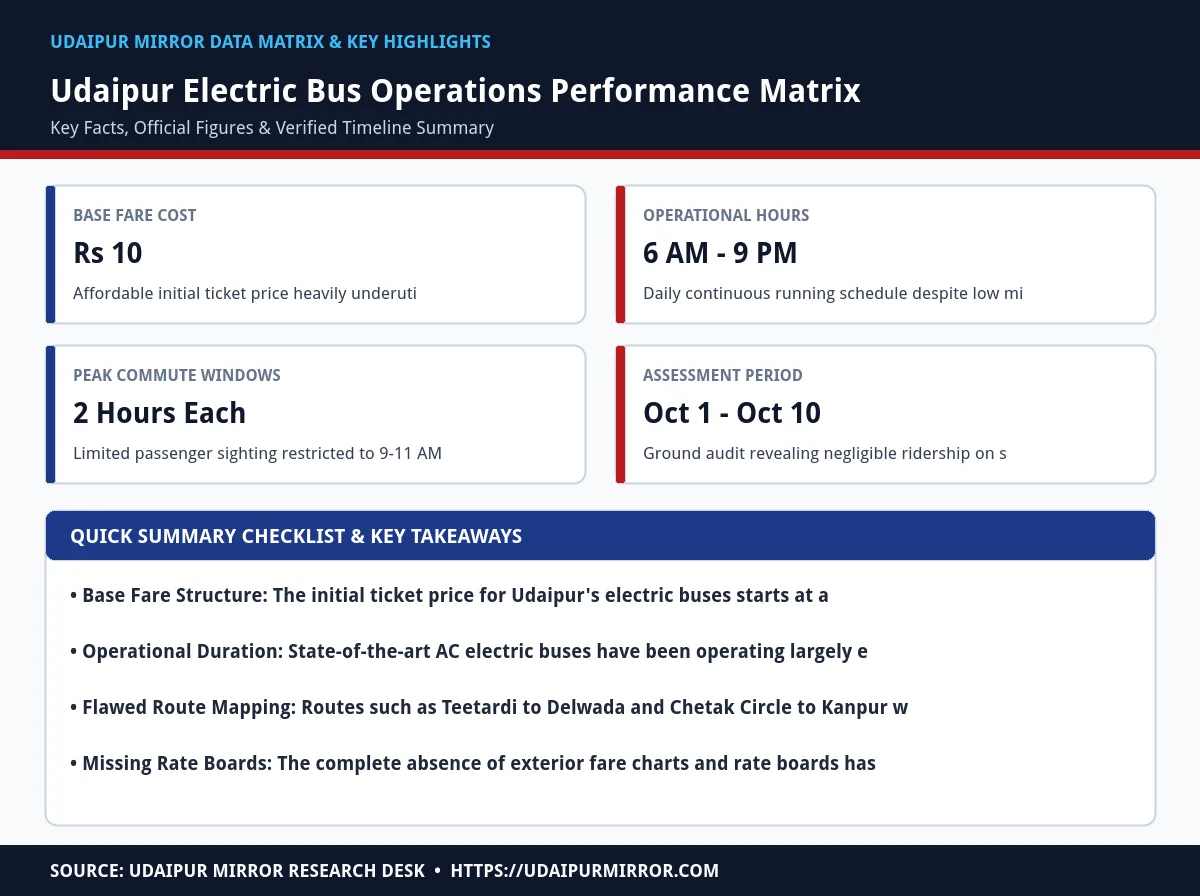
A detailed ground evaluation conducted between October 1 and October 10 highlights severe disparities in passenger footfall across various newly instituted electric bus corridors in Udaipur. The following data table outlines the designated routes, operational hurdles, and observed passenger occupancy status.
| Route Corridor | Distance & Connectivity | Observed Passenger Load | Primary Operational Obstacle |
|---|---|---|---|
| Teetardi to Delwada | Suburban Ring Link | Negligible / Zero | Route planned without baseline survey; lack of awareness |
| Chetak Circle to Kanpur | Central to Eastern Corridor | Extremely Low | Absence of exterior fare charts; fear of high AC ticket rates |
| Urban Commercial Hubs | Main City Interchanges | Moderate (Peak Hours Only) | Empty running during mid-day hours (11 AM to 4 PM) |
| General Transit Loops | Intra-city Residential Zones | Below Expectations | Preference for legacy diesel buses and auto-rickshaws |
Behind the empty seats lies a fundamental administrative lapse: routes were established without conducting rigorous preliminary passenger traffic surveys. Corridors such as the Teetardi-to-Delwada and Chetak-to-Kanpur stretches were authorized on paper without evaluating actual daily commuter volume or peak-hour directional demand. Consequently, buses assigned to these links ply virtually empty, ignoring high-density arterial roads where public transport demand is genuinely acute.
Municipal authorities and executing transport agencies failed to roll out any structured public awareness campaign prior to launching the fleet. In an era where digital campaigns, pamphlets, and bus-stop informational kiosks are standard procedure, Udaipur’s electric bus initiative relied entirely on passive deployment. This administrative passivity stands in sharp contrast to rigorous regulatory screenings seen elsewhere, such as the documentary checks enforced during Udaipur CID visa verification operations.
Urban planning experts argue that unless civic bodies take immediate corrective action—such as painting bold, readable fare lists on bus exteriors, relocating underperforming suburban buses to high-traffic inner-city arteries, and initiating aggressive media outreach—this vital green mobility experiment risks long-term financial unsustainability.
“If the administration does not step in to fix the route rationalization and display clear fare boards outside every bus, public funds invested in clean energy transit will simply go down the drain.” — Senior Udaipur Municipal Corporation Watchdog
उदयपुर शहर में प्रदूषण मुक्त और आरामदायक सार्वजनिक परिवहन को बढ़ावा देने के उद्देश्य से शुरू की गई आधुनिक इलेक्ट्रिक एसी बसें वर्तमान में गंभीर प्रशासनिक लापरवाही और प्रचार की कमी के चलते खाली दौड़ने को मजबूर हैं। पिछले दो महीनों से शहर की सड़कों पर संचालित हो रही इन चमचमाती बसों में शुरुआती किराया मात्र 10 रुपए होने के बावजूद आम जनता और निम्न आय वर्ग के यात्री सफर करने से कतरा रहे हैं।
इस स्थिति का सबसे बड़ा कारण बसों के बाहर स्पष्ट किराया सूची (रेट लिस्ट) का न होना है। अत्याधुनिक एसी बसों के लुक को देखकर आम नागरिकों में यह भ्रम फैला हुआ है कि इनका किराया बहुत अधिक होगा। इस अनावश्यक डर के कारण यात्री इन बसों में चढ़ने के बजाय पुरानी, खस्ताहाल सिटी बसों या महंगे ऑटो-रिक्शा में सफर करने को मजबूर हैं। इसके अलावा, सुबह 9 से 11 बजे और शाम 4 से 6 बजे के पीक आवर्स को छोड़कर दोपहर के समय इन बसों में सवारी नगण्य रहती है।
प्रशासन की बड़ी खामी यह रही कि तीतरड़ी से देलवाड़ा और चेतक से कानपुर जैसे रूटों पर बिना किसी जमीनी सर्वे और पैसेंजर लोड के आकलन के बसें चला दी गईं। 1 से 10 अक्टूबर के बीच की गई जमीनी पड़ताल में इन रूट्स पर बसों के भीतर यात्रियों की संख्या नाममात्र पाई गई। जनता को सहूलियत देने और शहर को प्रदूषण मुक्त बनाने का जो सपना देखा गया था, वह प्रचार के अभाव और गलत रूट निर्धारण के कारण पूरी तरह से भटक चुका है। (Also read: Udaipur Panchayat Elections: 1,480 Candidates Remain in Fray Across 283 Wards After Withdrawals | उदयपुर पंचायत चुनाव में 1480 प्रत्याशी मैदान में).
“ई-बसों का संचालन शहर के पर्यावरण के लिए बेहद जरूरी है, लेकिन जब तक जनता के मन से किराए का भ्रम दूर नहीं किया जाएगा और रूटों का सही सर्वे नहीं होगा, तब तक संसाधनों की बर्बादी रुक नहीं सकती।” — स्थानीय परिवहन विशेषज्ञ एवं नागरिक
बढ़ती आलोचना और खाली दौड़ती बसों के आंकड़ों को संज्ञान में लेते हुए अब उदयपुर जिला प्रशासन और संबंधित परिवहन अधिकारियों पर दबाव बढ़ गया है कि वे तुरंत सुधारात्मक कदम उठाएं। नागरिकों और यात्री संघों की ओर से मांग की जा रही है कि सभी ई-बसों के प्रवेश द्वार और बाहरी हिस्सों पर बड़े अक्षरों में किराए की सूची चस्पा की जाए, जिससे भ्रम की स्थिति पूरी तरह समाप्त हो सके।
इसके साथ ही, नगर विकास प्राधिकारियों को उन रूटों की तत्काल समीक्षा करनी होगी जहां यात्री भार शून्य के बराबर है। इन बसों को व्यस्त व्यावसायिक मार्गों और प्रमुख चौराहों जैसे सूरजपोल, अस्थाई बस स्टैंड और रेलवे स्टेशन लिंक पर डायवर्ट करने से न केवल यात्रियों को राहत मिलेगी, बल्कि सड़कों पर निजी वाहनों का दबाव भी कम होगा।
विशेषज्ञों का मानना है कि जब तक प्रशासन जमीनी स्तर पर जागरूकता अभियान नहीं चलाएगा और पब्लिक ट्रांसपोर्ट को जनता की जेब के अनुकूल नहीं बनाएगा, तब तक करोड़ों रुपए की इस महत्वाकांक्षी परियोजना का वास्तविक लाभ आम नागरिकों तक नहीं पहुंच पाएगा।
“प्रशासन को तुरंत प्रभाव से सभी ई-बसों पर रेट लिस्ट लगानी चाहिए और रूटों को री-प्लान करना चाहिए ताकि शहर के आम आदमी को इस बेहतरीन सुविधा का पूरा लाभ मिल सके।” — जिला नागरिक कल्याण समिति प्रतिनिधि
The starting base fare for Udaipur’s newly launched electric AC buses is Rs 10, designed to be affordable for daily commuters.
The buses are running empty due to a lack of passenger awareness, missing exterior rate charts that cause fear of high fares, and poorly planned routes designated without preliminary traffic surveys.
बसों के बाहर किराए की सूची (रेट लिस्ट) न होने के कारण लोगों में महंगा किराया होने का भ्रम है, और रूटों का बिना सर्वे के निर्धारण किया गया है।
तीतरड़ी से देलवाड़ा और चेतक सर्कल से कानपुर जैसे रूटों पर अक्टूबर के शुरुआती दिनों में यात्री भार लगभग नगण्य पाया गया है।
Add Udaipur Mirror as a preferred source on Google to see more of our travel guides in your AI overviews.


[…] INDW vs ENGW Warm-up Match 2026: India Women Face England in T20 World Cup Clash 3 seconds ago ⚡ News Udaipur Electric Buses Running Empty: Luxury Features But Zero Passenger Awareness, Routes Pla… News IIT Admissions 2026: Only 37 Female Candidates Secured Seats Through Gender Neutral Merit […]