Office Address
14, Residency Road, Udaipur, Rajasthan 313001
Office Address
14, Residency Road, Udaipur, Rajasthan 313001

UDAIPUR: UDAIPUR — In response to deficient precipitation across the Mewar region, the district administration has initiated urgent administrative measures. The Udaipur Agriculture Department has released a comprehensive udaipur rabi wheat sowing mitigation plan aimed at combating potential crop failures and severe water shortages as the winter sowing season commences this October 2026.
⚡ Quick Highlights: Udaipur Rabi Sowing Plan: 50% Wheat Drop Expected Due to Low Rain
The Udaipur district administration, operating under directives from the state directorate, has flagged critical concerns regarding groundwater levels following erratic monsoon spells. The traditional wheat sowing footprint across the district spans approximately 90,000 hectares. However, preliminary surveys conducted by agricultural extension officers indicate that insufficient water storage in local reservoirs and receding water tables will likely slash wheat cultivation by half.
To mitigate financial distress among rural farming communities, the district agricultural office has formulated a robust contingency framework. This strategy encourages growers to diversify away from water-intensive cereals toward resilient oilseeds and pulses. Furthermore, as the district administration ramps up administrative oversight—comparable to recent strict administrative audits seen in Udaipur Education Directorate compliance probes—field officers are being deployed to ensure timely advisory distribution across all tehsils.
“Deficit rainfall has altered our traditional sowing dynamics this year. Our immediate priority is to safeguard farmers from economic loss by encouraging low-water crops while ensuring absolute food and fodder security.” — District Agricultural Officer, Udaipur
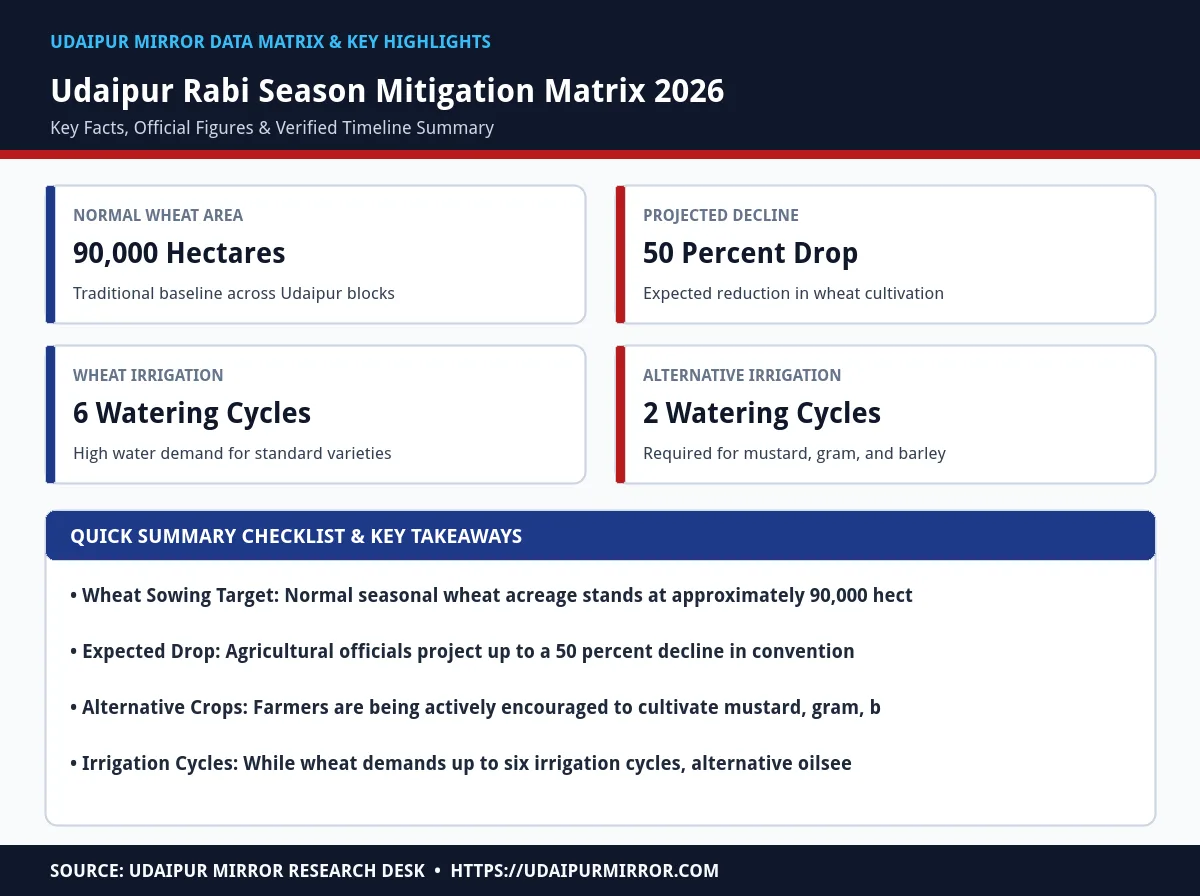
To counter the impending water scarcity during the Rabi 2026 season, the Udaipur Agriculture Department has detailed a comparative schedule for alternative crops, detailing irrigation needs and maturation timelines to guide local farmers effectively.
| Crop Type | Normal Acreage Share | Irrigation Cycles | Maturation Period | Recommended Action |
|---|---|---|---|---|
| Wheat (Conventional) | 90,000 Hectares | 6 Cycles | 120 Days | Restrict to high-moisture zones |
| Wheat (Short-Duration) | Moderate | 2-3 Cycles | 90-110 Days | Encouraged for assured water pockets |
| Mustard (Sarson) | Expanding | 2 Cycles | 110-120 Days | Primary substitute recommended |
| Gram (Chana) | Expanding | 1-2 Cycles | 130-140 Days | High preference in dry blocks |
| Barley (Jau) | Stable | 2-3 Cycles | 110-120 Days | Viable alternative for cereal needs |
| Fodder (Oats/Sorghum) | Emergency Plan | 2-3 Cycles | 60-90 Days | Mandatory for livestock protection |
In light of dwindling irrigation resources, agricultural scientists are advising farmers to substitute wheat with crops that require minimal watering. While standard wheat cultivation demands approximately six extensive irrigation cycles from germination to harvest, alternative options such as mustard (sarson), gram (chana), taramira, and barley (jau) can thrive successfully with just one or two watering rounds.
For farmers who remain dedicated to cultivating wheat due to household consumption needs, the department recommends adopting short-duration high-yield varieties. Normal wheat strains take up to 120 days to mature, whereas specialized drought-tolerant variants can be harvested within 90 to 110 days using restricted irrigation schedules. Similar proactive healthcare and diagnostic campaigns, such as recent Udaipur ANM training initiatives for safe motherhood, highlight the district’s readiness to address grassroots challenges effectively.
“Crops like mustard and chickpea not only consume a fraction of the water that wheat requires, but they also offer robust market returns under current agro-climatic conditions.” — Senior Agronomist, Krishi Vigyan Kendra, Udaipur
The agricultural deficit extends far beyond food grain production; diminished rainfall directly threatens the availability of green fodder, which could destabilize local dairy farming and animal husbandry across Mewar. To counter this threat, the mitigation draft plan places extraordinary emphasis on cultivating specialized forage crops alongside staple agricultural outputs.
The department is actively promoting the cultivation of nutritious fodder varieties such as oats (jau), sorghum (jowar), and napier grass. These quick-growing crops maximize biomass yield with minimal moisture input, ensuring that cattle feed remains accessible and affordable for rural dairy farmers throughout the harsh winter months. (Also read: Udaipur Nepcon 2026: AI Screening for TB and Lung Diseases Highlights Dual Medical Health Conferences | नेपकॉन-2026).
“Livestock is the backbone of rural Mewar's economy. Our mitigation draft explicitly integrates fodder production to ensure dairy farmers do not face feed shortages.” — Joint Director, Animal Husbandry & Agriculture, Udaipur
उदयपुर जिले में इस बार मानसून के दौरान कम बारिश होने के कारण रबी सीजन की खेती पर गहरा संकट मंडरा रहा है। कृषि विभाग द्वारा तैयार किए गए नए मिटिगेशन ड्राफ्ट प्लान के अनुसार, जिले में इस बार गेहूं की बुवाई में लगभग 50 प्रतिशत तक की भारी गिरावट आने की आशंका जताई जा रही है। उदयपुर जिले में सामान्य तौर पर गेहूं की बुवाई का कुल क्षेत्रफल लगभग 90 हजार हेक्टेयर है, लेकिन इस बार भूजल स्तर में आई भारी गिरावट और जलाशयों में कम पानी के चलते किसानों को अपनी पारंपरिक फसल चक्र में बदलाव करने के लिए मजबूर होना पड़ रहा है।
कम बारिश का यह असर केवल खाद्यान्न फसलों तक सीमित नहीं है, बल्कि इससे पशुओं के लिए चारे की उपलब्धता भी गंभीर रूप से प्रभावित हो सकती है। इसे ध्यान में रखते हुए कृषि विभाग ने किसानों को जई, ज्वार और नेपियर घास जैसी चारा फसलों की खेती पर विशेष जोर देने की सलाह दी है। विभाग का मुख्य उद्देश्य यह सुनिश्चित करना है कि कम पानी में भी खेती के बेहतर विकल्प अपनाकर किसानों को संभावित आर्थिक नुकसान से बचाया जा सके और पशुधन के लिए चारे की कोई कमी न हो।
गेहूं की खेती के विकल्प के तौर पर कृषि विभाग किसानों को सरसों, चना, तारामीरा और जौ जैसी फसलें उगाने के लिए प्रेरित कर रहा है। जहां सामान्य गेहूं की फसल को पकने के लिए लगभग छह बार सिंचाई की आवश्यकता होती है, वहीं इन वैकल्पिक फसलों को केवल दो सिंचाई चक्रों में ही तैयार किया जा सकता है। इसके अलावा, जो किसान अनिवार्य रूप से गेहूं की खेती करना चाहते हैं, उन्हें 90 से 110 दिन में पकने वाली कम अवधि की उन्नत किस्में बोने की सलाह दी जा रही है। फव्वारा (sprinkler) और ड्रिप सिंचाई पद्धतियों अपनाने पर भी विशेष अनुदान दिया जा रहा है।
“कम बारिश के कारण इस बार रबी सीजन में जल प्रबंधन हमारी सबसे बड़ी प्राथमिकता है। किसानों को कम पानी वाली फसलों और आधुनिक सिंचाई तकनीकों अपनाने के लिए प्रेरित किया जा रहा है ताकि उनकी आजीविका सुरक्षित रहे।” — उप निदेशक, कृषि विभाग, उदयपुर
Due to deficient rainfall and depleted groundwater levels, the Udaipur Agriculture Department’s mitigation plan projects up to a 50 percent drop in conventional wheat sowing from the normal 90,000-hectare baseline.
The department is strongly encouraging farmers to cultivate mustard (sarson), gram (chana), barley (jau), and taramira, as these crops require only two irrigation cycles compared to wheat’s six.
इस ड्राफ्ट प्लान का मुख्य उद्देश्य कम बारिश और जल संकट के बीच किसानों को संभावित नुकसान से बचाना, गेहूं के विकल्प के रूप में कम पानी वाली फसलें प्रमोट करना और पशुओं के लिए चारे की उपलब्धता सुनिश्चित करना है।
किसानों को 90 से 110 दिन में पकने वाली कम अवधि की गेहूं की किस्में, सरसों, चना तथा फव्वारा (sprinkler) और ड्रिप सिंचाई जैसी जल-बचत तकनीकों को अपनाने की सलाह दी जा रही है।
Add Udaipur Mirror as a preferred source on Google to see more of our travel guides in your AI overviews.






[…] Mumbai International Airport adds Udaipur and 8 other new domestic destinations 28 minutes ago ⚡ News Udaipur Agriculture Department Mitigation Draft Plan: 50 Percent Drop in Rabi Wheat Sowing Exp… Business Jio IPO GMP Hints at 22% Listing Gains; Check Allotment and Listing Dates 57 minutes ago […]
[…] Mumbai International Airport adds Udaipur and 8 other new domestic destinations 60 minutes ago ⚡ News Udaipur Agriculture Department Mitigation Draft Plan: 50 Percent Drop in Rabi Wheat Sowing Exp… Business Jio IPO GMP Hints at 22% Listing Gains; Check Allotment and Listing Dates 1 hour ago ⚡ […]