Office Address
14, Residency Road, Udaipur, Rajasthan 313001
Office Address
14, Residency Road, Udaipur, Rajasthan 313001


MUMBAI / NEW YORK: Global financial markets are bracing for a high-intensity trading cycle as investors worldwide navigate a convergence of major macro catalysts. At the center of this week’s financial radar are upcoming corporate earnings reports, critical monetary policy signals, and volatile energy benchmarks. For domestic and international portfolios alike, the interplay between the fed policy verdict and crude oil fluctuations will serve as the primary determinant of risk sentiment, dictating valuation multiples across Wall Street, Asian indices, and emerging markets like India.
⚡ Quick Highlights: Week Ahead: Fed Policy, Earnings & Crude Oil Shape Markets
As October progresses into its final week, Wall Street enters a crucial phase of the corporate earnings season. Major technology titans, financial institutions, and industrial giants are scheduled to release their quarterly scorecards, providing critical visibility into corporate profit margins, consumer spending resilience, and capital expenditure plans. Global equity investors are closely analyzing these reports to justify elevated valuation multiples, particularly in high-growth sectors.
The performance of US bellwethers often cascades directly into Asian markets and domestic bourses. Analysts suggest that any earnings miss or cautious forward guidance from multinational corporations could trigger swift profit-booking. Furthermore, institutional investors are evaluating how technological investments, including enterprise automation, translate into bottom-line growth, keeping market sentiment finely balanced between optimism and macroeconomic caution. As financial ecosystems modernize, digital resilience remains paramount, aligning with institutional frameworks similar to the RBI to Launch Advanced Data Centre and Cybersecurity Training Institute in Bhubaneswar initiative designed to fortify systemic defenses.
Simultaneously, retail investor participation remains robust, reflected in strong primary market interest. For instance, market observers tracking primary liquidity note parallel developments such as Jio IPO GMP Hints at 22% Listing Gains; Check Allotment and Listing Dates, which highlight the continued depth and appetite within domestic capital markets despite global headwinds.
“Corporate earnings quality this quarter will dictate whether equity markets can sustain their current valuations amidst tightening financial conditions.” — Senior Global Equity Strategist
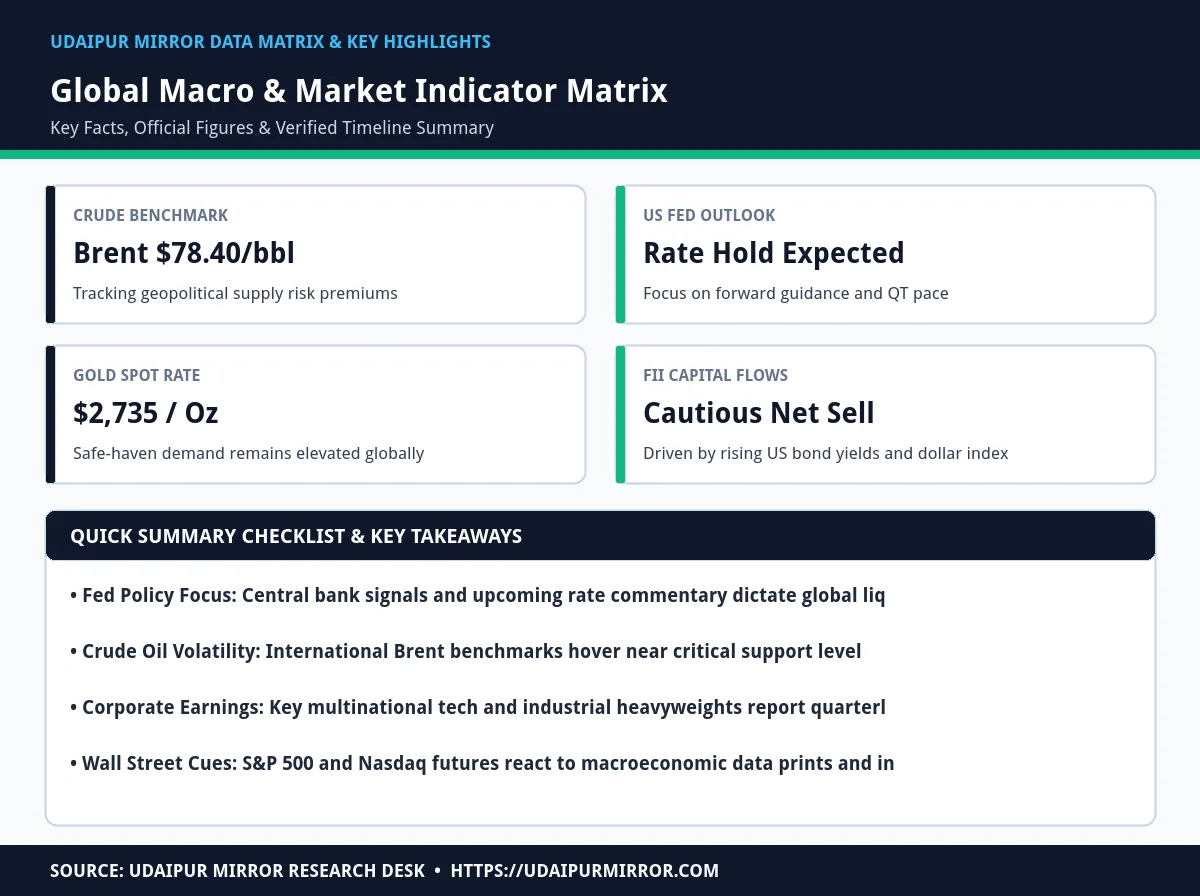
A detailed breakdown of key international asset classes, commodity benchmarks, and central bank expectations impacting cross-border investment flows for the trading week starting October 25, 2026.
| Asset Class / Indicator | Current Level / Range | Weekly Trend | Market Impact on India |
|---|---|---|---|
| Brent Crude Oil | $77.50 – $80.20 / bbl | Volatile / Firming | Higher import bill, pressure on fiscal deficit & INR |
| US 10-Year Treasury Yield | 4.24% – 4.38% | Upward Bias | Triggers FII outflows from emerging market equities |
| Spot Gold | $2,720 – $2,750 / Oz | Bullish Consolidation | Domestic jewellery demand & safe-haven hedging |
| US Dollar Index (DXY) | 103.80 – 104.50 | Range-bound | Weighs on Asian currencies including the Indian Rupee |
| S&P 500 Futures | 5,810 – 5,890 points | Cautious | Sets risk-on or risk-off tone for opening bell in Asia |
Central bank policy expectations remain a dominant narrative for global bond and currency traders. With inflation prints showing varying degrees of stickiness across developed economies, market participants are parsing every public statement from Federal Reserve officials. The upcoming monetary policy verdict and subsequent press conference are expected to provide definitive clues regarding the central bank’s rate trajectory and the pace of quantitative tightening.
While markets have largely priced in a cautious approach to monetary easing, any unexpected hawkish tilt could spike US Treasury yields and strengthen the US Dollar Index. For emerging economies, a stronger dollar complicates domestic monetary management, putting pressure on local currencies and forcing central banks to balance growth objectives with currency stability.
“The Fed's forward guidance is more critical than the rate action itself; markets want clarity on how long restrictive policy will remain in place.” — Chief Economist, Global Macro Research
Energy markets continue to experience heightened volatility driven by persistent geopolitical friction in key producing regions and fluctuating demand projections from major economies like China and the United States. International Brent crude futures have oscillated around critical technical bands as traders weigh supply security risks against moderating industrial demand.
Developments in maritime trade routes and energy infrastructure security remain acute concerns for global supply chains. Any escalation in geopolitical tensions across key transit choke points can instantly inject a risk premium into oil prices, compounding inflationary pressures globally. For oil-importing nations like India, sustained higher crude prices translate directly into a widened trade deficit and potential headwinds for domestic manufacturing margins. (Also read: Jio IPO GMP Hints at 22% Listing Gains; Check Allotment and Listing Dates).
“Energy markets remain hypersensitive to geopolitical headlines, making crude oil the primary wild card for global inflation forecasts.” — Head of Commodities Research
Global macroeconomic shifts do not occur in a vacuum; their domestic transmission to Indian financial markets is direct and swift. Foreign Institutional Investor (FII) flows remain closely correlated with US bond yield movements and dollar strength. When global yields rise, capital tends to rotate out of emerging market equities, creating intermittent consolidation phases in the Nifty 50 and Sensex.
Moreover, domestic investors must factor in imported inflation risks stemming from crude oil fluctuations and currency depreciation. Financial advisors recommend maintaining a well-diversified portfolio with an emphasis on companies possessing strong pricing power, low debt-to-equity ratios, and robust domestic consumption drivers capable of weathering external volatility.
“Indian equities retain strong structural growth drivers, but short-term tactical asset allocation must account for global macro crosscurrents.” — Chief Investment Officer, Domestic Wealth Fund
This week’s corporate earnings reports and central bank policy guidance provide essential data on corporate profitability, interest rate trajectories, and global liquidity, directly shaping investor risk appetite and equity valuations.
As India imports a significant portion of its crude oil requirements, rising international oil prices widen the current account deficit, increase inflationary pressures, and impact the valuation of the Indian Rupee against the US Dollar.
Rising US Treasury yields typically strengthen the US Dollar and prompt Foreign Institutional Investors (FIIs) to reallocate capital away from emerging markets like India toward safer US fixed-income assets, causing short-term equity consolidation.
Investors are advised to focus on high-quality companies with strong balance sheets, maintain disciplined asset allocation through Systematic Investment Plans (SIPs), and avoid reactionary trading driven by short-term macroeconomic headlines.
Add Udaipur Mirror as a preferred source on Google to see more of our travel guides in your AI overviews.






[…] | निगम की 6 साल पुरानी लापरवाही 47 minutes ago ⚡ Business The Week Ahead: Corporate Earnings Season, Fed Policy Verdict And Crude Oil Dynamics Drive… News Udaipur Financial Summit 2026 Focuses on Vision 2047, REITs, and Investment Strategies | […]