Office Address
14, Residency Road, Udaipur, Rajasthan 313001
Office Address
14, Residency Road, Udaipur, Rajasthan 313001

MUMBAI / UDAIRPUR —: MUMBAI / UDAIPUR — In a significant development for India’s macroeconomic landscape on Monday, October 26, 2026, financial markets reacted to institutional warnings that fcnr b deposit repayment dues could potentially escalate to a staggering $170 billion. According to reports highlighted by Kotak, these monumental foreign currency obligations require close monitoring by treasury managers, retail investors tracking banking stability, and policy makers alike. While structural economic measures such as the Rajasthan SSO Portal Jan Aadhaar & PM Surya Ghar Updates streamline domestic welfare, large-scale macroeconomic shocks originating from foreign debt maturities can ripple across domestic capital markets, bond yields, and currency valuations.
⚡ Quick Highlights: FCNR (B) Deposit Repayment Dues Could Hit $170bn: Kotak
Foreign Currency Non-Resident (Bank) accounts allow Non-Resident Indians (NRIs) and Persons of Indian Origin (PIOs) to maintain fixed deposits in foreign currencies such as the US Dollar, British Pound, Euro, Japanese Yen, or Australian Dollar. Because these accounts protect depositors from exchange rate fluctuations while offering attractive yields, they constitute a major component of India’s external liabilities.
When a large tranche of these deposits matures simultaneously or within a condensed window, commercial banks face the dual task of either rolling over the deposits at competitive global interest rates or repatriating the principal and accumulated interest in foreign exchange. As highlighted by Kotak analysts, a cumulative exposure scaling up to $170 billion requires proactive treasury planning by Indian financial institutions to avoid unexpected liquidity crunches. (Also read: Rajasthan SSO Portal Jan Aadhaar & PM Surya Ghar Updates: October 2026 Citizen Schemes Guide).
“Managing large-scale foreign currency deposit maturities without disrupting domestic credit growth is a core test for modern Indian banking treasuries.” — Senior Banking Analyst
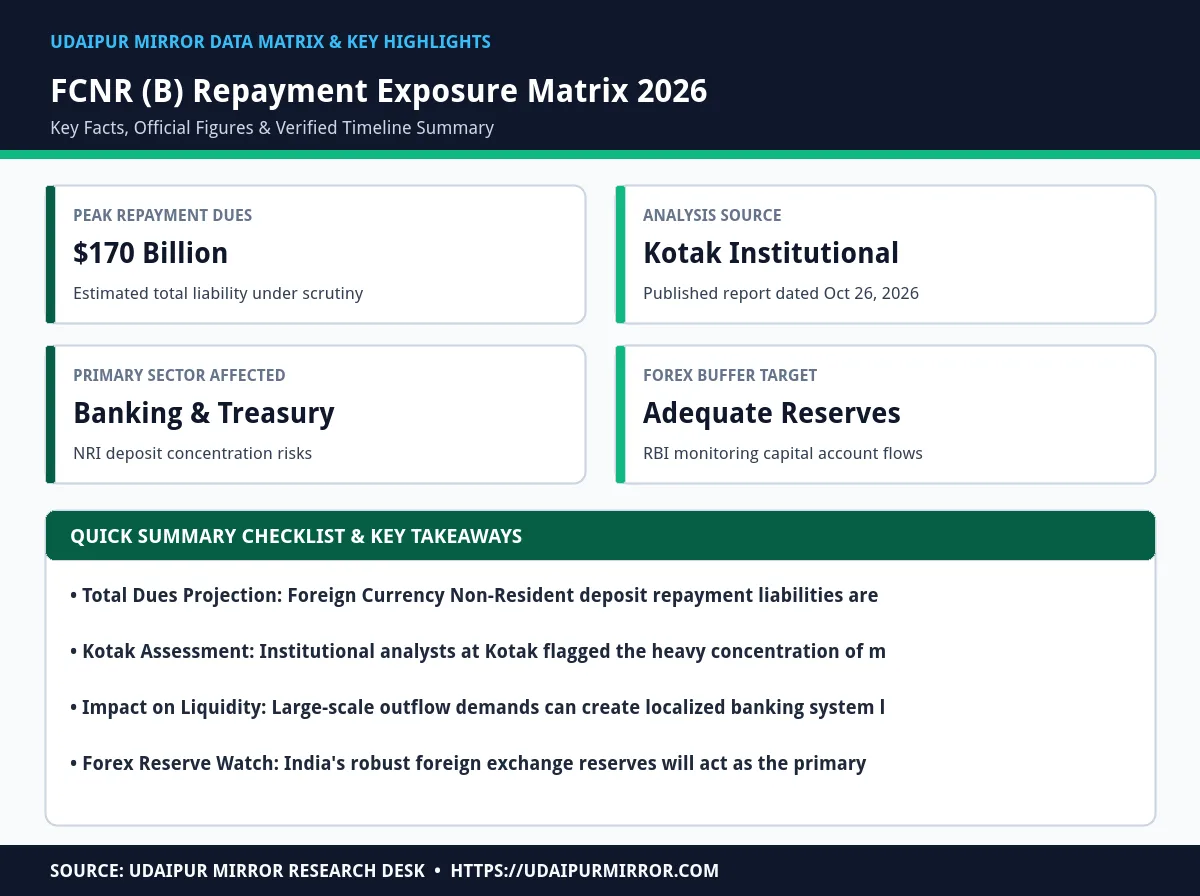
To understand the magnitude of the projected $170 billion FCNR (B) deposit repayment dues, it is essential to examine them against other critical external sector parameters and financial cushions maintained by the Indian economy.
| External Parameter | Approximate Scale | Primary Economic Role | Market Sensitivity |
|---|---|---|---|
| FCNR (B) Repayments | $170 Billion | NRI foreign currency deposit maturities | High liquidity impact |
| Forex Reserves | ~$680+ Billion | Sovereign shield for external shocks | Stabilizing anchor |
| Inward Remittances | $100+ Billion Annual | Household consumption & support | Stable structural inflow |
| External Commercial Borrowings | ~$225 Billion | Corporate foreign currency debt | Moderate refinancing risk |
| FPI Equity Portfolio | ~$700+ Billion | Foreign portfolio investments in stocks | High market volatility |
A withdrawal or large-scale rollover requirement of $170 billion in foreign currency can create ripple effects across domestic money markets. If depositors choose repatriation over renewal, banks must draw down their foreign exchange reserves or liquidate external assets, which can temporarily tighten systemic liquidity.
Furthermore, as institutional investors evaluate banking sector resilience following Q2 earnings reports—such as recent updates seen in broader venture and capital market movements—treasury desks are keeping a close watch on wholesale funding costs. Higher interest rates offered to retain NRI depositors could narrow net interest margins (NIMs) for major commercial lenders.
“Liquidity management will be paramount as banks navigate foreign currency liability redemptions through targeted deposit mobilization.” — Debt Market Strategist
India’s formidable foreign exchange reserves, hovering well above robust thresholds, serve as the ultimate line of defense against any disorderly capital outflows. The Reserve Bank of India (RBI) closely monitors external debt sustainability metrics, ensuring that commercial banks maintain adequate asset-liability matching for foreign currency obligations.
By utilizing forward market interventions and managing domestic rupee liquidity through variable rate repo (VRR) auctions, the central bank is well-equipped to neutralize sudden volatility spikes arising from large maturity schedules. (Also read: Fateh Sagar Lake & Rani Road Guide 2026: Boating Rates, Nehru Park Timings, Solar Observatory & Food Street).
“India's massive reserve buffer gives monetary authorities ample headroom to handle external debt redemptions smoothly.” — Macroeconomist
While retail equity and mutual fund investors rarely deal directly with FCNR (B) mechanics, macroeconomic liquidity trends directly influence equity market valuations, bond yields, and sectoral performance. Investors should maintain diversified portfolios across large-cap and resilient hybrid funds to navigate any short-term interest rate volatility.
As corporate earnings and banking sector metrics unfold through the festive quarter, keeping an eye on external debt repayment schedules ensures a comprehensive understanding of macro headwinds and tailwinds.
“In an interconnected global economy, macro debt metrics dictate domestic equity sentiment just as much as corporate earnings do.” — Portfolio Manager
Foreign Currency Non-Resident (Bank) deposits are fixed-term accounts maintained by NRIs in designated foreign currencies, offering tax-free interest and full repatriation rights.
A maturity concentration of $170 billion requires Indian commercial banks and treasuries to manage massive foreign exchange outflows or entice depositors to roll over funds, impacting systemic liquidity.
The Reserve Bank of India maintains robust foreign exchange reserves, utilizes forward market interventions, and manages domestic money market liquidity to ensure orderly debt servicing.
While direct impact is minimal, large liquidity shifts can influence domestic bond yields, bank margins, and overall market volatility, making portfolio diversification essential.
Add Udaipur Mirror as a preferred source on Google to see more of our travel guides in your AI overviews.