Office Address
14, Residency Road, Udaipur, Rajasthan 313001
Office Address
14, Residency Road, Udaipur, Rajasthan 313001


MUMBAI: MUMBAI — In a sweeping commentary that has sparked intense debate across India’s financial corridors, veteran market investor Shankar Sharma has urged policymakers to fundamentally rethink the nation’s economic framework. Addressing core structural reforms, Sharma called on the government to roll out the red carpet for foreign currency and implement a policy of capital gains tax zero to truly catalyze domestic wealth creation and attract global capital inflows on an unprecedented scale.
⚡ Quick Highlights: Shankar Sharma Calls for Zero Capital Gains Tax & Dollar Support
The proposition to eliminate taxes on capital gains has historically been viewed as a radical departure from conventional fiscal policy. However, proponents argue that penalizing investment growth creates artificial frictions in capital allocation. By advocating for capital gains tax zero, Sharma emphasizes that removing the tax burden on profits encourages greater entrepreneurial risk-taking and long-term asset holding.
As Indian retail investors increasingly diversify through mutual funds, equities, and alternative assets, tax drag remains a persistent hurdle in compounding wealth. Meanwhile, participants evaluating equity opportunities can also explore avenues like the M.K.Sons Fine Jewels IPO to understand evolving market sentiments.
“If we want India to become an undisputed global capital superpower, our tax policies must reward wealth creators rather than penalize capital growth.” — Financial Market Analyst
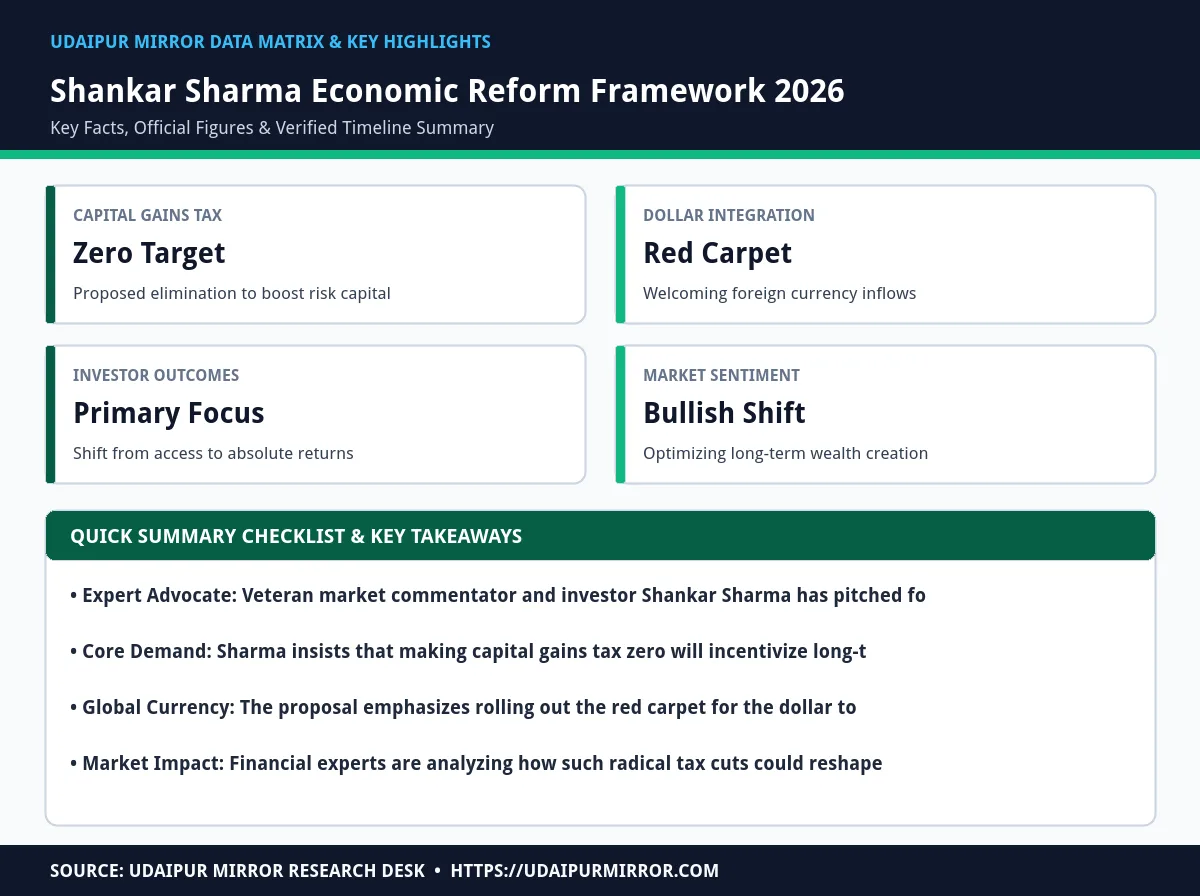
The ongoing discourse around rationalizing investment taxation involves weighing current structures against radical reform proposals put forward by market leaders like Shankar Sharma. Below is a comparative breakdown of traditional models versus the proposed growth-centric frameworks.
| Taxation Parameter | Current Regime (FY 2026-27) | Proposed Reform Vision | Expected Economic Impact |
|---|---|---|---|
| Equity Capital Gains | Applicable LTCG & STCG rates | Zero Capital Gains Tax | Massive surge in liquidity & retail participation |
| Foreign Inflows | Regulated & compliance heavy | Frictionless dollar entry | Stronger currency reserves & FDI boost |
| Mutual Fund Industry | Focus on asset under management | Outcome-driven wealth generation | Higher net investor satisfaction & yields |
| Fixed Income & Debt | Indexed/slab-based taxation | Rationalized yield structures | Better balance between debt and equity |
Beyond domestic taxation, Shankar Sharma’s thesis underscores the strategic necessity of rolling out the red carpet for the dollar. In an interconnected global economy, foreign capital flows serve as the lifeblood of infrastructure development, corporate expansion, and liquidity depth. Embracing foreign currency without bureaucratic red tape ensures that domestic enterprises secure competitive financing.
Citizens and investors tracking macroeconomic shifts often look at government support frameworks, similar to how households utilize initiatives highlighted in the Rajasthan Government Welfare Schemes 2026 guide to manage public benefits and subsidies efficiently.
“Capital goes where it is welcomed and stays where it is treated best. Fostering a dollar-friendly ecosystem is vital for macroeconomic robustness.” — Macroeconomic Strategist
As the debate on taxation unfolds, the mutual fund and asset management sectors are undergoing an internal reckoning. Industry experts note that the traditional focus on accumulating Assets Under Management (AUM) must pivot decisively toward delivering measurable investor outcomes. Retail participants are no longer satisfied with mere market access; they demand robust alpha generation and risk-adjusted returns.
This evolution aligns with the broader financial education drive, where investors seek absolute clarity on equity funds, hybrid structures, and tax-efficient portfolio construction. Ensuring that mutual funds prioritize real wealth creation over vanity metrics is critical for long-term financial literacy in India. (Also read: Rajasthan Government Welfare Schemes 2026: PM Surya Ghar, Jan Aadhaar & SSO Portal Guide).
“The mutual fund industry must measure its true success not by the size of its AUM, but by the financial security and actual returns delivered to the common investor.” — Industry Association Expert
Implementing reforms such as zero capital gains tax requires careful fiscal balancing by policymakers. While revenue concerns are natural for the exchequer, proponents maintain that the secondary and tertiary effects—such as heightened economic activity, formalization of savings, and corporate expansion—will ultimately expand the tax base organically.
Retail investors navigating these changing tides must maintain a disciplined approach, focusing on asset allocation, portfolio diversification, and continuous financial education rather than reacting impulsively to headline policy debates.
“Tax reform is not just about reducing collections; it is about unleashing an explosion of entrepreneurial and investment energy across the nation.” — Policy Researcher
Shankar Sharma advocated for making capital gains tax zero to remove friction, incentivize risk capital, and attract massive investment into the financial markets.
It refers to adopting friendly regulatory policies that welcome foreign currency and global institutional capital to deepen market liquidity and boost economic growth.
Experts emphasize that the mutual fund industry must shift its focus from merely increasing Assets Under Management (AUM) to delivering tangible, outcome-driven returns for investors.
Eliminating or reducing capital gains tax minimizes tax drag, allowing retail investors to compound their wealth much faster over long-term investment horizons.
Add Udaipur Mirror as a preferred source on Google to see more of our travel guides in your AI overviews.