Office Address
14, Residency Road, Udaipur, Rajasthan 313001
Office Address
14, Residency Road, Udaipur, Rajasthan 313001


NEW DELHI / UDAIPUR: As Indian capital markets gear up for sweeping regulatory shifts, retail investors must pay close attention to the upcoming sebi direct mutual fund rule set to take effect this November 1, 2026. Designed to eliminate distributor commissions and lower expense ratios, this regulatory update makes direct mutual fund investments the default choice across platforms. For an average retail investor running a monthly Systematic Investment Plan (SIP), understanding this structural shift is vital for maximizing compounding returns over a 10-to-20-year horizon, especially when compared with traditional regular plans.
⚡ Quick Highlights: SEBI Direct Mutual Fund Rule Nov 1: SIP Savings Explained
The capital markets regulator has consistently pushed for greater fee transparency and investor protection. Under the updated framework, fintech applications, registrar and transfer agents, and asset management companies must route new client investments through direct channels unless an explicit advisory mandate is signed. This prevents inadvertent selection of regular plans that siphon off a fraction of returns as commission payments.
While exploring wealth optimization strategies, retail participants often look at diverse financial planning tools. For instance, citizens evaluating state-backed welfare measures can check the Rajasthan Government Welfare Schemes 2026 portal for household subsidies. However, in the realm of equity markets, eliminating intermediary costs remains the single most effective way to enhance net portfolio yields.
“Fee transparency is the cornerstone of modern retail investing; every basis point saved in expense ratios directly translates to superior long-term wealth.” — Senior Financial Market Analyst
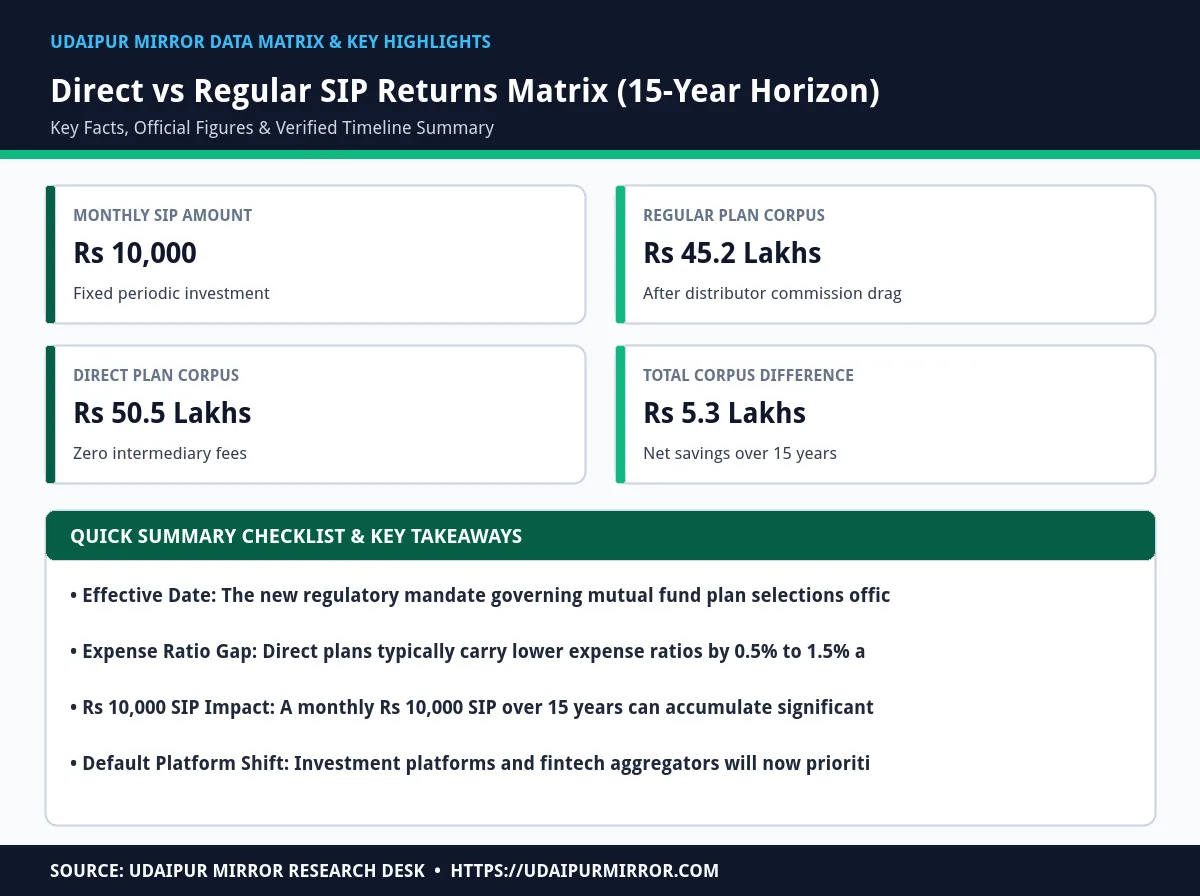
The following financial breakdown compares the projected maturity amounts between regular plans and direct plans for a standard Rs 10,000 monthly SIP investment. Notice how the compounding advantage expands significantly as the investment duration increases from 5 years to 20 years.
| Investment Tenure | Regular Plan Value | Direct Plan Value | Estimated Savings |
|---|---|---|---|
| 5 Years | Rs 8.1 Lakhs | Rs 8.3 Lakhs | Rs 20,000 |
| 10 Years | Rs 20.5 Lakhs | Rs 21.8 Lakhs | Rs 1.3 Lakhs |
| 15 Years | Rs 45.2 Lakhs | Rs 50.5 Lakhs | Rs 5.3 Lakhs |
| 20 Years | Rs 89.1 Lakhs | Rs 1.02 Crores | Rs 12.9 Lakhs |
To put numbers into perspective, consider an investor committing Rs 10,000 every month into an equity mutual fund. In a regular plan, a 1% annual commission might seem negligible in the first year. Over 15 years, however, that 1% fee eats away at the compounding base. Direct plans eliminate this friction, allowing the full sum to work uninterrupted in the market.
As startup ecosystems and financial literacy expand concurrently, specialized businesses are also scaling up. For example, medical tech startups have seen massive growth, such as when Docterz Raises Rs 5 Crore in Fresh Funding to strengthen doctor-user networks. Similarly, individual retail investors are adopting institutional discipline through automated monthly SIPs.
“Compounding is the eighth wonder of the world, but fee drag is its silent enemy.” — Mutual Fund Expert
With the new rules active from the start of November, retail participants should audit their current mutual fund folios. Check if your ongoing SIPs are tagged under regular or direct options. If you are currently locked into regular plans, evaluate the exit load and tax implications before executing a switch.
Financial discipline extends beyond equities into disciplined budgeting, emergency fund creation, and tax-efficient asset allocation. By embracing direct fund options, investors can retain a larger portion of their hard-earned savings without altering their risk appetite or stock-picking strategy. (Also read: Bagore Ki Haveli & Dharohar Dance Show Guide 2026: Show Timings, Ticket Booking, Museum & Puppet Show).
“An audit of your folio today will save you lakhs of rupees in avoidable distributor commissions tomorrow.” — Personal Finance Columnist
The rule mandates that investment platforms and asset management companies make direct mutual fund plans the default option for retail investors, eliminating accidental enrollment in higher-cost regular plans.
Over a 15-year horizon, choosing a direct plan over a regular plan can yield an additional corpus of approximately Rs 5.3 lakhs on a Rs 10,000 monthly SIP, assuming standard return differentials.
Yes, you can switch existing regular plans to direct plans, but doing so is treated as a redemption and fresh purchase, which may attract exit loads and capital gains taxes depending on your holding period.
Direct plans do not include advisory services or distributor commissions. Investors manage their portfolios independently or consult fee-only advisors who charge separate consultation fees rather than commission cuts.
Add Udaipur Mirror as a preferred source on Google to see more of our travel guides in your AI overviews.