Office Address
14, Residency Road, Udaipur, Rajasthan 313001
Office Address
14, Residency Road, Udaipur, Rajasthan 313001


NEW DELHI / UDAIRPUR: Navigating the financial landscape requires a thorough understanding of how income tax slabs investment planning go hand in hand under the current financial regulations. As retail investors across India map out their asset allocation for the fiscal year, matching systematic investments with the evolving tax regime structures remains critical. Whether choosing between old exemptions or the simplified tax slabs, synchronizing your portfolio with legal tax-saving mechanisms ensures higher post-tax yields.
⚡ Quick Highlights: How India's Income Tax Slabs Impact Investment Planning 2026
When constructing a long-term investment portfolio, retail investors often overlook the direct impact that statutory tax liabilities impose on net compounded returns. The structure of India’s income tax brackets dictates how much disposable income remains in the hands of earners, which in turn fuels systematic investment plans (SIPs) into mutual funds and direct equities. Because tax rules dictate whether deductions under Section 80C or standard rebates apply, every financial decision must begin with a clear calculation of gross versus net taxable income.
Furthermore, retail investors navigating the current financial year must weigh whether the simplified structure of the New Tax Regime outweighs the traditional deductions offered by the Old Tax Regime. While the new framework offers lower tax rates across broader income brackets, it strips away popular deductions like house rent allowance (HRA), leave travel concession (LTC), and investments in Public Provident Fund (PPF) or Equity Linked Savings Schemes (ELSS). Balancing tax efficiency with high-growth asset accumulation requires an analytical approach tailored to individual income tiers. (Also read: Rajasthan Government Welfare Schemes 2026: PM Surya Ghar, Jan Aadhaar & SSO Portal Updates).
“Tax planning is not merely an exercise in year-end compliance; it is the cornerstone of effective wealth accumulation and asset protection.” — Senior Financial Strategist
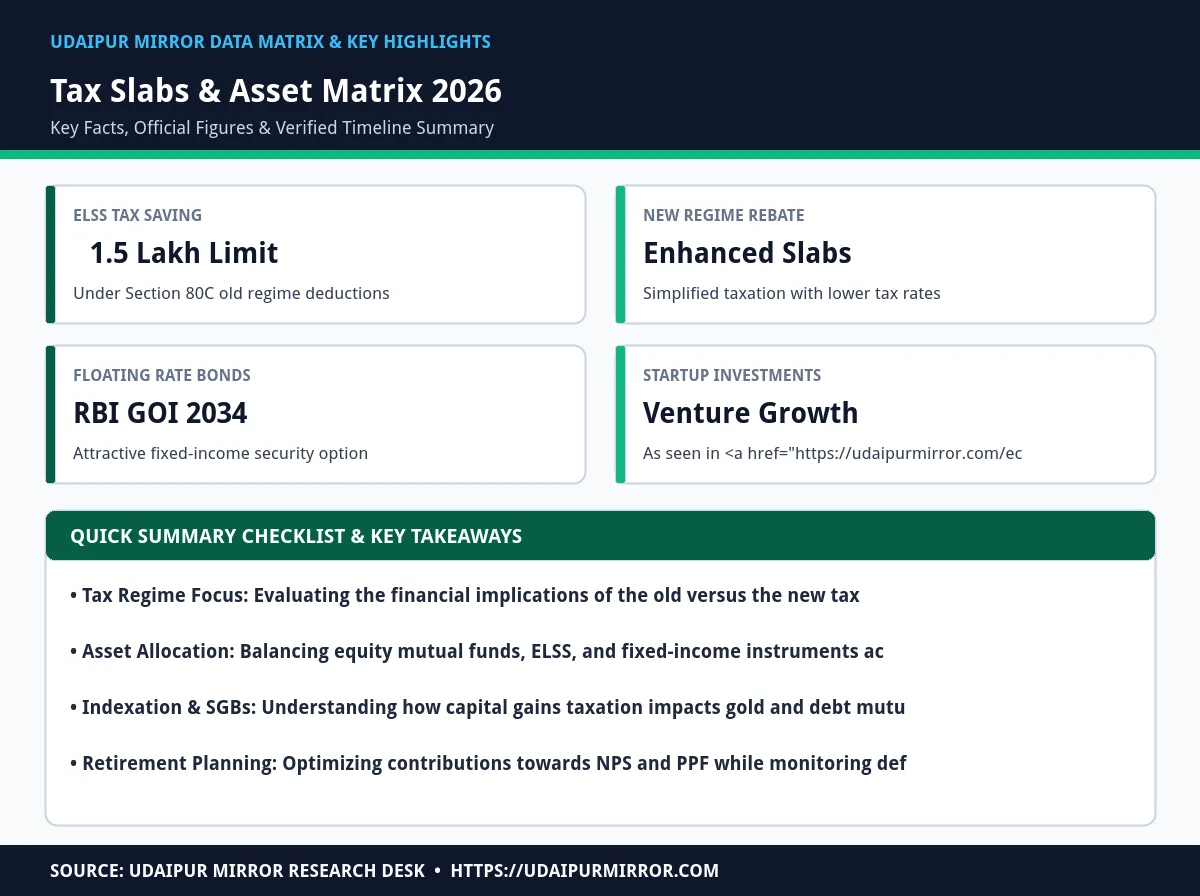
The following matrix outlines the core differences between the Old and New Tax Regimes for FY 2026-27, highlighting how specific investment instruments qualify for deductions or exemptions under each framework.
| Tax Parameter | Old Tax Regime | New Tax Regime (FY 2026-27) | Preferred Asset Classes |
|---|---|---|---|
| Tax Slabs & Rates | Higher base rates with progressive slabs up to 30% | Rationalized slabs with lower concessional rates | Equity Mutual Funds & Index Funds |
| Section 80C Deductions | Available up to ₹1.5 Lakh per annum | Not available (most exemptions removed) | ELSS, PPF, Life Insurance |
| Section 80CCD(1B) NPS | Additional ₹50,000 deduction allowed | Allowed up to ₹50,000 even in new regime | National Pension System (NPS) |
| Home Loan Interest (Sec 24) | Deduction up to ₹2 Lakh on self-occupied property | Not allowed for self-occupied properties | Real Estate Investments |
| Health Insurance (Sec 80D) | Eligible for deductions up to ₹25,000 – ₹50,000 | Not available | Medical Insurance Policies |
For decades, the Old Tax Regime encouraged retail investors to park capital in tax-saving instruments simply to lower their taxable income. Instruments like ELSS mutual funds offered a dual benefit: potential wealth creation through equity exposure combined with a three-year lock-in qualifying for Section 80C deductions. However, with the widespread adoption of the New Tax Regime, the incentive structure has shifted toward lower tax outlays without requiring documentary proof of investments.
Investors opting for the New Tax Regime must realize that products like ELSS lose their tax-deduction appeal, forcing investors to evaluate them purely on their post-tax investment merit compared to flexi-cap or index funds. Conversely, high-income earners with substantial home loans and insurance premiums may still find the Old Tax Regime more financially rewarding. Evaluating your specific tax bracket is essential before committing capital to long-term lock-in investment vehicles.
“The best tax-saving instrument is one that aligns with your financial goals, not just your April-to-March tax-saving panic.” — Tax Advisory Board
Beyond equity mutual funds, fixed-income instruments play a vital role in balancing portfolio volatility. With the Reserve Bank of India (RBI) announcing attractive interest rates on instruments like the GOI Floating Rate Bond and traditional options such as the Public Provident Fund (PPF) and Senior Citizen Savings Scheme, investors have diverse avenues for debt allocation. However, interest earned from these instruments is generally taxable according to your applicable slab rate, making pre-tax versus post-tax yield calculations mandatory.
For instance, investors in the highest tax bracket must look closely at tax-efficient alternatives or capital-gains-oriented assets to prevent severe tax erosion on fixed-income returns. Integrating annual financial health checks—similar to reviewing business investments like those analyzed in recent startup funding reports—ensures that your debt-to-equity ratio remains optimized against changing tax liabilities.
“Fixed-income stability must be paired with tax awareness to prevent inflation and taxation from eroding your principal gains.” — Macroeconomics Desk
A structured approach to personal finance prevents rushed decisions during the final quarters of the financial year. Retail investors should adopt a phased roadmap that begins with calculating projected annual income and determining the optimal tax regime in April. By establishing systematic investment plans (SIPs) early, investors benefit from rupee-cost averaging while spreading out liquidity requirements.
Mid-year portfolio reviews allow investors to rebalance asset allocation between equities, gold, and fixed income based on market performance. Finally, year-end execution involves gathering investment proofs (if under the old regime) or executing tax-loss harvesting strategies in equity portfolios to optimize overall tax liabilities before the fiscal year concludes on March 31.
“Discipline in financial planning beats market timing every single time. Plan your taxes early to let your investments compound uninterrupted.” — Chief Wealth Editor
Your income tax slab determines your marginal tax rate, which directly influences whether tax-saving instruments like ELSS under the old regime or pure growth index funds under the new regime offer better post-tax returns.
No, most deductions under Section 80C, including investments in ELSS mutual funds, Public Provident Fund (PPF), and life insurance premiums, are not available if you choose the New Tax Regime for FY 2026-27.
Short-Term Capital Gains (STCG) and Long-Term Capital Gains (LTCG) on mutual funds are taxed at specific flat rates depending on whether the fund is equity-oriented or debt-oriented, rather than being added directly to your normal income tax slab.
Even under the New Tax Regime, subscribers can claim an exclusive deduction of up to ₹50,000 per financial year for contributions made to Tier-1 National Pension System (NPS) accounts under Section 80CCD(1B).
Add Udaipur Mirror as a preferred source on Google to see more of our travel guides in your AI overviews.






[…] Guide 2026: Shreenathji 8-Jhanki Timings, Sanwaliya Seth & Darshan Rules 3 seconds ago ⚡ Articles How India's Income Tax Slabs For FY 2026-27 Directly Shape Your Strategic Investment … Articles Rajasthan Government Welfare Schemes 2026: PM Surya Ghar, Jan Aadhaar & SSO Portal […]
[…] The recent trading sessions have highlighted a classic financial paradox where headline indices register green figures while a vast majority of individual stocks experience downward corrections. For retail investors examining their portfolios, this divergence can be baffling. While institutional funds flow into defensive and export-oriented heavyweights, broader market breadth remains constrained. Smart capital allocation during such cyclical phases often requires a disciplined approach, keeping long-term financial milestones in perspective as detailed in guides on strategic investment planning. […]