Office Address
14, Residency Road, Udaipur, Rajasthan 313001
Office Address
14, Residency Road, Udaipur, Rajasthan 313001

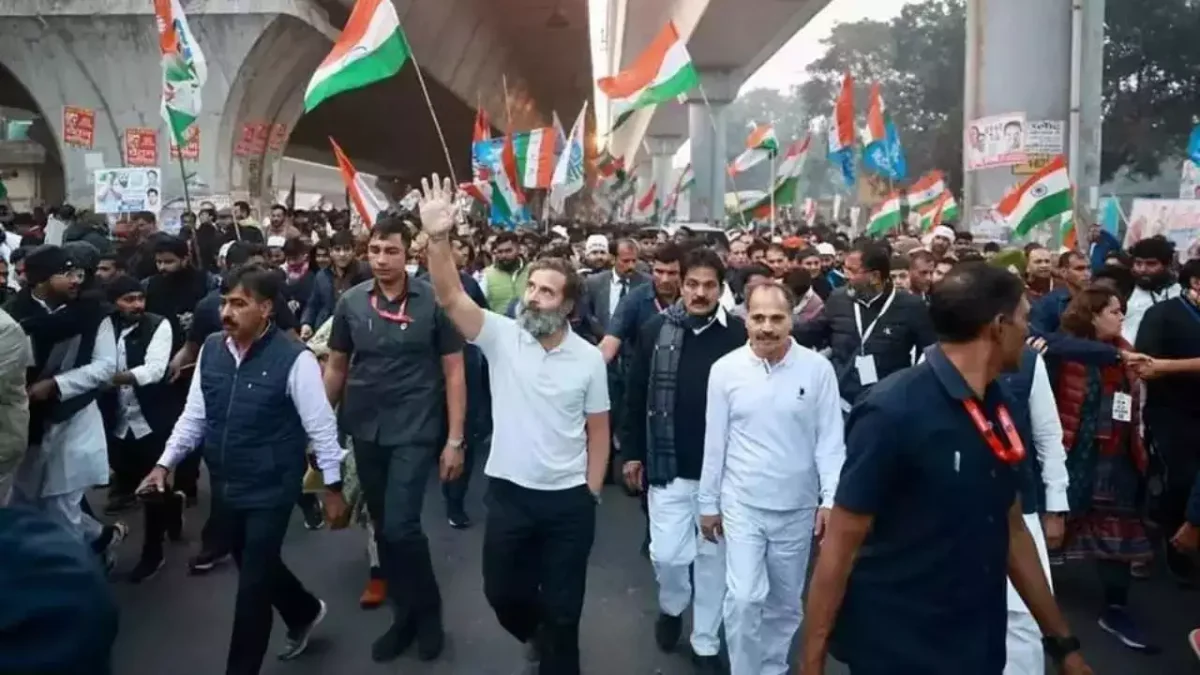
NEW DELHI: NEW DELHI — In a sharply escalated political confrontation, senior opposition leader Rahul Gandhi spearheaded a nationwide mobilization as the INDIA bloc stepped up its aggressive pushback against the contentious voter roll revision exercise. The coordinated opposition protest follows an intense weekend of political drama in the national capital, where opposition lawmakers staged a symbolic mock Parliament session targeting the Election Commission of India (ECI) and Chief Election Commissioner Gyanesh Kumar. The ruling administration has strongly condemned the opposition’s actions as a theatrical diversion, setting the stage for prolonged legislative and public conflict over electoral integrity and democratic accountability.
⚡ Quick Highlights: Rahul Gandhi Leads Opposition Rally Against Voter Roll Revision
The political landscape in New Delhi witnessed a dramatic escalation as senior Congress leader Rahul Gandhi took center stage in organizing a unified opposition front against the central election administration. Addressing supporters and party workers, Gandhi argued that administrative adjustments to electoral rolls must be executed with absolute transparency, warning that any perceived irregularities directly threaten the foundational principles of Indian democracy. Meanwhile, administrative departments in various regions continue their regular operations, echoing local initiatives such as the Udaipur Free Medical Camp that focus on grassroots welfare amidst high political noise.
Opposition leaders drawn from diverse regional parties have echoed similar apprehensions, claiming that hurried verification protocols could disenfranchise vulnerable demographics. The collective stance reflects a rare moment of legislative cohesion among INDIA bloc constituents, who have vowed to take their agitation from parliamentary committees directly to the electorate. (Also read: Ashok Gehlot Questions Rajasthan Government Over Shikhar Agrawal Property Scheme).
“We are not going to let you escape accountability on matters that touch the core of every citizen's voting rights.” — Rahul Gandhi, Senior Opposition Leader
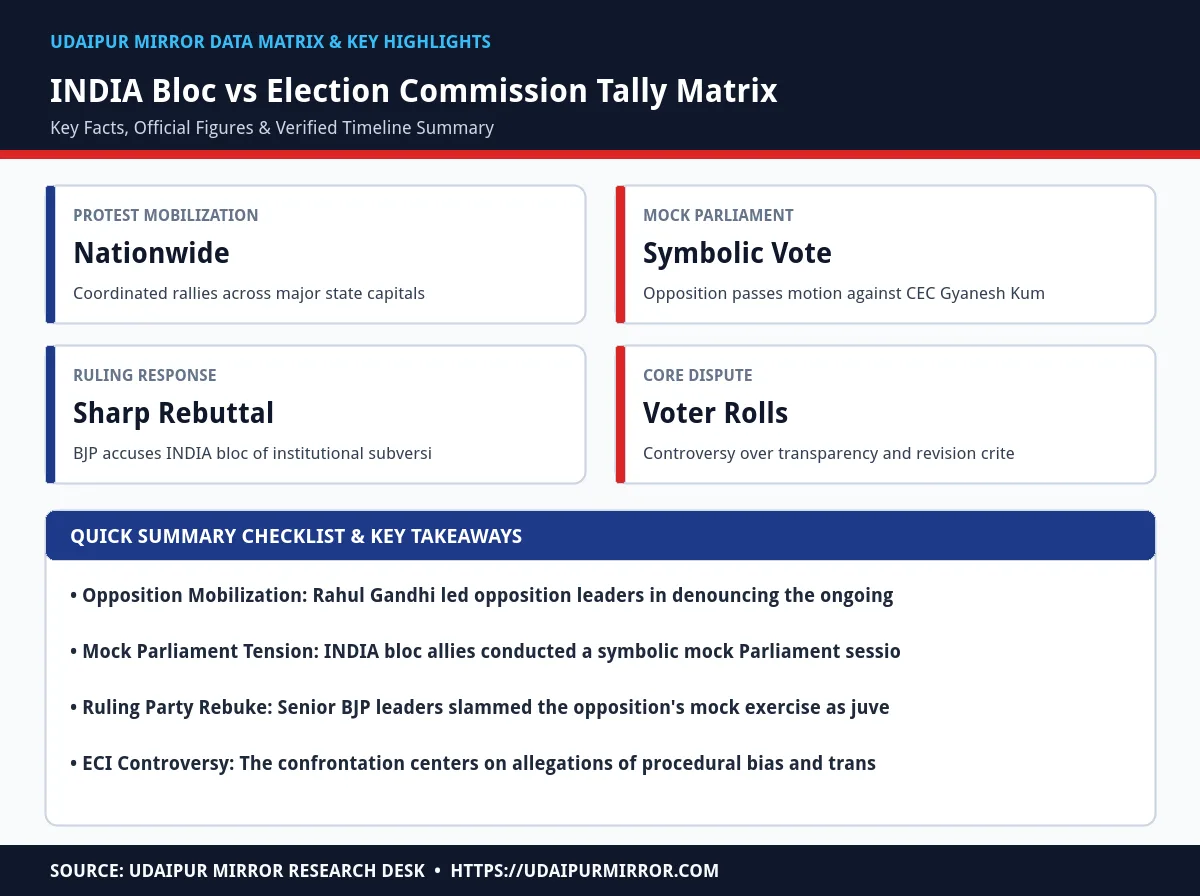
The following structured timeline outlines the rapid sequence of events leading from parliamentary friction to nationwide opposition rallies against the voter roll revision protocols.
| Date & Time | Key Event / Development | Primary Actors Involved | Political Implications |
|---|---|---|---|
| Sat, 31 Oct 2026 – 15:26 | Mock Parliament Session | INDIA Bloc Lawmakers | Symbolic impeachment motion passed against CEC |
| Sat, 31 Oct 2026 – 16:05 | BJP Press Conference | Ruling Party Spokespersons | Branded opposition exercise as political melodrama |
| Sat, 31 Oct 2026 – 16:11 | Legal & Procedural Review | Constitutional Analysts | Examining removal frameworks under statute |
| Sun, 01 Nov 2026 – 00:12 | Nationwide Opposition Rallies | Rahul Gandhi & Allies | Escalation of protests against voter roll revision |
| Sun, 01 Nov 2026 – Morning | Administrative Alert | State Electoral Officers | Heightened security and monitoring of voter lists |
The ongoing friction reached a boiling point during a high-profile mock Parliament exercise organized by opposition MPs. During the simulation, participants debated and symbolically passed a motion seeking the removal of Chief Election Commissioner Gyanesh Kumar, accusing the constitutional authority of procedural bias and treasonous disregard for electoral fairness. While constitutional scholars note that mock parliamentary sessions carry no binding legal authority, the exercise effectively highlighted deep institutional fault lines.
Legal experts emphasize that the removal of a Chief Election Commissioner is governed by stringent constitutional safeguards mirroring Supreme Court judge impeachment procedures. Consequently, the opposition’s symbolic move is viewed primarily as a political pressure tactic designed to capture national headlines rather than a formal legal proceeding. In parallel developments regarding administrative oversight, concerned citizens and political observers have also tracked independent state matters, akin to inquiries raised in cases like Ashok Gehlot Questions Rajasthan Government Over Shikhar Agrawal Property Scheme, reflecting broad public interest in governance accountability.
“The mock Parliament exercise puts the removal procedure under the lens, but it remains a symbolic political maneuver.” — Constitutional Law Expert
The ruling Bharatiya Janata Party (BJP) launched a ferocious counter-offensive against the opposition’s theatrics, dismissing the mock Parliament and subsequent street rallies as desperate political melodrama. Senior cabinet ministers and party spokespersons accused Rahul Gandhi and his allies of systematically attempting to undermine independent constitutional institutions whenever electoral outcomes or administrative procedures fail to favor their political ambitions.
BJP representatives maintained that the voter roll revision exercise is a standard, routine administrative update mandated by statutory guidelines to purge duplicate and deceased entries, thereby ensuring pristine electoral rolls. They argued that politicizing an autonomous body like the Election Commission sets a dangerous precedent for Indian parliamentary democracy. (Also read: JEE Main 2027 Application Correction Window & New Form Submission Guidelines | जेईई मेन-2027: फॉर्म में गलती पर विद्यार्थी भर सकेंगे नया ऑनलाइन आवेदन).
“The opposition has resorted to juvenile melodrama and mock parliaments because they have lost faith in the democratic verdict of the people.” — BJP National Spokesperson
As political temperatures soar across the country, political analysts are assessing the potential fallout of this confrontation on upcoming state assembly elections and legislative business. The ongoing standoff threatens to stall key legislative debates during upcoming parliamentary sessions, as opposition parties signal their intent to disrupt proceedings unless their demands regarding electoral transparency are formally addressed.
At the same time, district electoral officers across several states have been instructed to maintain strict neutrality and open channels of communication with local political representatives to address specific grievances regarding draft voter lists. The central administration remains firm that statutory timelines for electoral preparations will proceed uninterrupted despite political headwinds.
“Electoral integrity requires cooperation and trust between all political stakeholders and administrative bodies.” — Senior Electoral Observer
Opposition parties, led by Rahul Gandhi and the INDIA bloc, argue that the current voter roll revision protocols lack transparency and risk disenfranchising eligible voters through rushed administrative procedures.
During the mock Parliament session, opposition lawmakers symbolically passed a motion seeking the impeachment of Chief Election Commissioner Gyanesh Kumar, accusing the poll body of bias.
The BJP strongly condemned the mock Parliament and subsequent protests as political melodrama, asserting that the voter roll revision is a routine, necessary administrative update.
No. Mock Parliament sessions are symbolic political exercises and carry no legal binding. The actual removal of a CEC requires strict constitutional procedures mirroring Supreme Court judge impeachment.
Add Udaipur Mirror as a preferred source on Google to see more of our travel guides in your AI overviews.