Office Address
14, Residency Road, Udaipur, Rajasthan 313001
Office Address
14, Residency Road, Udaipur, Rajasthan 313001


NEW DELHI: NEW DELHI — As global climate negotiations intensify and domestic energy demands surge, india 500gw green goal stands as one of the world’s most aggressive renewable energy roadmaps. Driven by unprecedented policy backing, technological cost reductions, and nationwide grassroots campaigns like the PM Surya Ghar Muft Bijli Yojana, India is steadily transforming its power grid. While industrial centers retool their power procurement strategies, citizens and municipal corporations alike are embracing photovoltaic technology to curb emissions and stabilize electricity tariffs across states.
⚡ Quick Highlights: Harnessing the Sun: India's Path to 500GW Solar Energy
The roadmap to 500 gigawatts is not merely a quantitative target; it represents a fundamental restructuring of how electricity is generated, transmitted, and consumed in the subcontinent. Utility-scale solar parks spanning vast arid expanses in western and southern states form the backbone of this transition. These mega-installations benefit from high solar irradiance and supportive land acquisition policies, allowing energy conglomerates to deliver clean power at highly competitive tariffs.
At the same time, urban centers and tier-2 cities are experiencing a decentralized energy revolution. Homeowners and housing societies are leveraging central subsidies to install rooftop panels, significantly reducing strain on urban distribution transformers. While tracking macro-level infrastructure milestones, observers often look back at how regional development compares—much like travelers exploring the scenic trails detailed in our Bahubali Hills & Badi Lake Udaipur Guide 2026, where balancing natural preservation with human exploration mirrors the careful calibration required for sustainable green expansion.
“Solar power is no longer an alternative energy choice; it is the fundamental engine driving India's industrial competitiveness and ecological security.” — Senior Ministry of New and Renewable Energy Official
A closer look at how leading Indian states are contributing to the national renewable energy framework through utility parks and decentralized rooftop installations.
| State / Region | Installed Solar Capacity | Active Rooftop Installations | Key Policy Incentive |
|---|---|---|---|
| Rajasthan | 24.5 GW | 1,45,000+ | Land & transmission waivers |
| Gujarat | 18.2 GW | 3,20,000+ | Surya Gujarat rooftop scheme |
| Maharashtra | 16.8 GW | 2,10,000+ | Net metering fast-track clearance |
| Tamil Nadu | 9.4 GW | 1,15,000+ | Industrial open access support |
| Karnataka | 10.1 GW | 95,000+ | Pavagada solar park integration |
As renewable penetration surges past historical benchmarks, grid operators face the intricate challenge of intermittency. Solar generation peaks during daylight hours, while domestic and commercial demand often spikes during evening twilight. To prevent curtailment and ensure grid stability, federal agencies are fast-tracking Battery Energy Storage Systems (BESS) and pumped hydro storage facilities.
Modernizing transmission corridors is equally critical. High-voltage direct current (HVDC) lines are being constructed to channel surplus green energy from resource-rich regions to high-consumption industrial hubs across northern and eastern India. Managing these large-scale grid transitions safely requires stringent safety protocols and real-time monitoring—principles that resonate just as strongly in emergency preparedness, underscored by recent local reviews of highway safety equipment similar to those discussed in our report on the Udaipur-Ahmedabad highway incident.
“Grid stability is the bedrock of renewable expansion. Without robust energy storage and smart dispatch systems, high solar penetration risks localized voltage fluctuations.” — Power Grid Corporation Energy Analyst
The democratization of clean energy is perhaps best exemplified by consumer-centric schemes that lower the financial barrier to entry for ordinary households. Programs offering direct bank transfers for residential rooftop installations have turned millions of electricity consumers into power producers. Net metering regulations allow families to offset their monthly utility bills by feeding surplus generation back into the local grid.
This bottom-up participation fosters widespread environmental awareness and community-level climate action. Public engagement in policy rollouts relies heavily on transparent administrative processes and accurate public records, mirroring how citizens actively participate in civic life, from checking local welfare schemes to engaging with civic matters as highlighted in recent discourse surrounding democratic accountability and voter roll revision rallies.
“When every household becomes a power producer, energy security shifts from a macro-economic challenge to a decentralized citizen movement.” — Renewable Energy Policy Researcher
Achieving the 500GW green goal requires robust domestic manufacturing ecosystems to insulate the domestic market from global supply chain shocks. Through targeted production-linked incentive schemes, Indian manufacturers have scaled up production of high-efficiency solar photovoltaic cells, wafers, and ingots. This industrial expansion not only secures national energy independence but positions India as a major exporter of solar hardware to international markets.
Looking forward, the integration of artificial intelligence in predictive maintenance, automated solar panel cleaning robots, and transparent green financing mechanisms will further accelerate deployment speeds. As policy frameworks evolve to meet changing industrial needs, India remains firmly on track to redefine its energy future.
“Building an indigenous manufacturing supply chain ensures that our transition to green energy creates domestic manufacturing jobs rather than importing foreign technology.” — Solar Manufacturers Association Representative
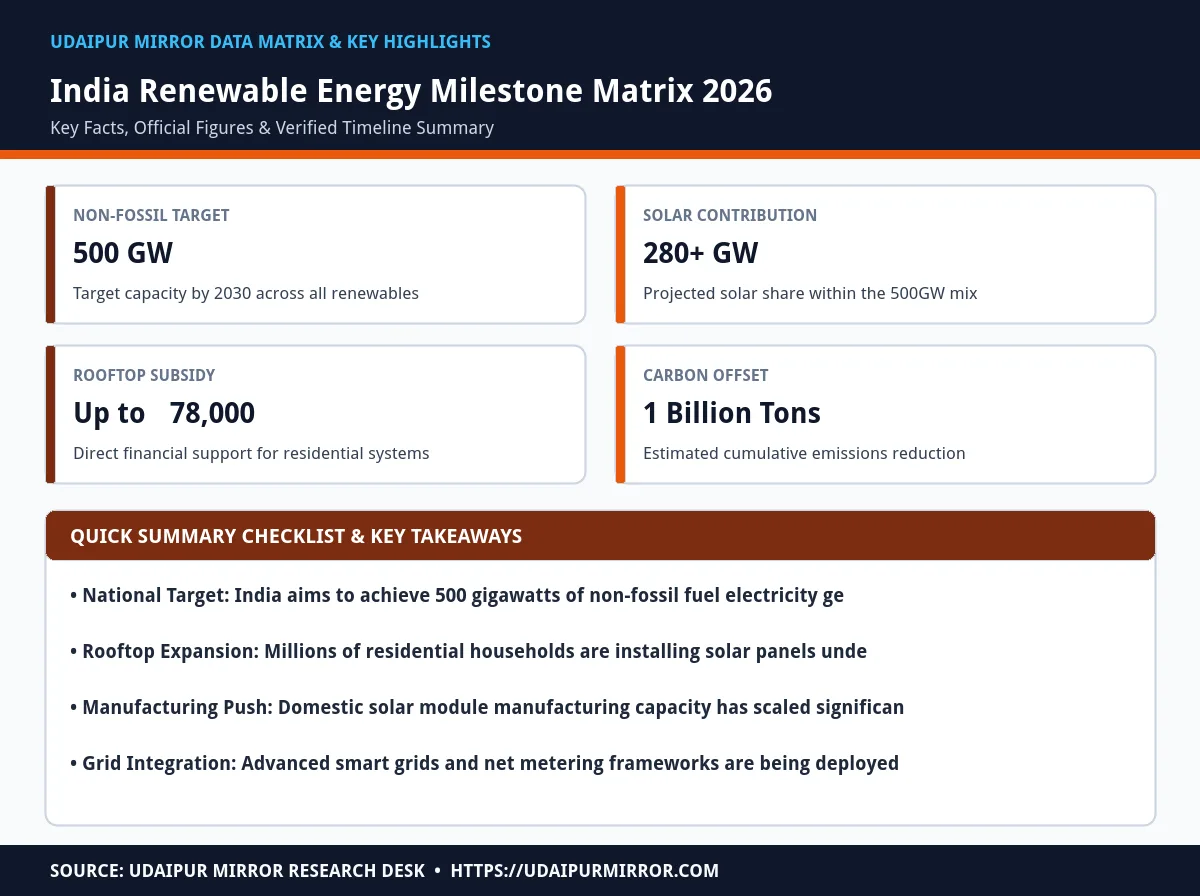
India has committed to achieving 500 gigawatts of non-fossil fuel electricity generation capacity by the end of this decade.
Eligible residential households receive direct financial subsidies transferred to their bank accounts after installing approved solar rooftop systems through designated national portals.
Net metering is a billing mechanism that credits solar energy system owners for the electricity they add to the local grid, offsetting their regular utility consumption.
Grid operators are deploying battery energy storage systems (BESS), pumped hydro storage facilities, and upgrading transmission corridors to manage peak demand and variable generation.
Add Udaipur Mirror as a preferred source on Google to see more of our travel guides in your AI overviews.