Office Address
14, Residency Road, Udaipur, Rajasthan 313001
Office Address
14, Residency Road, Udaipur, Rajasthan 313001


MUMBAI: As retail participation in domestic capital markets continues to expand at an unprecedented pace, asset management companies are rolling out fresh investment opportunities. This week introduces two fresh mutual fund nfos that open for subscription, giving investors a chance to participate in structured equity and hybrid portfolios designed for varied risk appetites. With broader market dynamics shifting following recent equity fluctuations and institutional capital inflows—such as Saudi Aramco taking a 49% stake in AI firm Humain with a $2.6 billion commitment—investors are increasingly evaluating systematic asset allocation strategies. Whether you are deploying capital via lump sum or examining how your growing SIP corpus requires strategic adjustments, understanding the mechanics of these new fund offerings is essential before committing capital.
⚡ Quick Highlights: Mutual Fund NFOs Opening This Week: Dates & Details
The mutual fund industry continues to witness robust retail inflows as investors transition from traditional fixed-income instruments to market-linked assets. This week’s introduction of two new mutual fund nfos provides an opportune moment for participants to evaluate whether fresh fund offerings fit into their existing portfolios. Unlike existing schemes that boast long performance track records, NFOs launch with a blank slate, offering units at a face value of Rs 10.
While new fund offers can be enticing due to their low starting NAV, financial advisors consistently emphasize that investors should look beyond the pricing gimmick. Evaluating the fund house’s historical performance, the pedigree and track record of the designated fund manager, and the clarity of the scheme information document (SID) are critical steps. As broader market indices experience weekly fluctuations—with major equity categories swinging by up to 5% recently—choosing a fund that aligns with your long-term asset allocation is paramount.
Furthermore, retail investors navigating how to deploy significant capital chunks over multi-year horizons can look at structured deployment strategies. For instance, experts discussing deployment models at recent wealth expos emphasize systematic transfer plans (STPs) over lumpsum commitments during volatile phases. You can also monitor parallel capital market trends, such as shifting market dynamics highlighted in our analysis of best and worst performing tech stocks to gauge broader sectoral momentum.
“An NFO should never be selected solely because its NAV is at Rs 10. The underlying investment mandate, risk parameters, and alignment with your financial goals matter above all else.” — Senior Wealth Strategist, Mumbai
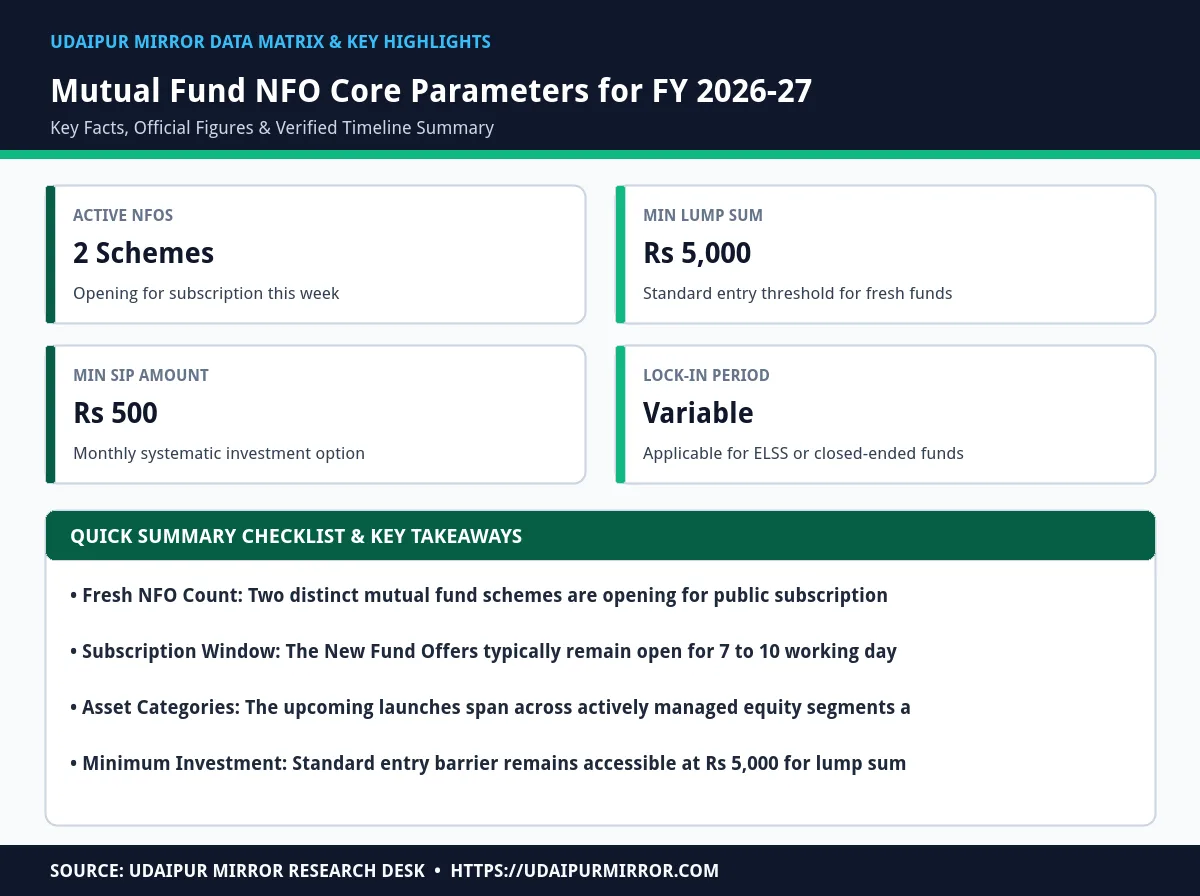
Review the following comparative matrix detailing the typical structures, risk profiles, and investment objectives of equity versus hybrid mutual fund NFOs opening this week.
| Parameter | Equity NFO Scheme A | Hybrid NFO Scheme B | Target Investor Profile |
|---|---|---|---|
| Asset Allocation | 80-100% in Large/Mid Cap Equities | 65% Equity, 35% Debt & Arbitrage | Aggressive vs Moderate Risk Takers |
| Minimum Investment | Rs 5,000 (Lump sum) / Rs 500 (SIP) | Rs 5,000 (Lump sum) / Rs 500 (SIP) | Retail and HNI Investors |
| Benchmark Index | Nifty 500 TRI / BSE 200 | CRISIL Hybrid 35+65 Aggressive | Indexed Performance Tracking |
| Exit Load | 1% if redeemed within 1 year | 0.5% if redeemed within 3 months | Short-term Liquidity Management |
| Fund Manager Type | Active Growth & Momentum Strategy | Dynamic Asset Rebalancing Desk | Professional Portfolio Management |
Both upcoming NFOs will officially open for public subscription early this week, maintaining an active window for approximately ten days. Investors can submit their applications digitally through registered mutual fund distributor platforms, direct AMC portals, or unified investment apps. It is crucial to note that once the NFO period closes, the schemes reopen for continuous sale and repurchase (re-entry) within a few business days, usually at the prevailing Net Asset Value.
When analyzing these offerings, investors should cross-check whether the scheme is open-ended or closed-ended. Open-ended funds offer high liquidity, allowing redemptions on any business day, whereas closed-ended schemes lock in capital for a fixed tenure (such as 3 to 5 years) and list on stock exchanges for secondary market trading. For most retail participants, open-ended equity and hybrid options remain the preferred vehicle for wealth accumulation.
As India marches toward ambitious clean energy targets—similar to massive infrastructural shifts seen in initiatives tracking solar power leading India towards its 500GW green goal—the thematic and sectoral underlying assets of these NFOs may also reflect evolving economic priorities, including green tech and sustainable infrastructure.
“Checking subscription timelines and ensuring your KYC is fully compliant prevents last-minute technical rejections during active NFO windows.” — Registrar and Transfer Agent Executive
As systematic investment plan portfolios mature and overall corpuses grow over the years, retail investors often face the critical question of whether their investment strategy needs a thorough overhaul. A growing SIP corpus means that market volatility impacts absolute portfolio value more substantially than during initial accumulation stages. Consequently, jumping into new NFOs just to diversify may disrupt a well-calibrated core portfolio if asset allocation limits are breached.
Financial planners suggest conducting quarterly or semi-annual portfolio reviews to check equity-debt asset mixes. If equity allocations swell beyond targeted risk limits due to market rallies, rebalancing into hybrid funds or stable debt instruments becomes necessary. Conversely, disciplined SIP investors should maintain their recurring monthly mandates regardless of short-term market noise, leveraging rupee-cost averaging effectively.
Additionally, investors managing diverse digital assets, startup portfolios, or ecommerce investments—such as ventures highlighted in reports on top ecommerce startups that raised major funding—must treat mutual funds as their disciplined, liquid equity core rather than speculative trading vehicles.
“Your investment strategy must evolve as your corpus grows. What worked for a Rs 1 lakh portfolio requires a more mature asset allocation framework when it scales to Rs 50 lakh.” — Certified Financial Planner
Before allocating hard-earned capital to either of the two newly launched mutual fund NFOs, investors should run through a comprehensive checklist. First, verify your KYC (Know Your Customer) status with CERSAI or registered KRA agencies to ensure PAN and Aadhaar linkages are fully up to date. Second, assess your portfolio’s existing overlap with the proposed NFO’s benchmark index to avoid overexposure to specific large-cap stocks or sectors.
Third, determine whether a new fund offering genuinely fills a gap in your financial plan. If you already hold diversified multi-cap or flexi-cap funds with stellar long-term track records, subscribing to a fresh equity NFO may be entirely redundant. On the other hand, if you are seeking a specialized hybrid structure or a newly approved thematic mandate, an NFO can serve as a calculated tactical entry.
Finally, consult a SEBI-registered investment advisor if you are uncertain about how these schemes impact your retirement horizon, children’s education fund, or emergency savings buffer.
“Discipline and patience remain the twin pillars of mutual fund wealth creation. NFOs are merely tools; your financial plan dictates your success.” — Investment Desk Analyst
An NFO (New Fund Offer) is the first-time subscription offer launched by an asset management company to raise capital from the public for a newly created mutual fund scheme.
Not necessarily. Existing funds have a proven performance track record, whereas NFOs start with a clean slate. You should invest in an NFO only if its investment mandate and strategy uniquely fit your portfolio goals.
The standard minimum investment for most equity and hybrid NFOs is Rs 5,000 for lump-sum investments and Rs 500 per month for systematic investment plans (SIPs).
No. A lower NAV of Rs 10 does not mean a fund is cheap. The growth of your investment depends entirely on the percentage increase in the underlying asset value, not the absolute number of units held.
Add Udaipur Mirror as a preferred source on Google to see more of our travel guides in your AI overviews.






[…] 2026: Shreenathji 8-Jhanki Timings, Sanwaliya Seth Rules & Eklingji Darshan 4 seconds ago ⚡ Articles Mutual Fund NFOs This Week: 2 New Schemes Open for Subscription With Key Details 1 hour ag… Articles Harnessing the Sun: How Solar Power Is Leading India Towards Its 500GW Green Goal 2 hours […]