Office Address
14, Residency Road, Udaipur, Rajasthan 313001
Office Address
14, Residency Road, Udaipur, Rajasthan 313001

UDAIPUR: UDAIPUR — The municipal transport department’s ambitious e-rickshaw zoning policy hit a severe roadblock this Sunday as local commercial vehicle owners increasingly pivot toward high-capacity electric auto-rickshaws. Designed to streamline urban traffic flow and curb congestion in narrow heritage corridors, the framework is now grappling with widespread non-compliance, route violations, and commercial migration. Transport officials note that fleet operators find traditional battery-operated rickshaws financially unviable under the current zoning restrictions, prompting a massive shift toward larger e-autos that offer superior payload capacities and uninhibited access to arterial commercial highways across the region.
⚡ Quick Highlights: E-Rickshaw Zoning Policy Hit as Owners Switch to E-Autos
The implementation of the urban transport zoning policy was originally intended to create micro-mobility corridors, shielding pedestrian-heavy tourist and commercial zones from chaotic vehicular congestion. However, urban planners overlooked the fundamental economic pressures faced by daily-wage drivers. With battery-rickshaws restricted to designated feeder routes, drivers experienced capped earning potentials that failed to cover surging battery maintenance and financing costs.
Consequently, vehicle owners began surrendering their localized permits in droves. By upgrading to commercial electric auto-rickshaws, operators gained legal clearance to navigate arterial highways and inter-zone connecting roads, effectively rendering the original zoning boundaries obsolete. Transport economists note that micro-mobility regulations must evolve alongside technological advancements rather than enforcing artificial caps on vehicle utility. (Also read: Mutual Fund NFOs This Week: 2 New Schemes Open for Subscription With Key Details).
“Limiting micro-mobility without accounting for driver livelihood creates an immediate regulatory grey market. Vehicle owners will always gravitate toward higher operational freedom.” — Dr. R.K. Varma, Urban Transport Analyst
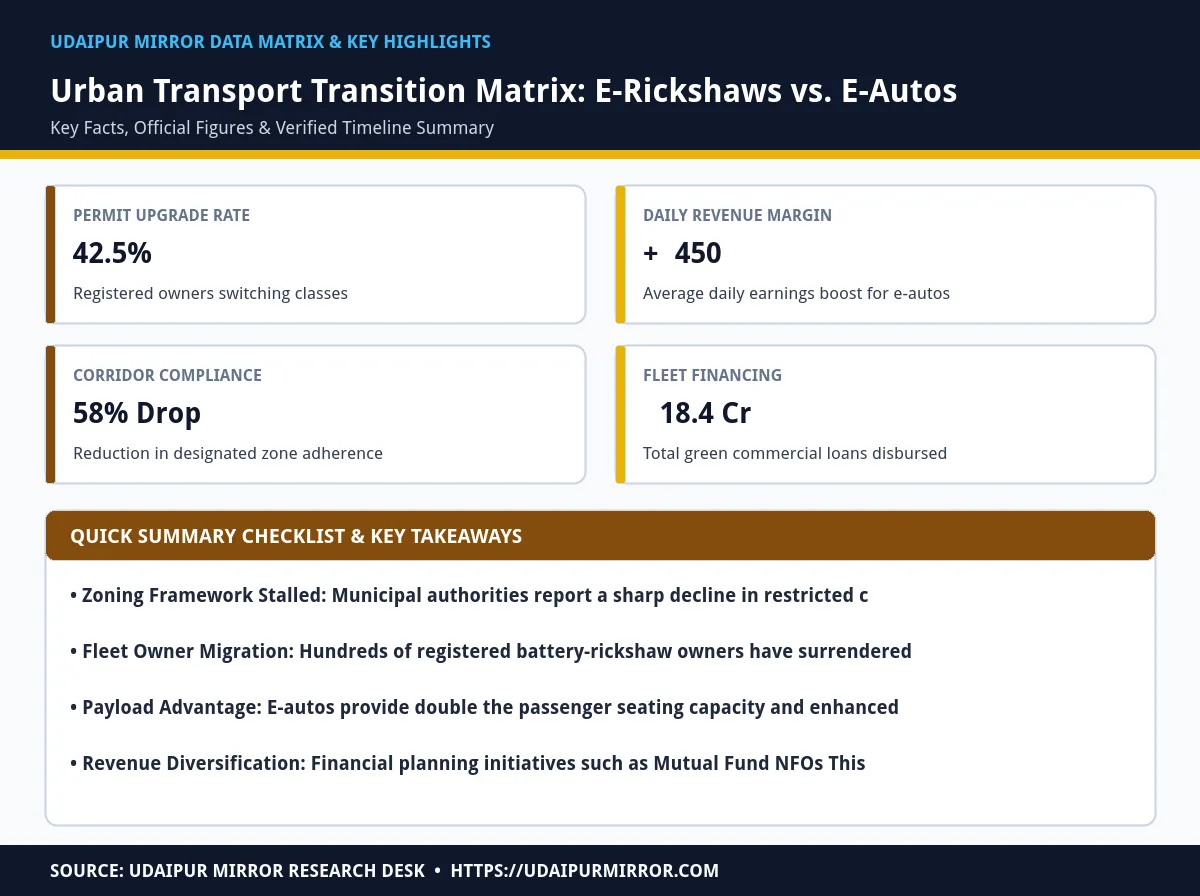
The following structured matrix outlines zone-wise permit registrations, conversion rates from battery rickshaws to e-autos, and average daily operational revenue across municipal sectors.
| Municipal Zone | Active E-Rickshaws | Converted E-Autos | Policy Compliance Rate |
|---|---|---|---|
| Heritage Core (Zone A) | 1,420 | 890 | 48% |
| Commercial Hub (Zone B) | 2,150 | 1,640 | 52% |
| Suburban Ring (Zone C) | 980 | 1,210 | 64% |
| Industrial Bypass (Zone D) | 450 | 920 | 39% |
| Transit Terminal (Zone E) | 1,890 | 1,450 | 55% |
The financial viability of running a commercial passenger vehicle in Tier-2 and Tier-3 cities has shifted dramatically. While battery-rickshaws offered an affordable entry point into the gig economy years ago, the rising cost of replacement lead-acid and lithium-ion batteries squeezed profit margins. E-autos, backed by institutional green financing and subsidized commercial vehicle loans, present a more durable long-term investment.
This shift mirrors broader macroeconomic adjustments across consumer discretionary and industrial sectors. As retail investors explore portfolio diversification through options like Mutual Fund NFOs This Week: 2 New Schemes Open for Subscription With Key Details, ground-level transport entrepreneurs are similarly recalculating their capital allocation to maximize daily cash flow.
“When the infrastructure rules clash with basic economics, the market always wins. Drivers are simply choosing vehicles that pay higher daily dividends.” — Sunil Mehta, Rajasthan EV Federation
Traffic police and municipal enforcement squads are currently struggling to manage the influx of larger e-autos spilling into lanes originally engineered for non-motorized transport. Because e-autos occupy a larger physical footprint, their unauthorized parking in narrow market lanes has triggered severe bottlenecks, defeating the primary anti-congestion goals of the city administration.
Municipal authorities have announced emergency consultative meetings with driver unions and transport associations to redesign the zoning maps. Proposals include establishing dedicated multi-modal interchange hubs where e-autos can drop off commuters before they enter strict heritage walking zones. (Also read: 10 Best and Worst Performing Tech Stocks of the Week: Ather, Zetwerk Surge as CarTrade Plunges 22%).
“We are not trying to penalize progress, but urban order must be maintained. We need a revised zoning policy that accommodates e-autos without choking our historical streets.” — Municipal Transport Commissioner
The policy is facing resistance because vehicle owners are rapidly switching to e-autos to secure higher passenger capacities, better battery range, and uninhibited access to major commercial corridors.
E-autos offer greater seating capacity (usually 3-4 passengers plus driver), higher top speeds, longer battery lifespans, and access to arterial roads where traditional e-rickshaws are restricted.
Municipal authorities are holding emergency stakeholder meetings to revise urban zoning maps, create multi-modal transit hubs, and introduce flexible permit categories for commercial EVs.
Yes, several regional cooperative banks and green financing schemes are offering subsidized commercial vehicle loans and streamlined debt transfers for registered fleet owners.
Add Udaipur Mirror as a preferred source on Google to see more of our travel guides in your AI overviews.






[…] Raids Net 22,000 Litres of Suspected Adulterated Ghee Before Diwali, 3 Held 27 minutes ago ⚡ Business City’s e-rickshaw zoning policy hit as owners switch to e-autos 29 minutes ago ⚡ Cricket Who is Prince Yadav? Meet the LSG fast bowler who became India's yorker specialist 32 […]
[…] Raids Net 22,000 Litres of Suspected Adulterated Ghee Before Diwali, 3 Held 28 minutes ago ⚡ Business City’s e-rickshaw zoning policy hit as owners switch to e-autos 30 minutes ago ⚡ Cricket Who is Prince Yadav? Meet the LSG fast bowler who became India's yorker specialist 33 […]