Office Address
14, Residency Road, Udaipur, Rajasthan 313001
Office Address
14, Residency Road, Udaipur, Rajasthan 313001


RAIPUR / NEW DELHI: RAIPUR / NEW DELHI — In a monumental leap for India’s clean energy transition, Chhattisgarh’s Khaira village has officially emerged as the country’s first 100 percent solar-powered settlement under the ambitious pm surya ghar yojana. Announced on Sunday, November 1, 2026, this landmark achievement underscores the grassroots scalability of decentralized rooftop solar installations. By transitioning every residential household to clean photovoltaic generation, Khaira has established a golden template for rural electrification, aligning directly with national net-zero ambitions and providing robust energy security to remote communities.
⚡ Quick Highlights: Khaira Becomes India's 1st 100% Solar Village Under Surya Ghar
The transformation of Khaira from a conventional rural settlement into a gleaming beacon of green technology did not happen overnight. It required meticulous coordination between district authorities, state renewable energy agencies, and local residents. Every household in the village was equipped with high-efficiency rooftop photovoltaic modules, paired with advanced micro-inverters capable of handling fluctuating grid voltages. As urban mobility transitions see parallel shifts—similar to how city’s e-rickshaw zoning policy hit as owners switch to e-autos due to evolving infrastructure demands—rural energy frameworks are likewise modernizing to embrace total solar saturation.
Residents noted that the elimination of recurring electricity bills has fundamentally improved household disposable incomes. Women and children, who traditionally bore the brunt of power outages and erratic supply schedules, now enjoy uninterrupted lighting, digital education access, and mechanized household appliances. (Also read: City’s e-rickshaw zoning policy hit as owners switch to e-autos).
“Khaira's complete solarization proves that rural India is ready to lead the green technology revolution from the front.” — State Renewable Energy Official
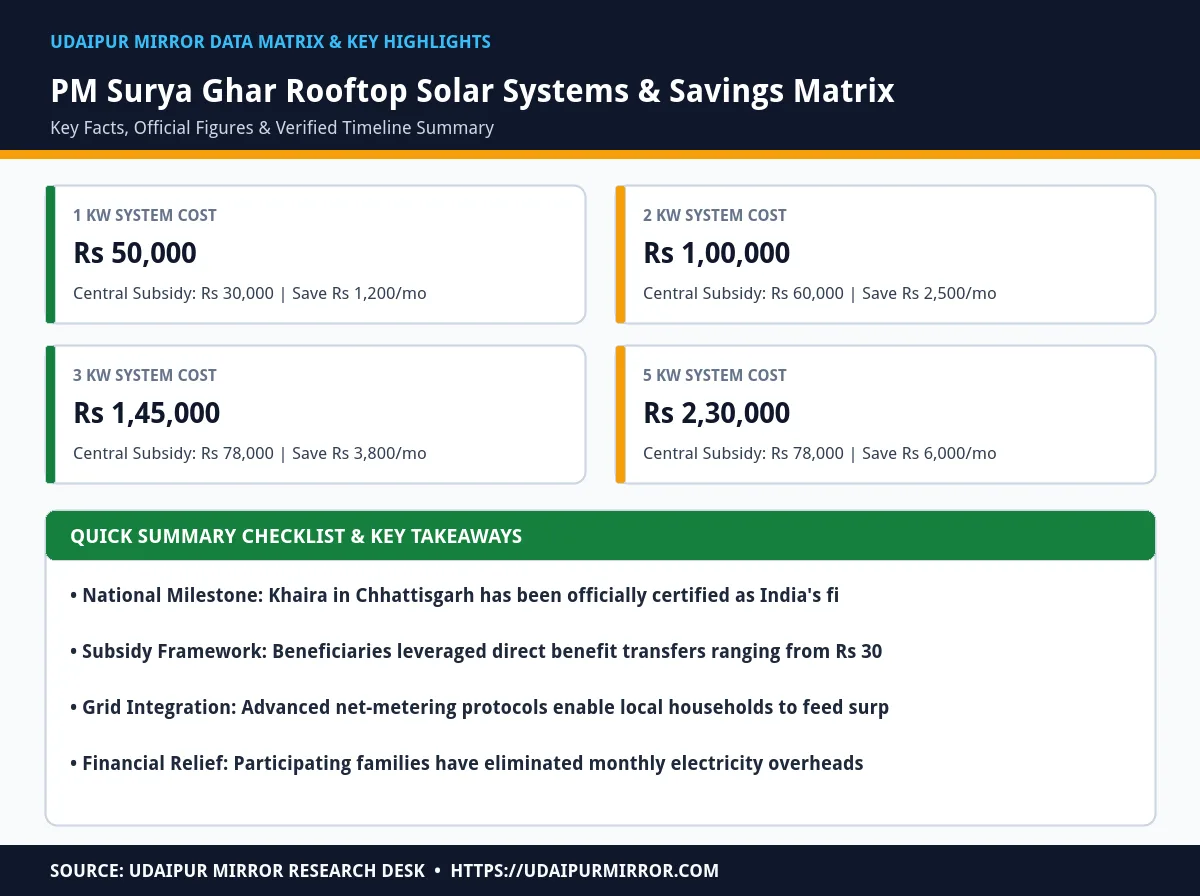
To help households evaluate their financial commitment before initiating DISCOM online applications, the table below outlines benchmark capital costs, applicable central financial assistance (CFA), net consumer investment, and projected monthly electricity savings across various capacity tiers.
| System Capacity | Benchmark Cost (INR) | Govt Subsidy (INR) | Net Cost to Consumer | Avg Monthly Savings |
|---|---|---|---|---|
| 1 kW | Rs 50,000 | Rs 30,000 | Rs 20,000 | Rs 1,200 – Rs 1,500 |
| 2 kW | Rs 1,00,000 | Rs 60,000 | Rs 40,000 | Rs 2,500 – Rs 3,000 |
| 3 kW | Rs 1,45,000 | Rs 78,000 | Rs 67,000 | Rs 3,500 – Rs 4,200 |
| 4 kW | Rs 1,90,000 | Rs 78,000 | Rs 1,12,000 | Rs 4,800 – Rs 5,500 |
| 5 kW | Rs 2,30,000 | Rs 78,000 | Rs 1,52,000 | Rs 6,000 – Rs 7,000 |
Securing central financial assistance under the national rooftop initiative involves a streamlined digital workflow managed through national portals and regional electricity distribution companies (DISCOMs). Homeowners must first register on the centralized consumer portal, providing their electricity consumer account number, sanctioned load details, and valid bank account credentials for direct benefit transfers.
Once the application is registered, applicants receive technical feasibility approval from their local DISCOM engineer. Following approval, consumers can engage empanelled vendors to execute the installation. After mounting the panels and bi-directional net meters, a joint inspection is conducted, triggering the automatic disbursement of subsidies directly to the beneficiary’s registered bank account within 30 days.
“Digital integration has reduced subsidy disbursement timelines from months to mere weeks, empowering everyday citizens.” — DISCOM Technical Cell Lead
Net metering serves as the technical backbone of decentralized rooftop installations, allowing consumers to monetize excess daytime power generation. Under guidelines enforced by distribution utilities across various states—such as JVVNL, AVVNL, and JdVVNL in Rajasthan—bi-directional meters record both power imported from the grid and solar energy exported back into transmission lines. This meticulous accounting ensures households receive credits for surplus generation, effectively offsetting night-time consumption.
While exploring broader technological milestones, experts often look at academic benchmarks like INI CET November 2026 exam analysis: subject-wise difficulty and overall review to gauge professional preparedness across sectors, mirroring the rigorous technical standards required for solar grid synchronizations.
“Net metering bridges the gap between individual rooftop generation and massive utility grids, ensuring seamless load balancing.” — Power Grid Integration Expert
Investing in a rooftop photovoltaic system offers one of the highest risk-adjusted returns for residential property owners in 2026. Factoring in benchmark capital costs, central government subsidies, and escalating commercial electricity tariffs, a standard 3kW system typically achieves full payback within 3.5 to 4.5 years. Given that high-quality solar panels carry performance warranties spanning 25 years, consumers secure over two decades of virtually free electricity.
As highlighted in our previous coverage on harnessing the sun: how solar power is leading India towards its 500GW green goal, decentralized rooftop adoption is a critical pillar for meeting India’s nationally determined contributions without overburdening central transmission infrastructure.
“Solar rooftops are no longer just an environmental choice; they are the most lucrative household financial asset of the decade.” — Green Tech Financial Analyst
Khaira has officially become India’s first 100 percent solar-powered village under the PM Surya Ghar Muft Bijli Yojana, with every residential household utilizing rooftop solar panels and net-metering.
For a 3 kW rooftop solar system, the central government provides a fixed financial subsidy of Rs 78,000, significantly lowering the net cost for homeowners.
Thanks to central subsidies and escalating grid electricity tariffs, standard residential solar systems achieve a complete return on investment within 3.5 to 4.5 years.
Homeowners can apply through the central national solar portal by registering their DISCOM consumer account, obtaining feasibility approval, and engaging empanelled installation vendors.
Add Udaipur Mirror as a preferred source on Google to see more of our travel guides in your AI overviews.