Office Address
14, Residency Road, Udaipur, Rajasthan 313001
Office Address
14, Residency Road, Udaipur, Rajasthan 313001


NEW DELHI / NEW YORK: Global energy markets experienced a sharp volatility spike on Tuesday as crude oil rebounds to $105 per barrel following escalating military strikes in the Middle East that overshadowed ongoing diplomatic peace talks. International benchmark Brent crude surged past critical resistance levels early in the Asian trading session, driven by reports of targeted infrastructure strikes. The sudden supply-side apprehension has rippled across global asset classes, pushing safe-haven assets higher and complicating macroeconomic outlooks for major emerging economies like India, which relies heavily on imported energy.
⚡ Quick Highlights: Crude Oil Rebounds to $105 Amid Middle East Tensions
The sharp escalation in crude oil pricing stems directly from renewed military engagements in the Persian Gulf and surrounding energy corridors. Despite persistent international diplomatic mediation led by European and Middle Eastern delegations, recent reports confirming targeted strikes on critical installations—including recent incidents near Qeshm Island—have effectively shattered hopes of an immediate ceasefire. Energy traders have quickly recalculated risk premiums, ensuring that crude oil rebounds to $105 after previously testing multi-week lows.
Market analysts note that physical supply disruptions are no longer treated as speculative tail risks. Instead, logistics bottlenecks, tanker rerouting around the Cape of Good Hope, and insurance premium surges are structurally embedding higher costs into the global supply chain. Institutional investors are watching inventory reports closely to gauge how long refining margins can absorb feedstock pricing above the psychological $100 barrier. (Also read: HCLTech Launches AI-Powered Operations for Mainframe Environments to Modernize Enterprise IT).
“The market has decisively shifted from pricing in de-escalation to factoring in prolonged supply friction across critical energy export routes.” — Senior Energy Strategist, Global Commodities Desk
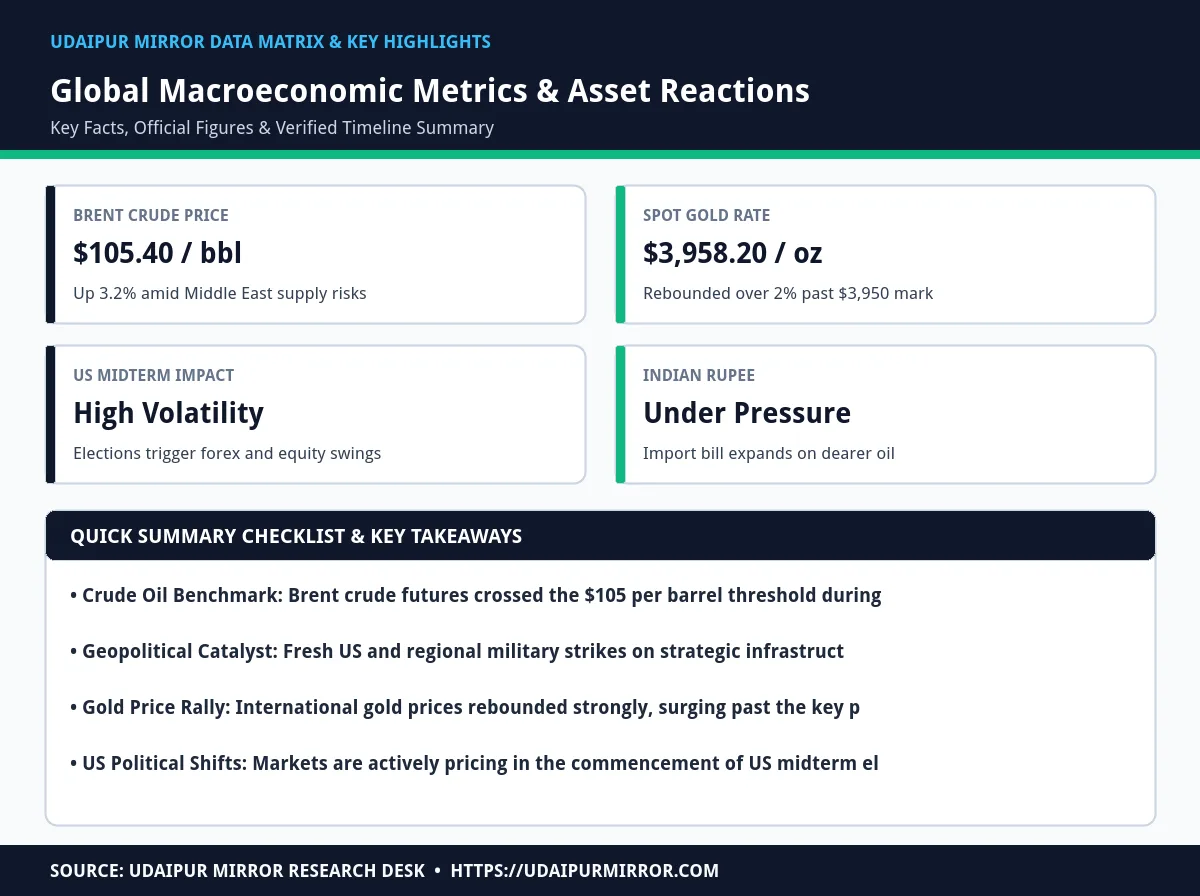
The following table outlines the current performance and intraday movement of major international commodities and financial benchmarks influencing cross-border trade and domestic investor sentiment on November 3, 2026.
| Asset Class | Current Price / Index | 24-Hour Change | Market Outlook |
|---|---|---|---|
| Brent Crude Oil | $105.40 / barrel | +3.25% | Bullish / Volatile |
| Spot Gold | $3,958.20 / ounce | +2.15% | Strong Safe Haven |
| S&P 500 Futures | 5,820 points | -0.85% | Cautious / Bearish |
| US Dollar Index | 104.15 | +0.40% | Strengthening |
| Nifty 50 Futures | 25,120 points | -0.60% | Consolidating |
Simultaneously, precious metals witnessed a massive flight to safety. After touching a one-year low earlier in the week, global gold prices staged an aggressive recovery, comfortably surpassing the $3,950 per ounce threshold. Institutional capital is flowing aggressively back into bullion ETFs and sovereign vaults as currency debasement fears mount alongside rising commodity bills.
Furthermore, retail investors looking at diversified portfolio allocations are also monitoring high-yield corporate primary offerings, such as when SFC Environmental Technologies IPO details, price band emerge alongside broader capital market reviews. However, macro assets like gold remain the primary barometer for systemic fear during geopolitical crunches.
“Gold reclaiming $3,950 confirms that institutional portfolios are actively hedging against twin threats: sticky global inflation and unpredictable geopolitical shocks.” — Head of Precious Metals Research
Compounding the commodity surge is the official commencement of the United States midterm elections. Wall Street indices—including the S&P 500, Nasdaq, and Dow Jones—opened lower in pre-market futures as traders priced in potential legislative gridlock and possible shifts in executive power following polls surrounding Donald Trump’s political standing and opposition momentum.
Currency markets have reacted swiftly, with the US Dollar Index strengthening as a secondary safe haven, putting emerging market currencies under severe strain. Foreign institutional investors (FIIs) are expected to adopt a risk-off stance across developing equity markets until political clarity emerges from Washington. (Also read: SFC Environmental Technologies IPO Details, Price Band, and Market Watch).
“The intersection of energy shocks and US election volatility creates a potent cocktail of uncertainty for global risk assets.” — Chief Global Equity Strategist
For India, a net importer of over 85% of its crude oil requirements, a sustained oil price above $105 poses immediate macroeconomic headwinds. The widening trade deficit puts direct pressure on the Indian Rupee, raising import bills for electronics, machinery, and energy. Domestically, higher transportation fuel costs threaten to stoke retail inflation, complicating the Reserve Bank of India’s interest rate trajectory.
Indian equity benchmarks like the Sensex and Nifty face short-term selling pressure from foreign portfolio outflows. However, sector-specific opportunities remain robust, with retail investors also evaluating active primary market opportunities such as those seen when reviewing HGS (India) IPO GMP review, dates and allotment details. Long-term investors are advised to focus on domestic consumption plays while hedging against high-beta energy exposures.
“India's macroeconomic fundamentals remain resilient, but a prolonged oil shock above $105 will necessitate strict fiscal vigilance and careful monetary management.” — Senior Macroeconomist, Mumbai Financial District
Crude oil rebounded to $105 due to fresh military strikes in the Middle East that overshadowed ongoing diplomatic peace talks, raising fears of physical supply disruptions.
Global gold prices surged more than 2%, comfortably surpassing the $3,950 per ounce mark as investors sought safe-haven assets amidst escalating macroeconomic risks.
Higher crude oil prices increase India’s import bill, widen the current account deficit, put depreciation pressure on the Rupee, and risk fueling domestic retail inflation.
The US midterm elections are driving volatility across Wall Street futures and currency markets, with investors pricing in potential policy shifts and legislative gridlock.
Add Udaipur Mirror as a preferred source on Google to see more of our travel guides in your AI overviews.