Office Address
14, Residency Road, Udaipur, Rajasthan 313001
Office Address
14, Residency Road, Udaipur, Rajasthan 313001


JAIPUR / UDAIPUR: JAIPUR / UDAIPUR — As energy demands surge across households in Rajasthan, residential consumers are increasingly turning toward clean and affordable solar energy solutions. The central and state governments have streamlined the rollout of the pm surya ghar muft bijli yojana rajasthan framework, enabling domestic electricity consumers to slash their monthly utility bills to near zero. Backed by robust financial incentives and simplified online processing portals, the initiative offers substantial capital subsidies for rooftop solar installations ranging from 1 kW to 3 kW capacities and beyond. For citizens exploring regional heritage and modern civic growth simultaneously, historical explorations like the Ahar Cenotaphs & Museum Udaipur Guide highlight how Rajasthan seamlessly bridges its glorious past with futuristic infrastructure developments.
⚡ Quick Highlights: PM Surya Ghar Yojana Rajasthan: Apply Online & Subsidy Rates
Before initiating an online application for rooftop solar deployment, applicants must verify that they meet all baseline criteria established by the Ministry of New and Renewable Energy (MNRE). The property must feature a suitable, shadow-free rooftop with structural integrity capable of supporting solar panel arrays and mounting frames.
Essential documentation includes a recent electricity bill issued by the local distribution company (AVVNL, JVVNL, or JdVVNL), a valid Jan Aadhaar card or Aadhaar card for identity proof, passport-size photographs, and bank account details linked with Aadhaar for direct subsidy transfers. Meanwhile, discussions regarding civic leadership echo sentiments that ‘Politics Must Be Driven by Character’, reminding public administrators of the need for transparent execution in welfare delivery.
“Adopting rooftop solar is not just about cutting down household expenses; it is a vital step toward making Rajasthan a self-reliant green energy hub.” — State Energy Department Official
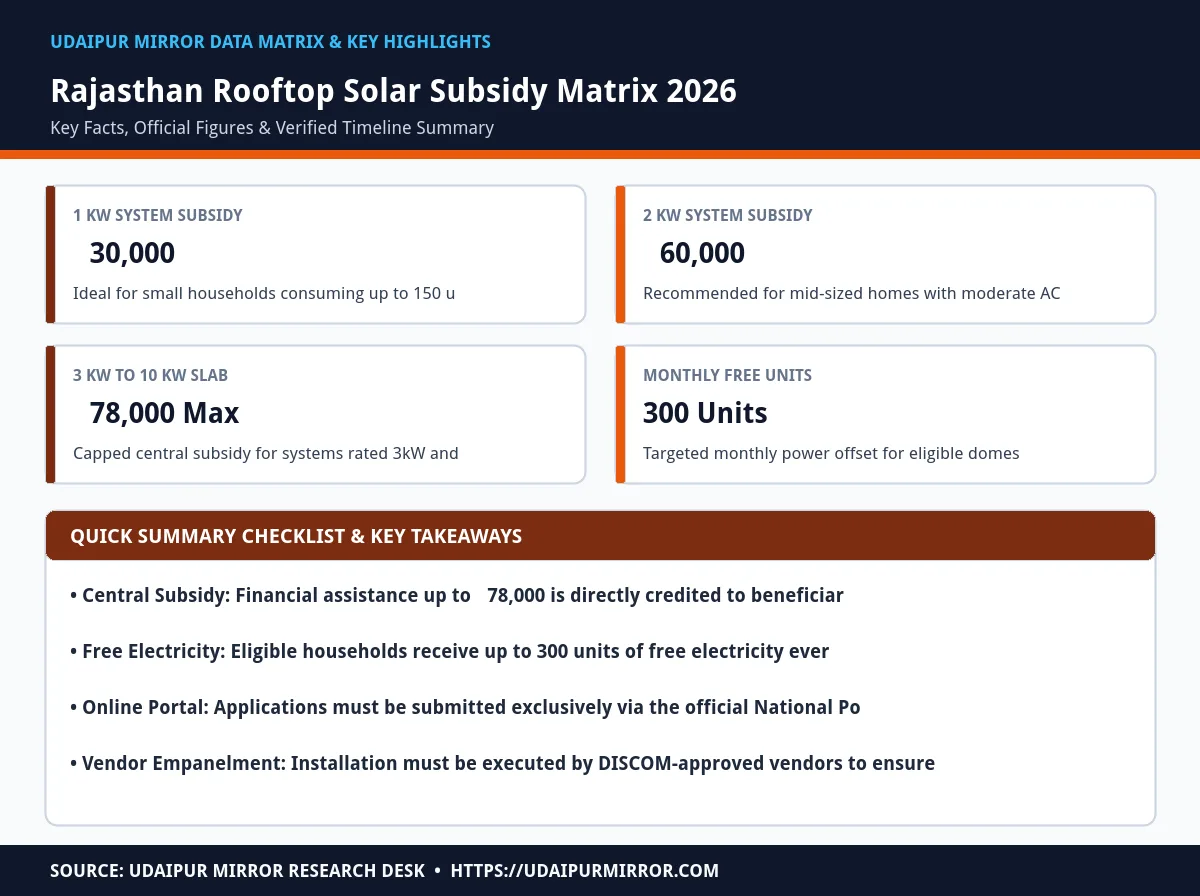
Review the following reference table detailing the system capacity, central financial assistance, required rooftop space, and expected daily solar generation for residential properties in Rajasthan.
| System Capacity | Central Subsidy | Rooftop Area Required | Avg. Daily Generation |
|---|---|---|---|
| 1 kW Rooftop | ₹30,000 | 10 Sq. Meters | 4.0 – 4.5 Units |
| 2 kW Rooftop | ₹60,000 | 20 Sq. Meters | 8.0 – 9.0 Units |
| 3 kW Rooftop | ₹78,000 | 30 Sq. Meters | 12.0 – 13.5 Units |
| 5 kW Rooftop | ₹78,000 + Slabs | 50 Sq. Meters | 20.0 – 22.5 Units |
| 10 kW Rooftop | Commercial Rates | 100 Sq. Meters | 40.0 – 45.0 Units |
The application journey has been completely digitized to eliminate middlemen and bureaucratic delays. Citizens can complete the registration within minutes by visiting the official PM Surya Ghar portal and following a structured workflow.
First, register on the portal using your state, electricity distribution company, and consumer account number. Once logged in, submit the rooftop solar application form with technical details of your expected load. After receiving feasibility approval from your local DISCOM, engage an empanelled vendor to complete the physical installation.
“The entire digital interface ensures complete transparency, allowing consumers to track every milestone from application approval to subsidy credit.” — Discom Technical Coordinator
Net metering is the cornerstone of the rooftop solar framework. It enables the bidirectional measurement of electricity consumed from the grid versus surplus solar energy exported back into the distribution network. Following the physical installation of the inverter and panels, an application for net meter testing must be submitted through the portal.
Engineers from the regional DISCOM will inspect the wiring, earthing safety standards, and inverter settings. Upon successful verification, a bi-directional net meter is installed, replacing the conventional meter and accurately reflecting net energy consumption on monthly billing cycles. (Also read: ‘Politics Must Be Driven by Character’: Ruhullah Plans New Movement).
“Net metering bridges the gap between self-consumption and commercial grid feeds, ensuring consumers get financial credit for every extra unit generated.” — Electrical Inspectorate Division
One of the primary concerns for homeowners is the timeline and mechanism of subsidy disbursement. Once the net meter is successfully installed and commissioning report is uploaded by the DISCOM on the national portal, the central financial assistance is processed directly to the beneficiary’s bank account within 30 working days.
Beyond direct subsidies, households save substantially on recurring electricity expenses. For instance, a standard 3 kW system generating around 350 units monthly can eliminate electricity charges entirely for families under the 300-unit free tier, while massive infrastructure undertakings like plans where NBCC to Construct World’s Largest Maharana Pratap Statue at Haldighati highlight how regional development continues to thrive across the state.
“Direct benefit transfers ensure that subsidies reach consumers without delay, making green technology financially accessible to middle-class families.” — Financial Welfare Analyst
The maximum central financial assistance is capped at ₹30,000 for a 1 kW system, ₹60,000 for a 2 kW system, and ₹78,000 for systems of 3 kW capacity and higher for residential consumers.
Tenants can install rooftop solar systems provided they secure a No Objection Certificate (NOC) from the property owner and have a valid individual electricity connection in their name.
Once the net meter is installed and the commissioning certificate is verified and uploaded by the local DISCOM on the portal, the subsidy is typically credited within 30 working days.
Yes, to qualify for central government subsidies and ensure technical standards compliance, installations must be carried out exclusively by vendors empanelled with the state DISCOM.
Add Udaipur Mirror as a preferred source on Google to see more of our travel guides in your AI overviews.



[…] Planning Services in India Expand as Retail Participation Surges in 2026 4 seconds ago ⚡ Articles PM Surya Ghar Muft Bijli Yojana Rajasthan: Online Apply, Subsidy Rates & Net Metering … Articles Ahar Cenotaphs & Museum Udaipur Guide 2026: Royal Mewar Chhatris, 4000-Year […]