Office Address
14, Residency Road, Udaipur, Rajasthan 313001
Office Address
14, Residency Road, Udaipur, Rajasthan 313001


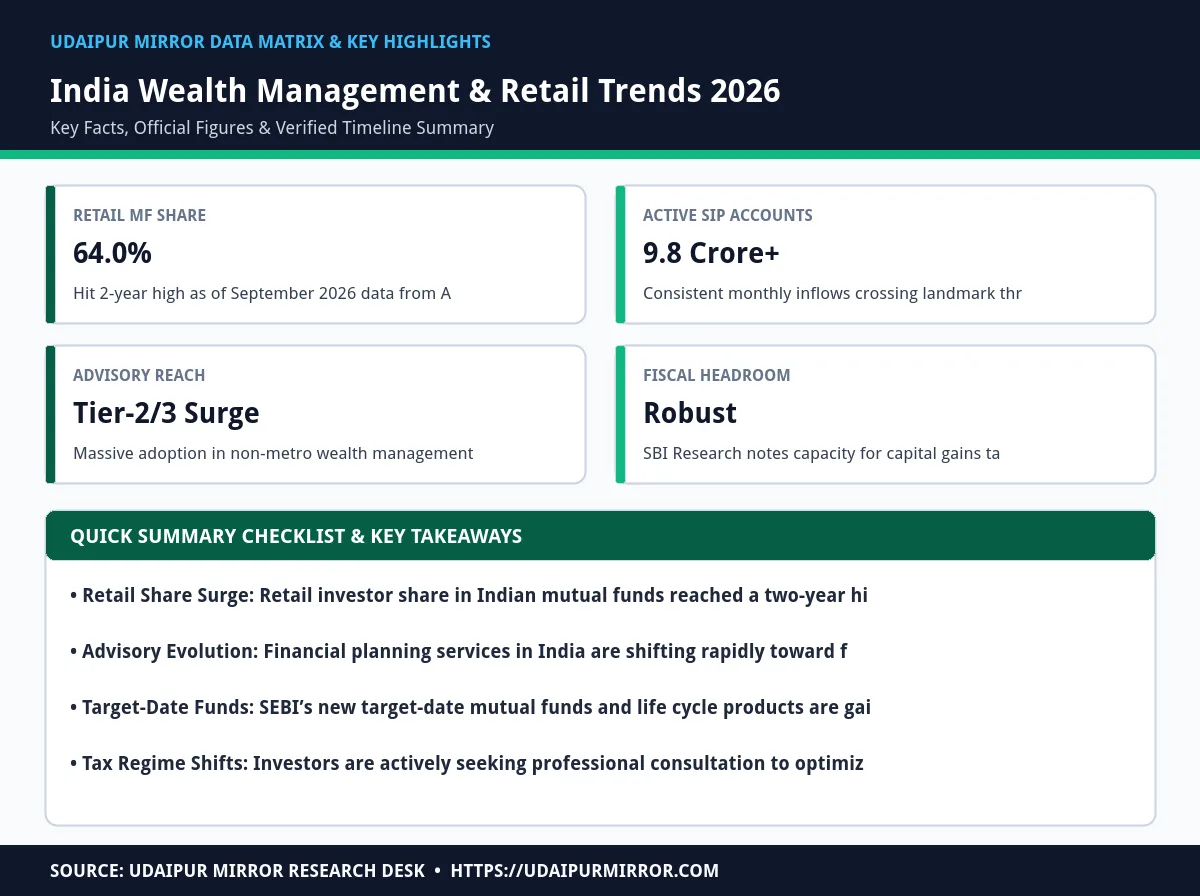
NEW DELHI: NEW DELHI — The demand for structured financial planning services in india has experienced an unprecedented surge as retail participation in domestic capital markets continues its stellar upward trajectory. According to recent data released by the Association of Mutual Funds in India (AMFI), retail investor share in mutual funds scaled a two-year high of 64 percent, underscoring a structural shift in how Indian households manage their hard-earned savings. This monumental transition from traditional fixed-income instruments to equity mutual funds, systematic investment plans (SIPs), and sophisticated wealth advisory frameworks has prompted financial institutions to overhaul their advisory models. As market complexities multiply with evolving tax regimes and regulatory updates, professional guidance has transitioned from a luxury for ultra-high-net-worth individuals to an essential roadmap for everyday retail earners navigating the modern financial ecosystem.
⚡ Quick Highlights: Financial Planning Services in India: 2026 Growth & Growth
For decades, the Indian middle class parked the majority of its savings in traditional bank fixed deposits, gold bullion, and physical real estate. However, the economic landscape of 2026 demonstrates a decisive pivot toward financialized assets. With active SIP accounts crossing landmark figures and monthly inflows breaking previous records, retail investors are displaying remarkable maturity. Households no longer view the stock market as a speculative casino but as a primary vehicle for wealth accumulation and beating inflation.
This behavioral transformation has placed immense pressure on traditional banking institutions to upgrade their advisory verticals. Consumers today demand transparent, goal-based wealth management rather than product-pushing sales tactics. To complement their long-term portfolios, many forward-thinking investors are also leveraging clean energy subsidies and modern residential upgrades, similar to how families utilize schemes detailed under PM Surya Ghar Muft Bijli Yojana Rajasthan: Online Apply, Subsidy Rates & Net Metering Rules to reduce fixed household overheads and free up surplus capital for monthly equity investments.
“The democratization of India's capital markets is complete. Retail investors are now the anchor of domestic equity stability.” — Senior Market Strategist, Mumbai
Choosing the right asset class and advisory structure requires a clear understanding of risk, return potential, and regulatory guidelines for FY 2026-27. Below is a structured comparison of popular investment and planning avenues currently utilized by Indian retail participants.
| Investment / Service Vehicle | Primary Objective | Risk Profile | Regulatory Framework |
|---|---|---|---|
| Systematic Investment Plans (SIP) | Long-term wealth creation & compounding | Moderate to High | SEBI & AMFI Guidelines |
| Target-Date Life Cycle Funds | Automated glide-path retirement planning | Moderate | SEBI Mutual Fund Regulations |
| Sovereign Gold Bonds (SGB) | Capital preservation & sovereign gold exposure | Low to Moderate | Reserve Bank of India (RBI) |
| ELSS Tax-Saving Funds | Section 80C tax deduction & equity growth | High | Income Tax Act & SEBI |
| Traditional PPF & SCSS | Guaranteed fixed-income returns | Very Low | Ministry of Finance, Government of India |
To address the complexities of retirement planning, the Securities and Exchange Board of India (SEBI) has facilitated the rollout of target-date mutual funds and advanced life cycle products. These innovative investment vehicles automatically adjust their asset allocation—gradually shifting from aggressive equities to conservative fixed-income instruments as the target maturity date approaches. This ‘set-and-forget’ mechanism removes emotional bias from portfolio rebalancing, making it an ideal choice for salaried professionals who lack the time to monitor markets daily.
Financial planners across major financial hubs are integrating these target-date funds into standard retirement advisory packages. By aligning risk exposure strictly with an individual’s biological and career timeline, these funds minimize sequence-of-returns risk during the critical retirement drawdown phase. Furthermore, as citizens plan their long-term estates, many also engage in cultural preservation and heritage financial planning, mirroring the meticulous care seen in municipal restorations such as the historical insights found within the Ahar Cenotaphs & Museum Udaipur Guide 2026.
“Target-date funds solve the biggest dilemma in retail investing: knowing exactly when and how to shift from risk to safety.” — Principal Wealth Advisor, New Delhi
Recent policy discussions have also brought taxation on capital gains to the forefront of financial planning. Recent research reports from institutions like SBI Research suggest that the Central Government possesses sufficient fiscal headroom to evaluate potential rationalizations or alternatives to the Long-Term Capital Gains (LTGC) tax structure. Such flexibility could provide additional impetus to domestic equity investments by reducing friction costs for long-term holders.
As retail investors prepare their annual tax filings for FY 2026-27, distinguishing between the Old Tax Regime (with its plethora of deductions under Section 80C, 80D, and home loan interest) and the simplified New Tax Regime remains crucial. Professional financial advisors play an indispensable role here, running personalized cash-flow models to determine whether tax-saving instruments like ELSS mutual funds outweigh the lower tax slab rates offered under the revised tax framework. (Also read: Ahar Cenotaphs & Museum Udaipur Guide 2026: Royal Mewar Chhatris, 4000-Year Archaeology & Timings).
“Fiscal headroom gives policymakers the luxury to design tax structures that reward long-term capital formation rather than penalize it.” — Macroeconomic Analyst, Bengaluru
Financial planning services in India encompass professional advisory frameworks that help individuals manage income, expenses, tax planning, investments, insurance, and retirement goals through personalized strategies.
Retail participation has reached record highs due to increased digital financial literacy, easy onboarding via fintech apps, robust long-term equity returns, and a cultural shift away from traditional physical assets.
Target-date mutual funds automatically adjust their asset allocation mix—moving from high-equity growth to conservative fixed-income debt—as the investor approaches a predetermined target retirement year.
The choice depends on your eligible deductions. If you utilize extensive deductions like Section 80C, HRA, and home loan interest, the Old Regime may save you more; otherwise, the New Tax Regime offers lower tax slabs with fewer compliances.
Add Udaipur Mirror as a preferred source on Google to see more of our travel guides in your AI overviews.






[…] Nathdwara 8-Jhanki Darshan Timings & Mewar Pilgrim Heritage Guide 2026 4 seconds ago ⚡ Articles Financial Planning Services in India Expand as Retail Participation Surges in 2026 36 minu… Articles PM Surya Ghar Muft Bijli Yojana Rajasthan: Online Apply, Subsidy Rates & Net Metering […]