Office Address
14, Residency Road, Udaipur, Rajasthan 313001
Office Address
14, Residency Road, Udaipur, Rajasthan 313001


JAIPUR / UDAIPUR: As households across the state accelerate their transition toward renewable energy, understanding the structural mechanics of solar net metering in rajasthan has become essential for maximizing financial returns. Under the updated regulatory framework enforced by Rajasthan’s state electricity distribution companies—Ajmer Vidyut Vitran Nigam Limited (AVVNL), Jaipur Vidyut Vitran Nigam Limited (JVVNL), and Jodhpur Vidyut Vitran Nigam Limited (JdVVNL)—homeowners installing rooftop photovoltaic systems under the PM Surya Ghar scheme must navigate precise technical guidelines. From securing an Assistant Engineer feasibility report to installing bi-directional smart meters, navigating DISCOM protocols ensures seamless grid integration and maximized unit banking credits.
⚡ Quick Highlights: Rajasthan Solar Net Metering 2026: AVVNL & JVVNL Rules
Navigating the regulatory landscape of Rajasthan requires a clear grasp of how electricity accounting operates. Under net metering regulations enforced by AVVNL, JVVNL, and JdVVNL, homeowners consume solar energy generated on-site and export excess units back to the state grid. This methodology reduces electricity bills substantially by charging only for the net energy consumed. Conversely, gross metering mandates that every single unit generated by the rooftop solar array is fed directly into the distribution network through a dedicated generation meter, with the consumer being compensated at a predetermined feed-in tariff.
For most residential rooftop owners participating in national green initiatives, net metering remains the preferred and economically viable path. It allows families to hedge against rising conventional electricity tariffs while ensuring that no self-generated clean energy goes to waste. As capital markets and household expenditures shift toward sustainable assets, smart investments in green technology parallel broader financial strategies, much like diversifying portfolios with precious metal and tech purchases during festive seasons.
“Net metering provides consumers with absolute financial transparency, ensuring that every kilowatt-hour generated on residential rooftops directly offsets grid consumption.” — State Renewable Energy Directorate Official
Choosing the correct metering mechanism is critical for maximizing household savings. While net metering offsets self-consumption by measuring the net difference between energy imported from and exported to the grid, gross metering measures all generated power independently. Review the regulatory comparison table below to determine which framework applies to your specific installation tier.
| Parameter | Net Metering Framework | Gross Metering Framework | Applicable Consumer Tier |
|---|---|---|---|
| Primary Objective | Offset self-consumption & bank surplus | Inject 100% solar generation into grid | Residential & small commercial |
| Meter Setup | Single bi-directional smart meter | Two separate meters (generation & import) | Mandatory for systems > 10kW commercial |
| Billing Logic | Net units (Import minus Export) | Feed-in tariff paid for total generation | Standardized across AVVNL and JVVNL |
| Surplus Credit | Rolled over monthly & settled annually | Direct monetary payout via feed-in tariff | Governed by RERC guidelines |
| Regulatory Approval | AEN technical feasibility mandatory | DISCOM substation clearance required | All rooftop applicants in Rajasthan |
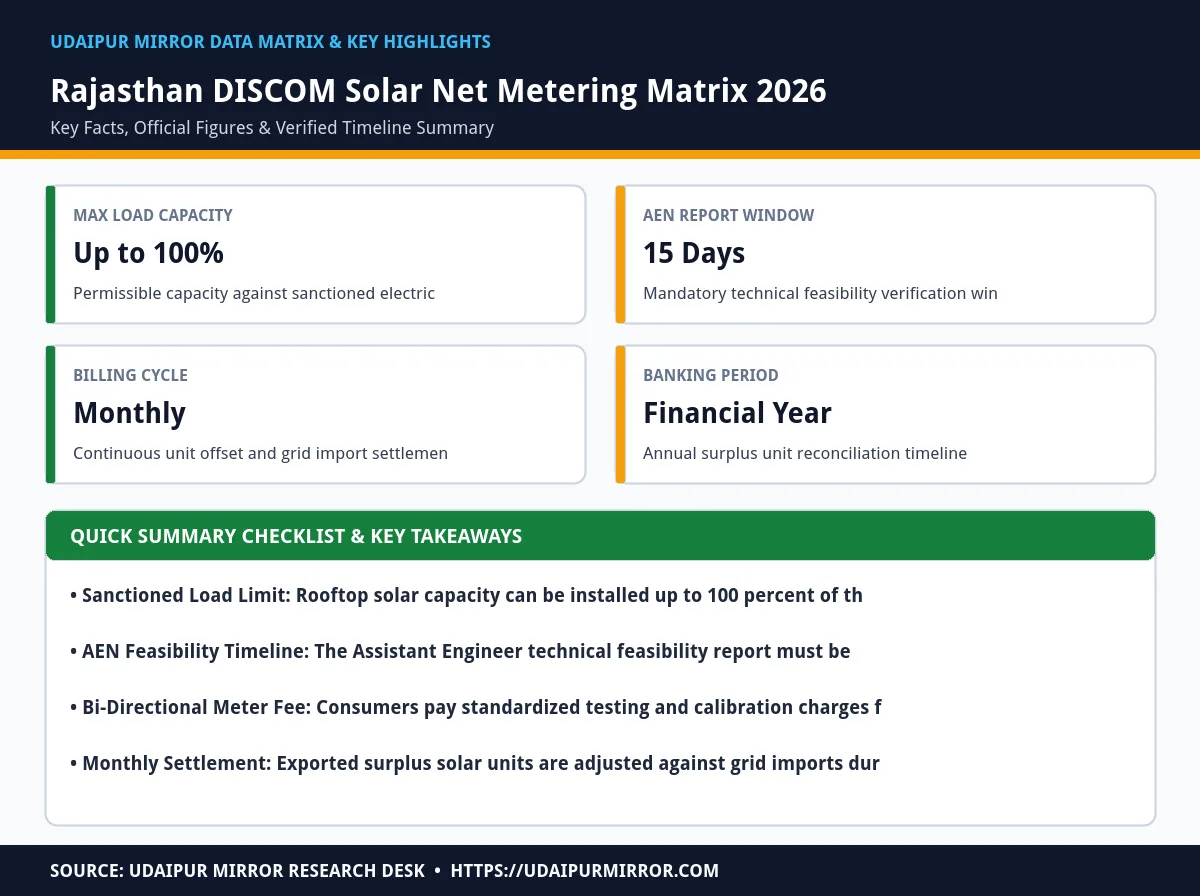
The journey toward a operational rooftop solar connection begins with an online application filed through the official Rajasthan DISCOM portal. Once submitted, the local Assistant Engineer (AEN) initiates a technical feasibility study to evaluate the transformer capacity, wiring infrastructure, and safety clearances of the residential premises. Per current service standards, the AEN must complete this evaluation and issue a feasibility report within 15 working days.
Sanctioned electrical load limits dictate the maximum permissible capacity of the solar inverter. Homeowners can install photovoltaic systems with a capacity of up to 100 percent of their sanctioned connected load. If an applicant wishes to install a higher capacity, they must first apply for an official load enhancement with their respective discom division. Securing this preliminary approval guarantees that the existing neighborhood transformer will not face thermal overloads when surplus power is injected back into the grid.
“Strict adherence to AEN feasibility timelines ensures grid stability across rural and urban distribution circles in Rajasthan.” — DISCOM Technical Operations Head
Following successful physical installation by an approved vendor and receipt of safety clearances, the deployment of a bi-directional smart meter is mandatory. This specialized meter records both electricity imported from the DISCOM grid and surplus solar energy exported back into the network. Consumers are required to pay standardized bi-directional meter testing and calibration charges directly to the utility before the final synchronization takes place.
The testing protocol ensures tamper-proof data recording and accurate time-of-day tariff calculations. Once tested at authorized DISCOM laboratories, the meter is mounted on the consumer premises by certified line staff. Just as consumers meticulously verify purity marks and bullion certificates when evaluating market-driven gold investments, verifying the calibration certificates of your bi-directional solar meter guarantees accurate monthly energy accounting.
“Bi-directional metering is the technological backbone of decentralized power generation, ensuring tamper-proof credit accounting for every unit exported.” — Chief Engineer, Smart Metering Cell
The financial settlement of solar generation operates on a dual-tier cycle comprising monthly bill adjustments and annual banking reconciliations. During each monthly billing cycle, the total imported units from the grid are offset against the total exported solar units. If generation exceeds consumption, the surplus units are carried forward as a credit balance in the consumer’s virtual energy account.
At the conclusion of the financial year (March 31), any unadjusted accumulated surplus units are subjected to annual banking settlements governed by Rajasthan Electricity Regulatory Commission (RERC) guidelines. This framework ensures that residential prosumers are fairly compensated or credited for their annual net contribution to the state’s green energy pool, safeguarding against seasonal generation fluctuations caused by winter fog or summer overcast conditions.
“Annual banking provisions protect residential solar adopters by rolling over surplus generation through low-consumption winter months.” — RERC Regulatory Affairs Analyst
Despite streamlined digital procedures, procedural delays occasionally arise regarding physical smart meter installation by local DISCOM divisions. When meter deployment exceeds the statutory 30-day window following system completion, consumers have access to a structured grievance redressal mechanism. Escalations can be lodged via the state’s central consumer helpline or through online grievance portals managed independently by AVVNL, JVVNL, and JdVVNL.
Escalating unresolved delays through the Consumer Grievance Redressal Forum (CGRF) ensures that utilities adhere to mandated service level agreements (SLAs). Prosumers should retain all work completion certificates, vendor invoices, and AEN feasibility approvals as documentary evidence when filing formal tracking tickets to expedite their grid synchronization.
“Empowering prosumers with rapid grievance redressal pathways ensures accountability across all distribution circles.” — State Consumer Ombudsman
You can install a rooftop solar system with a total capacity of up to 100 percent of your sanctioned electrical load without requiring a formal load enhancement from your DISCOM.
The Assistant Engineer (AEN) is mandated to complete the technical feasibility inspection and issue the report within 15 working days of submitting your application on the DISCOM portal.
Unadjusted surplus solar units banked in your account are reconciled annually at the end of the financial year (March 31) in accordance with RERC regulatory guidelines.
If your meter installation exceeds 30 days following system completion, you can file a formal complaint through the state DISCOM consumer grievance portal or escalate the matter to the CGRF.
Add Udaipur Mirror as a preferred source on Google to see more of our travel guides in your AI overviews.