Office Address
14, Residency Road, Udaipur, Rajasthan 313001
Office Address
14, Residency Road, Udaipur, Rajasthan 313001


JAIPUR: JAIPUR — In a major administrative push toward transparent financial aid delivery, the Rajasthan state administration has officially confirmed that rajasthan transfers rs 482 cr directly to the bank accounts of 66 lakh students across the state. Announced on Saturday, November 7, 2026, this massive welfare rollout aims to streamline scholarship distribution, uniform allowances, and textbook stipends, cutting out middlemen and ensuring that grassroots beneficiaries receive their financial entitlements without administrative delays. This initiative aligns with broader regional economic developments, such as the recent industrial area expansion in Jodhpur-Pali-Marwar, highlighting the state’s balanced focus on fiscal infrastructure and human capital development.
⚡ Quick Highlights: Rajasthan Transfers Rs 482 Cr To 66 L Students via DBT
The implementation of the Direct Benefit Transfer (DBT) framework represents a monumental shift in how state-sponsored financial aid reaches citizens. By bypassing traditional bureaucratic bottlenecks and physical voucher systems, the government ensures that funds move securely from state treasuries directly into Aadhaar-seeded bank accounts. This prevents administrative delays and eliminates intermediaries.
Educational administrators have noted that transparency has improved exponentially. Families no longer need to visit district offices for follow-ups; automated SMS notifications alert parents the moment funds land in their accounts. Furthermore, visitors exploring cultural hubs, such as those planning trips after checking out top national tourist rankings for Udaipur, can observe firsthand how digital governance is transforming public service delivery across Rajasthan.
“Digital financial architecture ensures that every single rupee sanctioned for a student's welfare reaches their account without friction.” — State Education Department Spokesperson
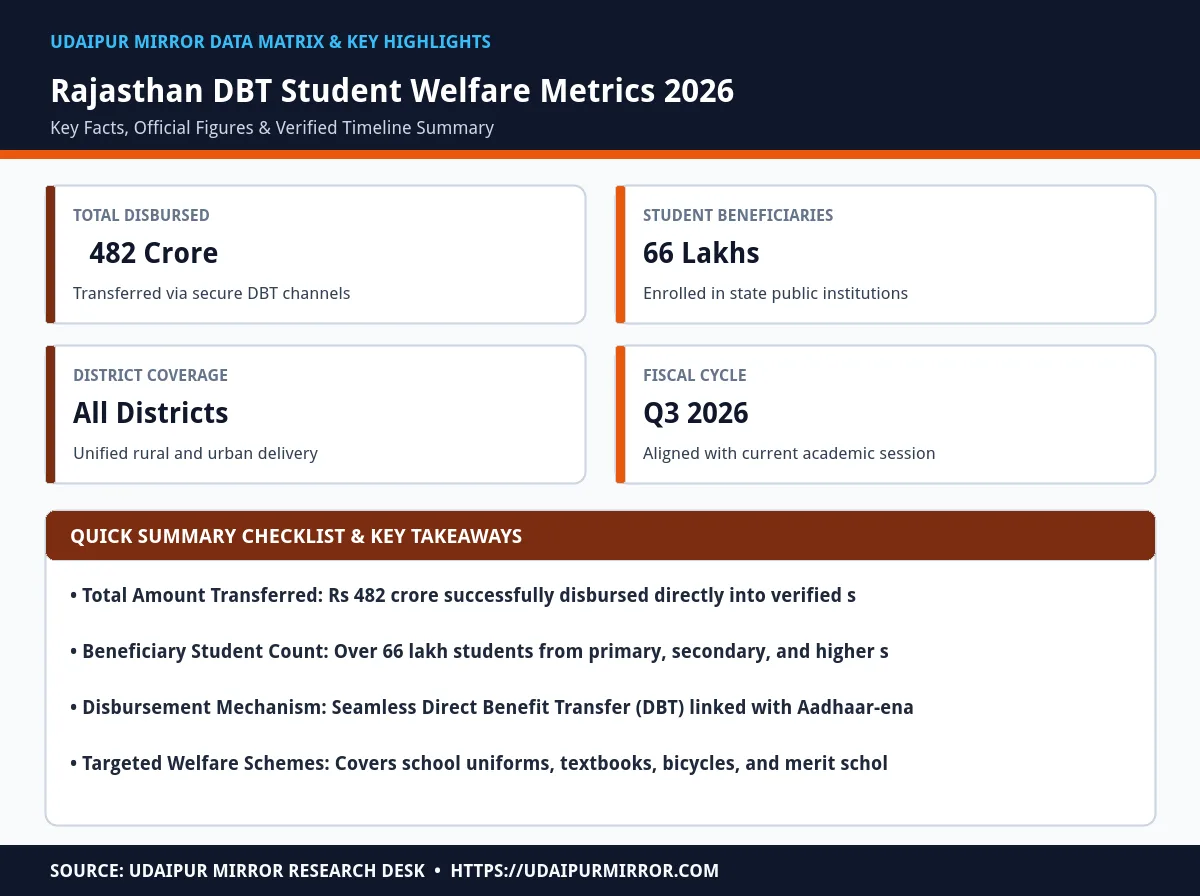
The distribution of the Rs 482 crore financial package is strategically mapped across various administrative zones in Rajasthan. The following reference table outlines the estimated student beneficiary brackets, core welfare components covered under the scheme, and verification status across major educational zones for the current academic session.
| Administrative Zone | Est. Beneficiaries | Primary Component Covered | Verification Status |
|---|---|---|---|
| Jaipur & Amber Region | 11.5 Lakhs | Uniforms & Textbooks Stipend | 99.4% Completed |
| Jodhpur Marwar Zone | 9.8 Lakhs | Merit Scholarships & Bicycles | 98.9% Completed |
| Udaipur Mewar Division | 8.7 Lakhs | Tribal Student Support Grants | 99.1% Completed |
| Kota & Hadoti Region | 7.2 Lakhs | Higher Education Board Aid | 98.5% Completed |
| Bikaner & Western Sector | 8.1 Lakhs | Rural School Welfare Stipends | 99.0% Completed |
| Ajmer Central Zone | 6.5 Lakhs | General Educational Assistance | 98.8% Completed |
The Rs 482 crore financial package is not a singular grant but a consolidated fund supporting multiple ongoing student welfare initiatives. These include annual uniform grants, textbook distribution allowances, bicycle distribution programs for girl students in rural areas, and merit-based stipends for secondary school achievers.
By consolidating these streams into a single disbursement window, the government has reduced administrative overheads while maximizing the purchasing power of families at the beginning of the academic term. Schools have also reported higher attendance rates and improved engagement as financial barriers to basic educational materials are systematically dismantled.
“Our objective is to ensure that financial constraints never become a reason for any child in Rajasthan to drop out of school.” — Directorate of Secondary Education Official
To qualify for funds under this massive DBT rollout, students must meet specific state-mandated criteria. Beneficiaries must be enrolled in recognized government or government-aided schools across Rajasthan, maintain a minimum attendance threshold of 75 percent, and possess a verified Jan Aadhar card linked with their active bank account.
Educational institutions play a crucial role in vetting student records before final submission to the state treasury portal. Parents and guardians are advised to keep their KYC documentation updated with their respective banking institutions to avoid transaction failures during future disbursement cycles. (Also read: Udaipur Ranked 7th Among Top 10 Diwali Destinations Nationwide | देश के टॉप-10 दीपावली डेस्टिनेशन में उदयपुर 7वें नंबर पर).
Financial inclusion initiatives in Rajasthan extend far beyond immediate classroom needs. By introducing millions of young students and their families to formal banking channels early on, the state is fostering long-term digital financial literacy. Children grow up witnessing transparent digital transactions, which positively influences community economic behaviors.
As educational infrastructure and fiscal governance continue to evolve in tandem with industrial milestones, Rajasthan is solidifying its position as a progressive state capable of managing large-scale welfare distributions efficiently and equitably.
The Rajasthan government has transferred a total of Rs 482 crore directly into the bank accounts of students across the state.
Approximately 66 lakh students across primary, secondary, and higher secondary institutions benefited from this disbursement.
Funds are distributed securely through the Direct Benefit Transfer (DBT) mechanism, linked directly with verified Aadhaar and Jan Aadhar accounts.
The funds cover school uniforms, textbook stipends, merit scholarships, and bicycle distribution programs for eligible students.
Add Udaipur Mirror as a preferred source on Google to see more of our travel guides in your AI overviews.




[…] buying: Drop in yellow metal prices boosts jewellery sales – Should you buy? 11 minutes ago ⚡ Articles Rajasthan Transfers Rs 482 Cr To 66 L Students Through Direct Benefit Transfer 27 minutes … Articles Rajasthan Plans to Develop Additional 300 Hectares at Jodhpur-Pali-Marwar Industrial Area […]