Office Address
14, Residency Road, Udaipur, Rajasthan 313001
Office Address
14, Residency Road, Udaipur, Rajasthan 313001


NEW DELHI / KOLKATA: NEW DELHI / KOLKATA — In an unprecedented administrative escalation that has caught national observers off guard, the Trinamool Congress (TMC) has initiated a massive campaign involving the submission of lakhs of sworn declarations. This intense tmc war of affidavits unfolding before the Election Commission of India (ECI) marks a critical turn in contemporary electoral governance, setting up a complex legal and procedural battleground as national and regional bodies grapple with transparency norms.
⚡ Quick Highlights: TMC War of Affidavits in Election Commission: Latest Updates
The decision by the ruling camp in West Bengal to compile and transport declarations numbering in the lakhs represents a novel tactic in electoral dispute resolution. Rather than relying solely on traditional judicial petitions or standard memorandum submissions, the party has opted for individual sworn affidavits to document grievances regarding electoral rolls and voter verification. This strategy places an immense administrative burden on the central poll panel, requiring unprecedented verification protocols.
Observers note that while political parties frequently contest electoral rolls, the sheer scale of this intervention transforms a routine administrative grievance into a high-visibility political campaign. As policymakers navigate complex educational reforms—such as those seen when the Bengal Govt Clears 393 Private BEd Colleges for Admissions in 2026-28 Session—governance structures in the state remain under constant scrutiny from both national and regional administrative watchdogs.
“Submitting lakhs of individual sworn affidavits redefines how political entities challenge administrative oversight and electoral rolls in India.” — Senior Electoral Law Analyst
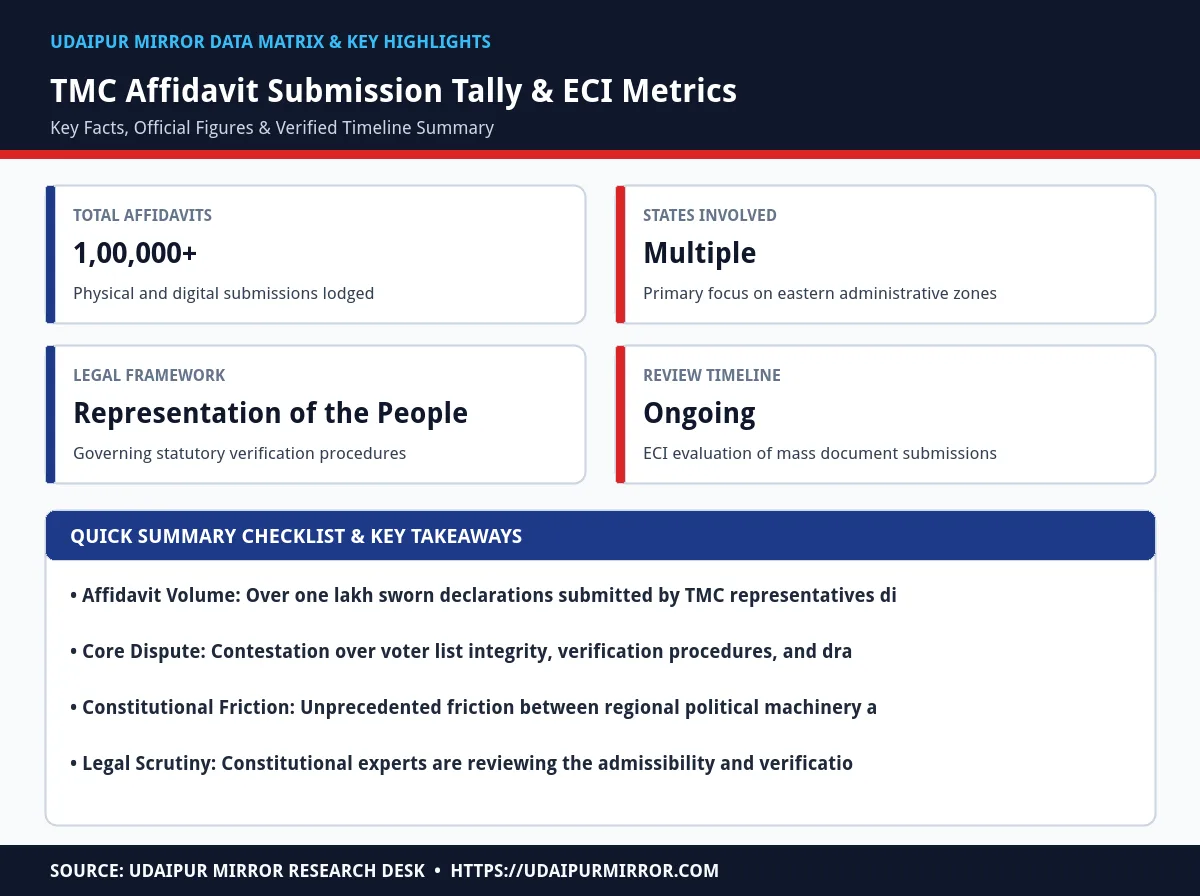
The following table tracks the sequence of events leading up to the current affidavit mobilization, highlighting key regulatory interventions and administrative developments across various jurisdictions.
| Date | Event Description | Key Authority / Party | Impact Level |
|---|---|---|---|
| November 6, 2026 | EC re-opens window for electors left out of draft rolls | Election Commission | High |
| November 6, 2026 | Former CEC questions legal validity of specific state polls | Legal Experts | Moderate |
| November 7, 2026 | Panchayat voter status discrepancies highlighted | Civil Society / Collective | High |
| November 8, 2026 | Massive submission of TMC affidavits at ECI office | Trinamool Congress | Critical |
The Election Commission of India operates under strict constitutional mandates governed by Article 324 and the Representation of the People Act. When faced with a deluge of individual affidavits, the commission must balance its statutory duty to verify electoral rolls efficiently with the obligation to address legitimate grievances raised by registered political entities. Legal experts have pointed out that while political parties possess the right to make representations, processing individualized claims at this magnitude tests the operational limits of election machinery.
Furthermore, this development intersects with broader urban and real estate governance shifts occurring across other fast-growing regions—comparable to the trends observed when Udaipur Property Boom: Over 25,000 Registrations in First 9 Months of 2026 as Luxury Duplexes and High-Rise Apartments Surge highlights how administrative efficiency underpins public trust in institutional registries.
“The ECI must adjudicate these filings strictly within the framework of statutory law, ensuring neither political pressure nor logistical constraints compromise electoral integrity.” — Constitutional Expert
The TMC’s affidavit campaign does not occur in a vacuum. Recent weeks have witnessed multiple controversies concerning voter lists across various states. Reports from civil society groups regarding voters incorrectly marked as deceased, alongside emergency windows opened by the poll panel for electors left out of draft rolls in multiple states, have heightened political sensitivity surrounding voter databases.
As political parties prepare for upcoming electoral cycles, the accuracy and transparency of electoral rolls remain paramount. The ongoing war of affidavits serves as both a pressure tactic and a reflection of deep-seated concerns regarding database management, setting a precedent for how political opposition groups may leverage mass documentation in future electoral disputes. (Also read: Udaipur Property Boom: Over 25,000 Registrations in First 9 Months of 2026 as Luxury Duplexes and High-Rise Apartments Surge | उदयपुर प्रॉपर्टी कारोबार में भारी तेजी).
“Voter list integrity is the bedrock of Indian democracy. Every discrepancy identified must be addressed with absolute transparency.” — Election Watchdog Representative
It refers to the Trinamool Congress submitting over a lakh sworn affidavits to the Election Commission of India to challenge voter list discrepancies and administrative decisions.
The submission is a high-stakes political and administrative strategy aimed at highlighting alleged errors, omissions, and verification issues in electoral rolls.
The ECI processes representations and statutory grievances according to the guidelines set under the Representation of the People Act and internal administrative protocols.
It tests the administrative capacity of election machinery and sets a new precedent for how political parties challenge electoral roll integrity in India.
Add Udaipur Mirror as a preferred source on Google to see more of our travel guides in your AI overviews.