Office Address
14, Residency Road, Udaipur, Rajasthan 313001
Office Address
14, Residency Road, Udaipur, Rajasthan 313001


HANOI / TOKYO: In a momentous diplomatic milestone that is set to reshape regional trade and geopolitical dynamics across Asia, vietnam top leader visits japan this weekend, ushering in an unprecedented era of enhanced strategic partnership. The high-level diplomatic engagement focuses heavily on diversifying global supply chains, strengthening high-tech manufacturing corridors, and securing critical investments in digital infrastructure and renewable energy. As Indo-Pacific security architectures evolve in 2026, both nations have signaled a shared commitment to maintaining maritime stability, boosting bilateral commerce, and countering macroeconomic vulnerabilities through robust institutional cooperation.
⚡ Quick Highlights: Vietnam Top Leader Visits Japan for Strategic Partnership
The state visit commenced with a ceremonial welcome at the Imperial Palace in Tokyo, followed by high-level bilateral negotiations between the Vietnamese delegation and Japanese government officials. The dialogue underscored a shared urgency to insulate bilateral trade from external macroeconomic shocks, volatile currency fluctuations, and shifting global trade tariffs. By streamlining regulatory frameworks, both administrations aim to facilitate smoother capital flows and encourage multinational enterprises to anchor their regional operations in Southeast Asia.
Furthermore, global macroeconomic analysts have noted that this bilateral alignment complements broader Asian market strategies. As industrial heavyweights recalibrate their footprints, capital is increasingly flowing toward stable emerging economies. In tandem with developments like India Launches Semicon 2.0 Portal and Approves ₹7,503 Crore in ECMS Applications, Asian nations are aggressively positioning themselves as indispensable nodes in the global technology hardware supply chain. (Also read: India Launches Semicon 2.0 Portal and Approves ₹7,503 Crore in ECMS Applications).
“Our partnership represents a bedrock of stability and mutual growth in an increasingly uncertain global economic landscape.” — Senior Diplomatic Spokesperson, Tokyo Summit
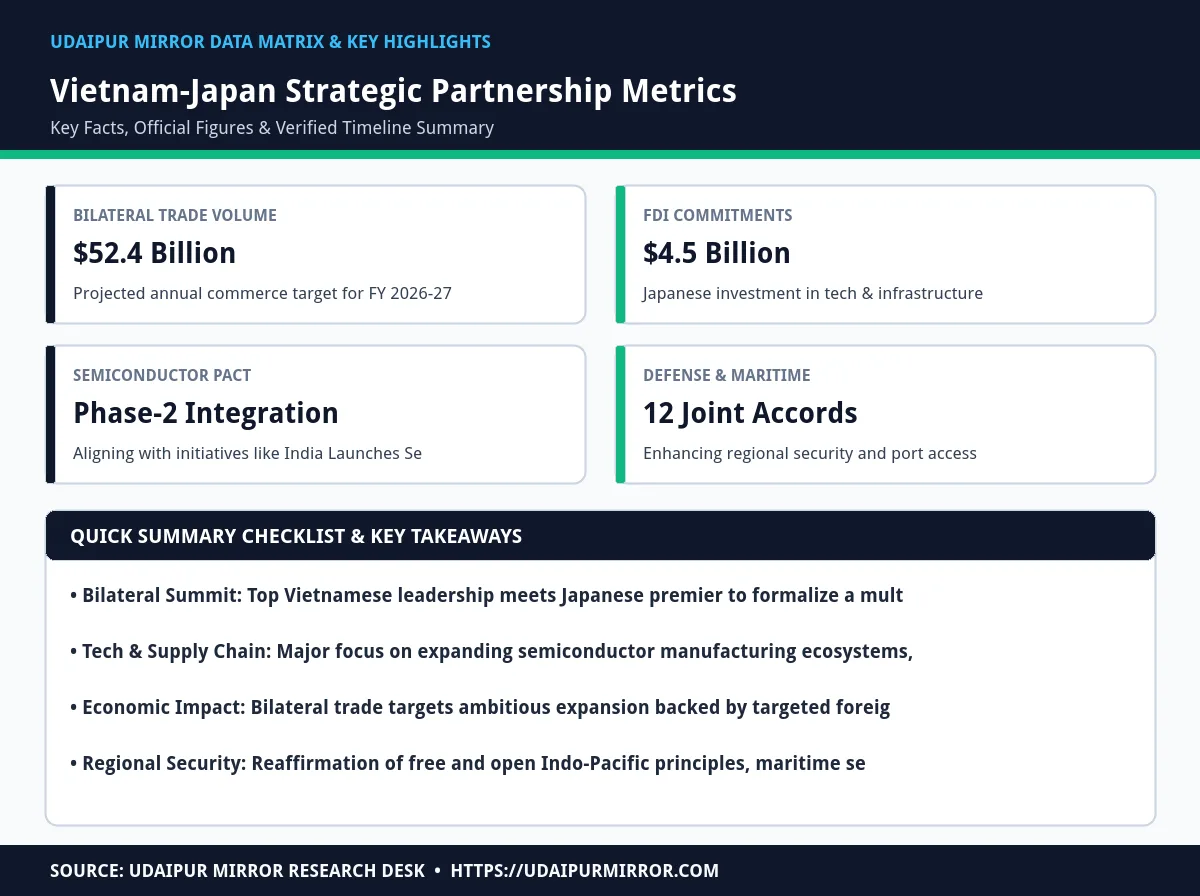
The comprehensive diplomatic visit is structured across four primary pillars designed to integrate industrial supply chains, financial markets, and strategic defense frameworks across Southeast and East Asia.
| Sector Focus | Key Objective | Financial Allocation | Strategic Impact |
|---|---|---|---|
| Semiconductors & Tech | Supply chain diversification & chip design | $1.8 Billion | Integration with global electronics manufacturing |
| Green Energy & Solar | Renewable grid expansion & decarbonization | $1.5 Billion | Alignment with global net-zero emission targets |
| Maritime Security | Joint patrols & naval modernization aid | $800 Million | Ensuring freedom of navigation in Indo-Pacific |
| Consumer Goods & Retail | Streamlining export-import regulatory clearances | $400 Million | Bolstering consumer market resilience, similar to shifts seen as Coca-Cola India Bottling Arm HCCH Files DRHP for Mega Initial Public Offering |
| Human Capital | Vocational training & technical exchange programs | $500 Million | Addressing high-tech labor shortages across industries |
A cornerstone of the discussions in Tokyo centered on technology transfer and joint ventures in advanced manufacturing. With global demand for semiconductors, electric vehicle components, and smart consumer electronics surging, Japanese technology giants are expanding their manufacturing footprint in Vietnam. This industrial expansion mirrors the aggressive domestic pushes seen across emerging markets, where nations are racing to capture high-value manufacturing segments.
The collaboration also touches upon consumer sector resilience and retail supply chains. As corporate entities pursue aggressive growth strategies—comparable to how Coca-Cola India Bottling Arm HCCH Files DRHP for Mega Initial Public Offering—efficient logistical corridors and predictable trade policies established under this new partnership will provide businesses with the stability required for long-term capital allocation and large-scale public offerings.
“Technology collaboration between Tokyo and Hanoi will serve as a catalyst for next-generation industrial growth across the entire Asian continent.” — Lead Economist, Asian Trade Research Institute
Beyond economic metrics, the visit carries profound geopolitical implications for the Indo-Pacific region. Both Vietnam and Japan share mutual concerns regarding maritime security, freedom of navigation, and regional sovereignty. The leaders reiterated their commitment to upholding international maritime law, peaceful dispute resolution, and multilateral security dialogues that prevent regional hegemony.
Strategic analysts view this renewed partnership as a crucial counterweight in maintaining regional equilibrium. By strengthening defense intelligence sharing and conducting joint maritime exercises, Tokyo and Hanoi are actively contributing to a predictable security architecture, which in turn fosters investor confidence across the wider Asian financial markets. (Also read: Coca-Cola India Bottling Arm HCCH Files DRHP for Mega Initial Public Offering).
“Peace and prosperity in the Indo-Pacific are inextricably linked; our reinforced partnership guarantees a steadfast defense of shared regional values.” — Defense Strategy Analyst, Tokyo
The announcement of the strategic partnership has injected positive momentum into regional stock exchanges and commodity markets. Investors tracking Asian equities have welcomed the certainty provided by long-term bilateral agreements. Furthermore, with global central banks navigating delicate monetary policy shifts, stable trade pacts act as a buffer against inflationary pressures and commodity price swings.
For global institutional investors, Vietnam’s ascent as a premier manufacturing destination, backed by Japanese capital and technological prowess, offers diversified growth opportunities. As retail and institutional portfolios rebalance toward high-growth Asian corridors, this diplomatic milestone is expected to drive substantial inflows into regional equity and debt instruments over the coming quarters.
“Capital follows stability. This partnership gives global investors the structural assurance they need to commit long-term funds to the region.” — Global Markets Strategist, Singapore
The primary objective is to formalize a new era of strategic partnership, focusing on expanding bilateral trade, boosting Japanese high-tech and semiconductor investments in Vietnam, and strengthening regional maritime security.
The agreement aims to diversify global supply chains by establishing resilient manufacturing hubs in Vietnam, backed by Japanese technology, capital, and infrastructure expertise, reducing single-source dependency.
The primary sectors receiving focus include semiconductor manufacturing, green energy and solar power transitions, advanced electronics, retail logistics, and maritime infrastructure development.
The visit has bolstered investor confidence across Asian financial markets by providing long-term regulatory stability, encouraging foreign direct investment inflows, and reinforcing Indo-Pacific trade corridors.
Add Udaipur Mirror as a preferred source on Google to see more of our travel guides in your AI overviews.