Office Address
14, Residency Road, Udaipur, Rajasthan 313001
Office Address
14, Residency Road, Udaipur, Rajasthan 313001


AHMEDABAD / UDAIPUR —: AHMEDABAD / UDAIPUR — In a decisive structural evolution across India’s western venture ecosystem, recent market intelligence highlights how gujarat startup funding deep-tech growth is capturing unprecedented institutional interest. Moving away from standard consumer internet plays and hyper-localized aggregators, venture capital firms and angel networks are deploying substantial capital into hard-tech engineering, artificial intelligence hardware, semiconductor-adjacent manufacturing, and advanced industrial automation. This pivot reflects broader national policy shifts, aligning closely with heavy public sector investments like the India Launches Semicon 2.0 Portal and Approves ₹7,503 Crore in ECMS Applications initiative. As institutional investors reassess risk matrices across Tier-1 and Tier-2 industrial hubs, Gujarat’s manufacturing prowess is fusing seamlessly with engineering research to spawn globally competitive deep-tech enterprises.
⚡ Quick Highlights: Gujarat Startup Funding Signals Deep-Tech Growth Pivot
For years, the narrative of Indian venture capital was dominated by consumer-facing applications, food delivery aggregators, and fintech payment apps. However, market reports from late 2026 demonstrate a profound recalibration. As institutional investors demand clearer paths to profitability and tangible intellectual property, gujarat startup funding deep-tech growth has emerged as the definitive headline. Gujarat—traditionally known for its robust chemical, textile, and pharmaceutical manufacturing sectors—is rapidly converting its industrial backbone into a fertile testing ground for robotics, advanced materials, and semiconductor support systems.
Venture capitalists are realizing that software-only solutions face severe margin compression, whereas deep-tech startups possess defensible moats anchored in proprietary hardware and patents. This evolution is further supported by government-backed frameworks linking local innovators to thousands of national research institutions, drastically lowering the initial capital expenditure barrier associated with deep-tech prototyping. (Also read: Vietnam’s Top Leader Visits Japan: Entering a New Era of Strategic Partnership).
“The transition from software application development to hardcore deep-tech engineering in Gujarat marks a mature phase in India's entrepreneurial evolution.” — Aayush Mehta, Managing Partner, Western India Venture Fund
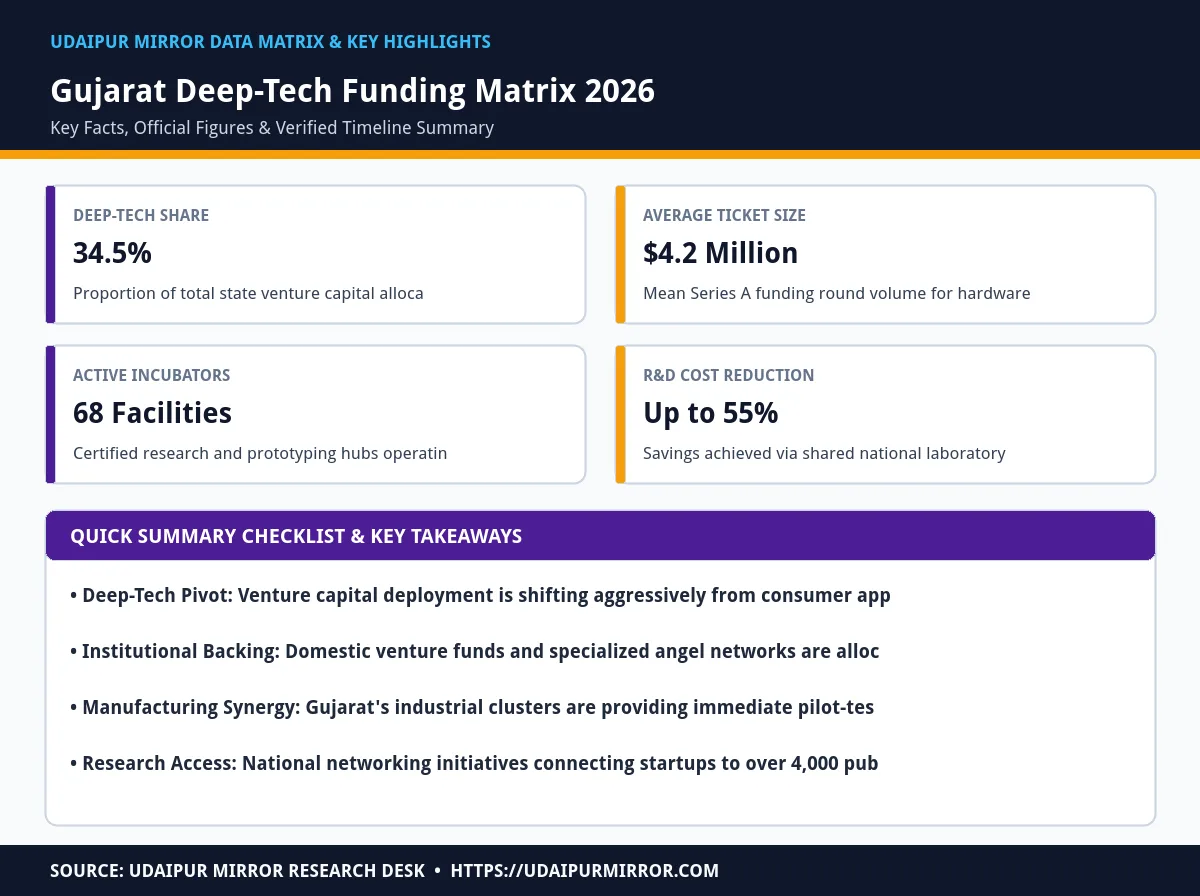
The following structured data table outlines the transformation of sectoral capital distribution across Gujarat’s startup ecosystem, contrasting traditional digital commerce with emerging deep-tech and hardware ventures.
| Startup Sector | Capital Share (%) | Avg Round Size (USD) | Primary Investor Type | Growth Outlook |
|---|---|---|---|---|
| Deep-Tech & AI Hardware | 34.5% | $4.2M – $12M | VC & Strategic Funds | Very High |
| Industrial Automation | 22.0% | $2.5M – $6.5M | Private Equity & Angels | High |
| Fintech & Lending Tech | 18.5% | $3.0M – $8.0M | Venture Capitalists | Stable |
| AgriTech & Supply Chain | 14.0% | $1.0M – $3.5M | Impact Funds & Angels | Moderate |
| Consumer D2C Brands | 11.0% | $1.5M – $5.0M | Consumer Funds | Mature |
One of the primary catalysts behind this regional surge is the democratization of high-end research infrastructure. Historically, early-stage deep-tech companies struggled with the exorbitant costs of procuring specialized testing equipment, cleanrooms, and simulation software. Recent policy interventions have successfully connected innovative startups to over 4,000 public and private research institutions across the country, allowing founders to lease high-end machinery at subsidized rates.
This institutional backing has instilled immense confidence among Series A and Series B lead investors. Rather than burning capital on basic laboratory setup, founders are channeling funds directly into core product refinement, talent acquisition, and initial commercial scaling. As global supply chains continue to diversify, international enterprises are looking toward Indian deep-tech hubs for resilient, cost-effective hardware engineering solutions.
“Access to shared research infrastructure has shortened our product development cycle by nearly fourteen months, directly attracting institutional VC interest.” — Dr. Tanmay Shah, Founder & CEO, Kutch Advanced Mechatronics
The profile of the contemporary Gujarat startup founder has also undergone a radical transformation. While the previous decade was characterized by fresh graduates launching e-commerce portals, today’s deep-tech ventures are predominantly helmed by veteran engineers, PhD researchers, and seasoned industry executives who possess decades of domain expertise in manufacturing and industrial automation. Their intimate understanding of supply chain bottlenecks enables them to build solutions that address genuine enterprise pain points rather than manufactured consumer desires.
Business models have simultaneously shifted from subscription-based SaaS to hybrid hardware-as-a-service (HaaS) and deep industrial integration. This ensures predictable, long-term B2B revenue streams that appeal heavily to institutional risk committees looking for durable revenue models amidst macroeconomic volatility. (Also read: India Launches Semicon 2.0 Portal and Approves ₹7,503 Crore in ECMS Applications).
“Domain expertise is the ultimate currency in deep-tech. Founders who understand shop-floor realities are building companies with unbreakable enterprise moats.” — Ritu Desai, Partner, Ahmedabad Angel Network
Looking ahead into the remainder of 2026 and beyond, ecosystem stakeholders anticipate an even greater concentration of deep-tech venture capital in western India. Specialized incubation centres in Gandhinagar, Ahmedabad, and Surat are scaling up their capacity to host double the number of cohort startups compared to the previous fiscal year. Furthermore, state-level policy incentives aimed at reducing electricity tariffs and offering tax holidays for R&D-heavy entities are expected to accelerate this momentum.
As international capital continues to flow into India’s resilient startup corridors, Gujarat is well-positioned to cement its status not merely as a commercial trade capital, but as the premier destination for deep-tech hardware manufacturing and advanced scientific innovation.
“We are witnessing the dawn of an industrial renaissance where Gujarat's entrepreneurial grit meets world-class deep-tech engineering.” — Karan Vora, Principal Economist, Western Regional Startup Council
The surge is primarily driven by a strategic pivot toward deep-tech, hardware engineering, artificial intelligence, and industrial automation, supported by strong state manufacturing ecosystems and shared research infrastructure.
Startups leverage national networking initiatives that connect them to over 4,000 public and private research institutions, allowing them to utilize high-end testing labs and equipment at heavily subsidized rates.
Deep-tech and AI hardware currently lead venture capital allocations at roughly 34.5% of total capital inflow, followed closely by industrial automation and specialized fintech solutions.
Unlike consumer internet startups, today’s deep-tech ventures are predominantly founded by veteran engineers, PhD researchers, and seasoned industrial executives with deep domain expertise in manufacturing and R&D.
Add Udaipur Mirror as a preferred source on Google to see more of our travel guides in your AI overviews.