Office Address
14, Residency Road, Udaipur, Rajasthan 313001
Office Address
14, Residency Road, Udaipur, Rajasthan 313001


MUMBAI: MUMBAI — As festive celebrations light up households across the country, retail investors looking past traditional gifting are increasingly turning their attention toward financial fixed-income planning. A panel of top financial minds, featuring veteran fund manager debt funds investment diwali nilesh shah alongside four other industry experts, has released a comprehensive decoding of short-term versus long-duration debt fund strategies. This timely analysis arrives as the Reserve Bank of India maintains a calibrated stance on interest rates, creating unique opportunities and challenges for bond investors seeking predictable cash flows alongside capital protection during Samvat 2083.
⚡ Quick Highlights: Debt Funds Investment Diwali: Nilesh Shah Strategies
Diwali has traditionally been a time for gold purchases and conservative bank deposits across India. However, financial literacy has evolved, prompting investors to look at sophisticated fixed-income instruments that outpace traditional bank fixed deposits while keeping volatility in check. Nilesh Shah and other market authorities emphasize that debt mutual funds offer unmatched flexibility, allowing investors to tailor their portfolios according to liquidity needs and macroeconomic forecasts. Meanwhile, as global technology sectors experience rapid shifts—comparable to trends observed in India’s high-tech industrial policy developments—domestic capital markets remain buoyant with diverse investment avenues.
The core debate this festive season centers around whether retail investors should lock into attractive yields offered by short-term instruments or position themselves for potential capital gains by entering long-duration bond funds. Each approach carries distinct risk-reward ratios that demand careful calculation. (Also read: Gujarat Startup Funding Signals a Shift Towards Deep-Tech Growth and Capital Inflows).
“Fixed income is no longer just about capital preservation; it is about strategic duration management in a dynamic rate environment.” — Nilesh Shah, Financial Market Expert
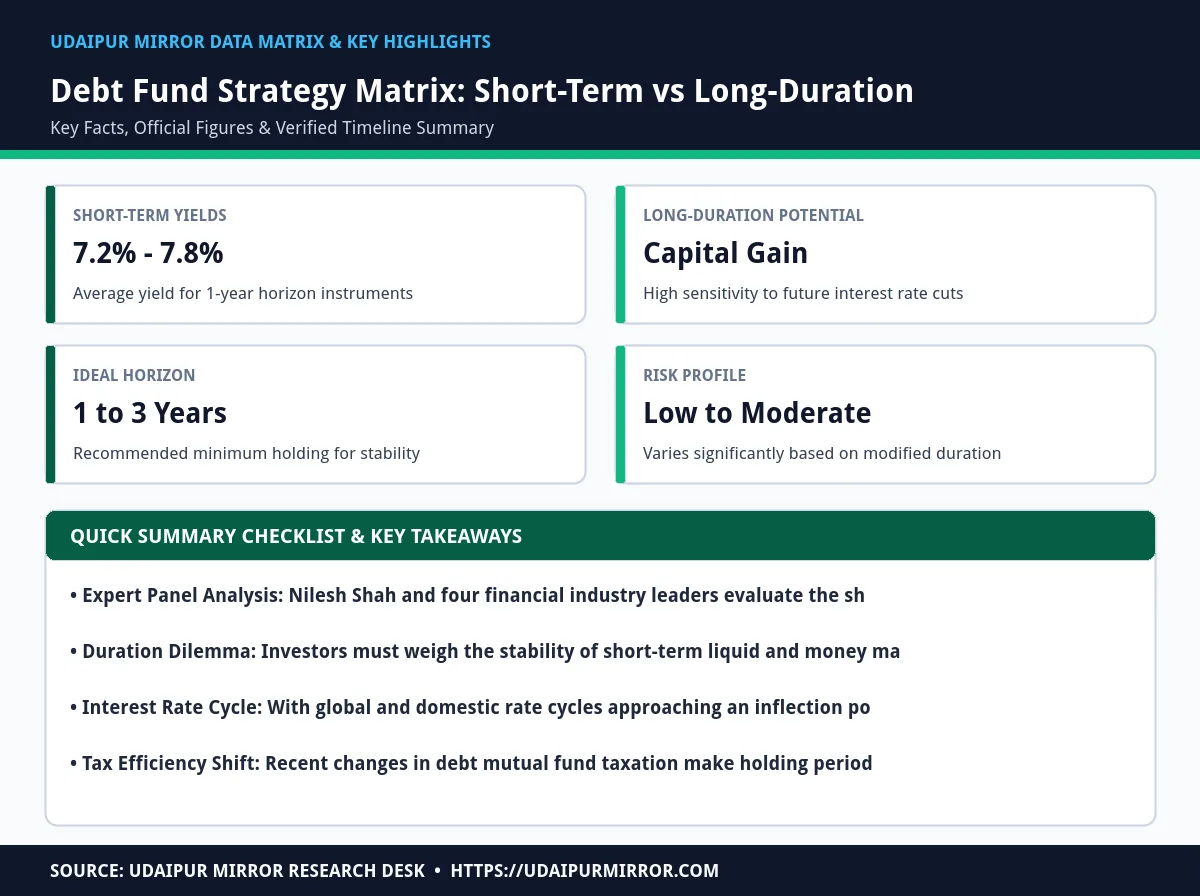
Choosing the right debt fund category depends entirely on your investment horizon, risk appetite, and expectations regarding interest rate movements. The table below outlines key parameters across popular debt fund segments analyzed by market experts.
| Fund Category | Recommended Horizon | Interest Rate Risk | Primary Objective | Tax Treatment |
|---|---|---|---|---|
| Liquid Funds | Up to 3 Months | Very Low | Emergency corpus & cash parking | As per slab |
| Short Duration Funds | 1 to 3 Years | Moderate | Steady income with low volatility | As per slab |
| Banking & PSU Debt | 2 to 4 Years | Moderate | Credit safety in top-tier banks | As per slab |
| Long Duration Gilt | 5+ Years | High | Capital gains from rate cuts | As per slab |
For investors with a horizon ranging from a few months to two years, short-term debt funds, money market funds, and banking and PSU funds remain the preferred choice. These categories focus primarily on earning interest from high-quality corporate bonds and government securities while maintaining a low modified duration.
By avoiding papers with extended maturities, these funds insulate portfolios from unexpected interest rate hikes. Financial experts note that parking festive bonuses or surplus cash in these vehicles ensures safety of principal while beating standard savings bank interest rates comfortably.
“If your financial goal is less than two years away, duration risk is your biggest enemy. Stick to accrual-focused short-term funds.” — Senior Debt Fund Manager
Conversely, investors with a multi-year horizon—typically exceeding three to five years—are advised to evaluate long-duration funds and gilt funds. When interest rates peak and begin their descent, bond prices rise inversely, generating substantial capital gains for funds holding long-term government securities.
The expert panel points out that while interim volatility can be pronounced in long-duration funds, patient investors who enter during consolidation phases often capture outsized returns that surpass conventional fixed-income products. (Also read: Vietnam’s Top Leader Visits Japan: Entering a New Era of Strategic Partnership).
“Long-duration funds require stomach for volatility, but they reward disciplined investors generously when the interest rate cycle turns.” — Fixed Income Strategist
No investment decision in 2026 is complete without evaluating tax efficiency. Following regulatory revisions, capital gains from debt mutual funds are taxed at applicable income tax slab rates regardless of the holding period. Consequently, investors must prioritize pre-tax yield and fund suitability rather than tax arbitrage.
Financial advisors recommend a core-satellite approach for this Diwali: allocate the core safety portion to liquid and short-duration funds while committing a smaller satellite portion to dynamic bond or gilt funds to capture potential macroeconomic tailwinds.
“Align your asset allocation with your life goals rather than chasing tax loopholes that disappear with regulatory updates.” — Tax and Investment Planner
Nilesh Shah and industry experts emphasize matching investment duration with your financial horizon, balancing the safety of short-term accrual funds with the capital appreciation potential of long-duration gilt funds.
Yes, short-term debt funds have lower modified duration, making them less sensitive to interest rate fluctuations and ideal for conservative investors with horizons under two years.
Under current tax regulations, capital gains from debt mutual funds are taxed at your applicable income tax slab rates regardless of the holding period.
Gilt funds, which invest exclusively in government securities, are best suited for investors with a long-term horizon (5+ years) who can tolerate volatility and wish to benefit from potential interest rate cuts.
Add Udaipur Mirror as a preferred source on Google to see more of our travel guides in your AI overviews.