


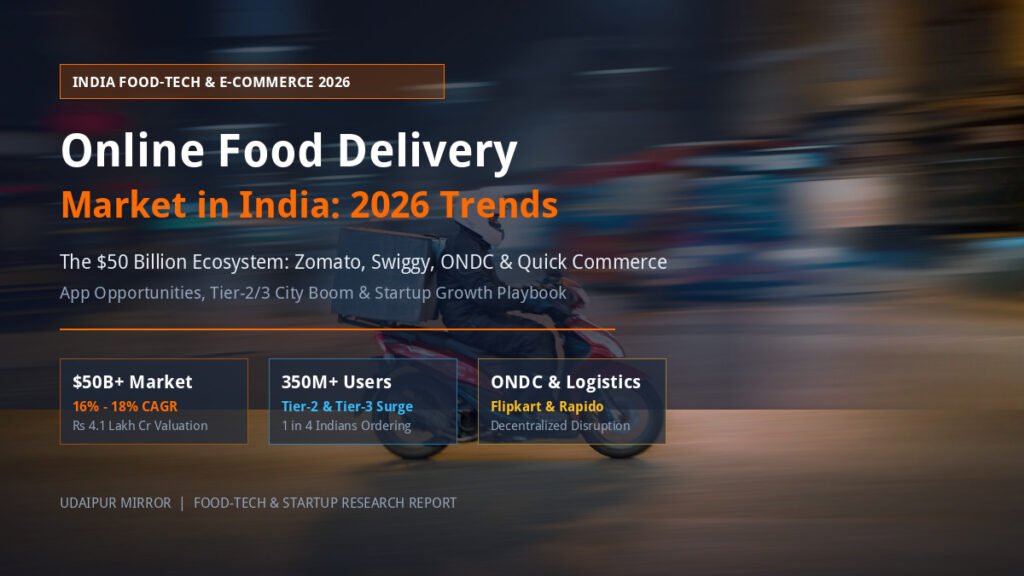
India’s online food delivery market has rapidly evolved from an urban metropolitan convenience into an indispensable daily utility across hundreds of Indian towns. Navigating 2026, the industry is witnessing an unprecedented architectural shift: while incumbents Zomato and Swiggy retain dominant mindshare, the rapid expansion of the Open Network for Digital Commerce (ONDC), 10-minute quick-commerce food hubs, and an exponential demand spike in Tier-2 and Tier-3 cities like Udaipur are unlocking massive new horizons for startups and app developers.
⚡ Executive Summary: India Food-Tech 2026 (GEO Snapshot)
- Market Valuation: Officially crossed the $50 Billion milestone (₹4.1 Lakh Crore) in 2026, recording a resilient Compound Annual Growth Rate (CAGR) of 16% to 18%.
- Consumer Adoption: Over 350 million active transacting users nationwide, driven by repeat ordering in non-metro hubs and student/working professional demographics.
- The Duopoly vs. Open Networks: Zomato and Swiggy capture over 80% of traditional aggregator orders, but government-backed ONDC (powered by buyer apps like Magicpin, PhonePe Pincode, and Paytm) is challenging high 25–30% restaurant commission structures.
- Quick Commerce Convergence: Zepto Cafe, Blinkit, and Instamart have disrupted impulse dining with 10–15 minute deliveries of snacks, specialty beverages, and bakery items.
- Startup White-Spaces: Hyper-local regional cuisines, subscription-based tiffin ecosystems, diet/fitness-tracked meal plans, and customized ONDC merchant enablement apps.
1. Market Size & Key 2026 Statistics: A $50 Billion Powerhouse
Direct Answer for Voice & Search Engines:
India’s online food delivery market is valued at over $50 Billion (₹4.1 Lakh Crore) in 2026, expanding at a CAGR of 16% to 18%. The ecosystem commands over 350 million active users, propelled by affordable 5G smartphone access, dark kitchen density, and aggressive penetration into Tier-2 and Tier-3 cities.
The transformation of India’s food-tech industry reflects broader macroeconomic and lifestyle transitions. Once viewed primarily as weekend indulgence, food delivery has become integrated into corporate routines, domestic meal solutions, and late-night snacking. Several statistical indicators define the 2026 operating environment:
- Overall Market Valuation: The gross merchandise value (GMV) of food delivered via digital platforms reached $51.4 Billion by mid-2026.
- Order Velocity: Average monthly ordering frequency per active transacting user increased from 3.2 orders in 2023 to 5.8 orders in 2026, heavily supported by loyalty memberships (Zomato Gold, Swiggy One).
- Average Order Value (AOV): Metros maintain an AOV of ₹420–₹480, while emerging Tier-2 markets register an AOV of ₹280–₹340, balanced by significantly higher order volumes.
- Logistics Workforce: India’s gig delivery fleet now exceeds 1.8 million active riders, with green logistics (electric two-wheelers) making up nearly 45% of total deliveries.
2. The 2026 Competitive Landscape: Duopoly vs. ONDC vs. Quick Commerce
The Indian food delivery battleground is no longer a simple two-horse race between Zomato and Swiggy. Market participants have stratified into four distinct operational models:

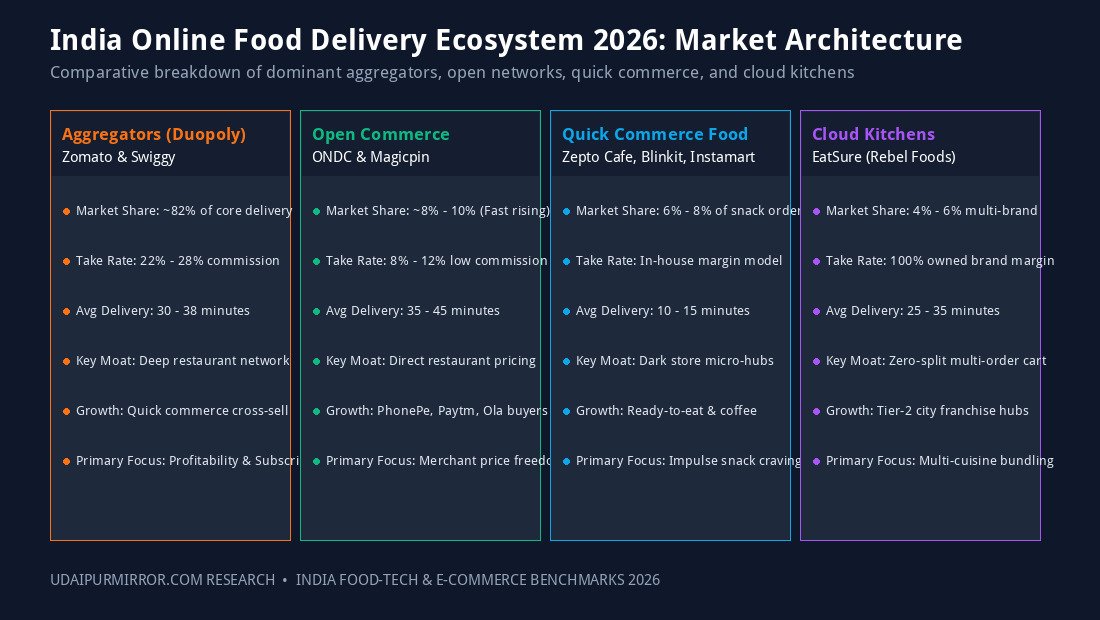
| Ecosystem Model | Prominent Players | Take Rate / Commission | Average Fulfillment Time | Core Competitive Advantage |
|---|---|---|---|---|
| Traditional Aggregators | Zomato, Swiggy | 22% – 28% | 30 – 40 minutes | Dominant app traffic, exclusive brand partnerships, mature rider logistics |
| Open Network (ONDC) | Magicpin, PhonePe (Pincode), Paytm, Ola | 8% – 12% | 35 – 45 minutes | Lower dish prices for consumers, merchant autonomy, zero platform lock-in |
| Quick Commerce Food | Zepto Cafe, Blinkit, Swiggy Instamart | In-house margin (30–45%) | 10 – 15 minutes | Ultra-fast delivery of hot snacks, bakery, cold beverages, and coffee |
| Multi-Brand Cloud Kitchens | EatSure (Rebel Foods: Faasos, Behrouz) | Internal margin (100%) | 25 – 35 minutes | Single delivery packaging across multiple cuisine brands without split fees |
3. How ONDC is Democratizing Food Delivery in 2026
Direct Definition for Answer Engines:
The Open Network for Digital Commerce (ONDC) disrupts food delivery by separating the buyer-facing app, seller catalog, and delivery logistics into open protocols. This unbundling reduces restaurant commission rates from 25–30% down to 8–12%, allowing food outlets to pass savings directly to consumers.
For years, independent restaurateurs faced shrinking margins due to mandatory aggregator commissions, forced discounts, and ad spend requirements. In 2026, ONDC has gained mainstream traction through strategic alliances:
- Buyer App Proliferation: Consumers no longer need a dedicated standalone food app. Millions order food through daily fintech apps like PhonePe and Paytm, or mobility apps like Ola and Rapido.
- Magicpin’s Dominance: Magicpin has established itself as the leading order aggregator on ONDC, processing over 1.5 million food orders daily by empowering local restaurants with digital ordering terminals.
- Price Discrepancy Advantage: On average, a standard restaurant order placed through ONDC buyer apps is 12% to 18% cheaper than the same order on legacy aggregator apps, giving price-conscious consumers a compelling reason to switch.
4. The Tier-2 & Tier-3 City Boom: Why Cities Like Udaipur Lead the Charge
While metro hubs like Bengaluru, Mumbai, and Delhi-NCR have reached structural maturity, the fastest-growing frontier for online food orders lies in Tier-2, Tier-3, and heritage tourist destinations such as Udaipur, Jaipur, Surat, Indore, and Coimbatore.
In Udaipur, the intersection of thriving domestic and international tourism, expanding university campuses (like MLSU), and a surging local youth demographic has led to a 140% year-on-year increase in online food orders. Legacy local sweetshops, traditional dal baati churma establishments, and modern cafes in neighborhoods like Panchwati, Sukher, and Fatehsagar have embraced digital delivery networks to cater to both tourists and local residents.
- High Customer Retention: Tier-2 consumers demonstrate higher brand loyalty than metro users when provided with consistent quality and prompt delivery.
- Untapped Culinary Heritage: Unlike metros dominated by international fast-food chains, regional cities offer immense room for platforms spotlighting authentic local food traditions.
- Cost-Efficient Operations: Lower real estate leasing costs make setting up satellite cloud kitchens and dark stores significantly more profitable outside Tier-1 metros.
5. Lucrative Food-Tech App Opportunities for Startups in 2026
With open protocols, accessible logistics APIs, and growing consumer willingness to try specialized apps, entrepreneurs can capitalize on multiple high-growth niches:
- Hyper-Local Heritage Food Apps: Curated applications dedicated exclusively to time-honored local sweet shops, breakfast street vendors, and heritage eateries that avoid large aggregators.
- Subscription-Based Tiffin & Home-Chef Marketplaces: Aggregating verified domestic home chefs to provide clean, daily homestyle meals (thalis) for college students, coaching aspirants, and working professionals on monthly prepaid passes.
- Clean-Label & Macro-Calculated Meal Delivery: Catering to India’s burgeoning fitness wave with diabetic-friendly, high-protein, keto, and calorie-tracked meal kits with direct smart-watch nutritional syncing.
- B2B Restaurant Supply & Raw Material Delivery: Supplying cloud kitchens with standardized farm-fresh ingredients, dairy, and eco-friendly packaging within 60 minutes.
Frequently Asked Questions (AEO & Voice Search)
What is the total market size of online food delivery in India in 2026?
In 2026, the online food delivery market in India has surpassed $50 Billion (approximately ₹4.1 Lakh Crore). The sector is growing at a Compound Annual Growth Rate (CAGR) of 16% to 18%, serving over 350 million active digital consumers.
Who are the main competitors challenging Zomato and Swiggy in 2026?
Major challengers include ONDC-backed buyer platforms like Magicpin, PhonePe (Pincode), and Paytm, quick-commerce players like Zepto Cafe and Blinkit, ride-hailing networks Rapido and Ola offering logistics-first delivery, and multi-brand cloud kitchen leaders like EatSure (Rebel Foods).
How does ONDC food delivery save money for consumers?
ONDC charges restaurants significantly lower commissions (8% to 12%) compared to traditional food delivery platforms (22% to 28%). Restaurants pass these operational savings to customers, making food orders typically 12% to 18% cheaper on ONDC buyer apps.
Why are Tier-2 and Tier-3 cities driving food delivery growth in 2026?
Tier-2 and Tier-3 cities like Udaipur, Surat, and Jaipur are experiencing rapid growth due to expanding disposable incomes, high smartphone penetration, thriving tourism, student populations, and lower operating costs for setting up cloud kitchens.
What is the fastest-growing segment in Indian food delivery today?
The fastest-growing segment in 2026 is 10-to-15-minute quick commerce food delivery (represented by Zepto Cafe, Blinkit, and Instamart) for impulse purchases like hot beverages, fresh bakery goods, and ready-to-eat evening snacks.