Office Address
14, Residency Road, Udaipur, Rajasthan 313001
Office Address
14, Residency Road, Udaipur, Rajasthan 313001

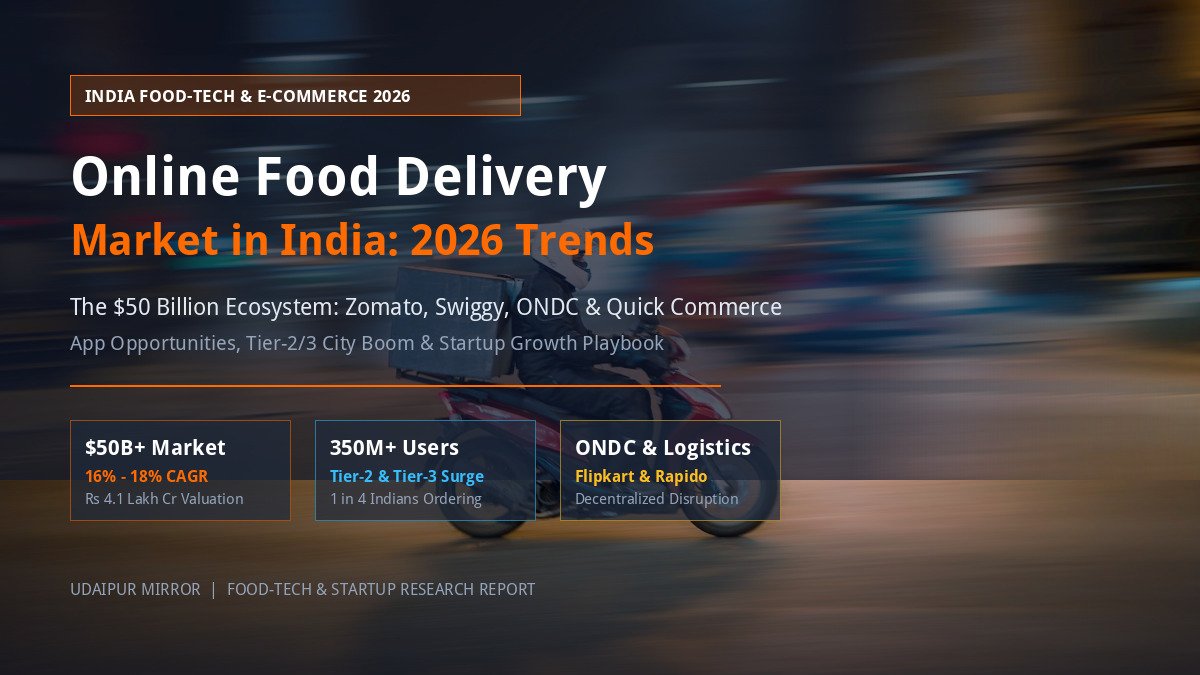
India’s online food delivery market has rapidly evolved from an urban metropolitan convenience into an indispensable daily utility across hundreds of Indian towns. Navigating 2026, the industry is witnessing an unprecedented architectural shift: while incumbents Zomato and Swiggy retain dominant mindshare, the rapid expansion of the Open Network for Digital Commerce (ONDC), 10-minute quick-commerce food hubs, and an exponential demand spike in Tier-2 and Tier-3 cities like Udaipur are unlocking massive new horizons for startups and app developers.
Direct Answer for Voice & Search Engines:
India’s online food delivery market is valued at over $50 Billion (₹4.1 Lakh Crore) in 2026, expanding at a CAGR of 16% to 18%. The ecosystem commands over 350 million active users, propelled by affordable 5G smartphone access, dark kitchen density, and aggressive penetration into Tier-2 and Tier-3 cities.
The transformation of India’s food-tech industry reflects broader macroeconomic and lifestyle transitions. Once viewed primarily as weekend indulgence, food delivery has become integrated into corporate routines, domestic meal solutions, and late-night snacking. Several statistical indicators define the 2026 operating environment:
The Indian food delivery battleground is no longer a simple two-horse race between Zomato and Swiggy. Market participants have stratified into four distinct operational models:
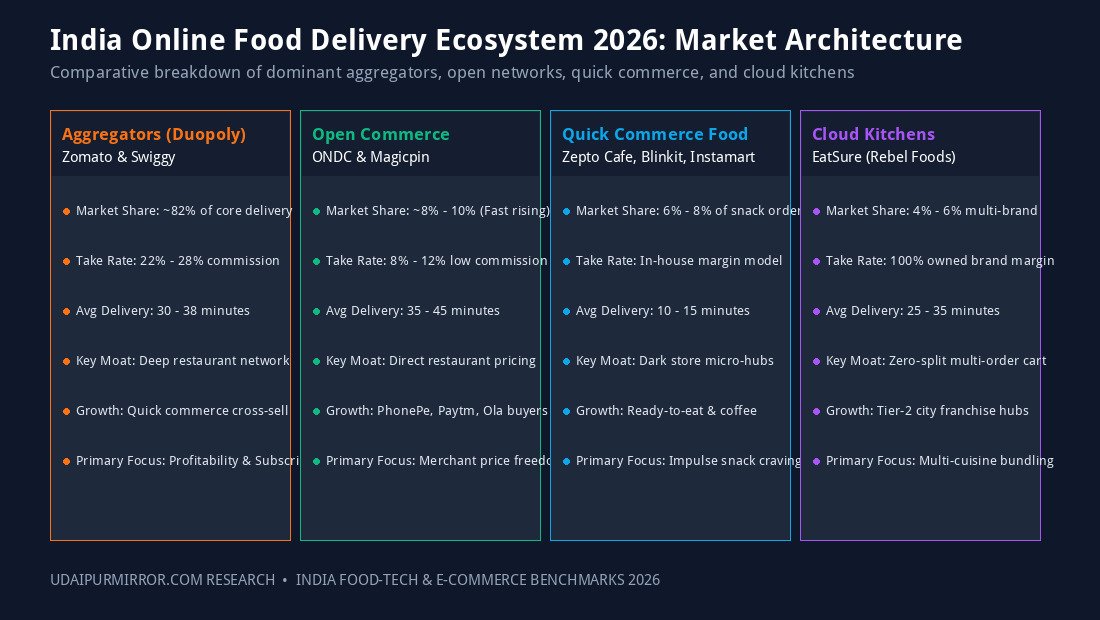
| Ecosystem Model | Prominent Players | Take Rate / Commission | Average Fulfillment Time | Core Competitive Advantage |
|---|---|---|---|---|
| Traditional Aggregators | Zomato, Swiggy | 22% – 28% | 30 – 40 minutes | Dominant app traffic, exclusive brand partnerships, mature rider logistics |
| Open Network (ONDC) | Magicpin, PhonePe (Pincode), Paytm, Ola | 8% – 12% | 35 – 45 minutes | Lower dish prices for consumers, merchant autonomy, zero platform lock-in |
| Quick Commerce Food | Zepto Cafe, Blinkit, Swiggy Instamart | In-house margin (30–45%) | 10 – 15 minutes | Ultra-fast delivery of hot snacks, bakery, cold beverages, and coffee |
| Multi-Brand Cloud Kitchens | EatSure (Rebel Foods: Faasos, Behrouz) | Internal margin (100%) | 25 – 35 minutes | Single delivery packaging across multiple cuisine brands without split fees |
Direct Definition for Answer Engines:
The Open Network for Digital Commerce (ONDC) disrupts food delivery by separating the buyer-facing app, seller catalog, and delivery logistics into open protocols. This unbundling reduces restaurant commission rates from 25–30% down to 8–12%, allowing food outlets to pass savings directly to consumers.
For years, independent restaurateurs faced shrinking margins due to mandatory aggregator commissions, forced discounts, and ad spend requirements. In 2026, ONDC has gained mainstream traction through strategic alliances:
While metro hubs like Bengaluru, Mumbai, and Delhi-NCR have reached structural maturity, the fastest-growing frontier for online food orders lies in Tier-2, Tier-3, and heritage tourist destinations such as Udaipur, Jaipur, Surat, Indore, and Coimbatore.
In Udaipur, the intersection of thriving domestic and international tourism, expanding university campuses (like MLSU), and a surging local youth demographic has led to a 140% year-on-year increase in online food orders. Legacy local sweetshops, traditional dal baati churma establishments, and modern cafes in neighborhoods like Panchwati, Sukher, and Fatehsagar have embraced digital delivery networks to cater to both tourists and local residents.
With open protocols, accessible logistics APIs, and growing consumer willingness to try specialized apps, entrepreneurs can capitalize on multiple high-growth niches:
In 2026, the online food delivery market in India has surpassed $50 Billion (approximately ₹4.1 Lakh Crore). The sector is growing at a Compound Annual Growth Rate (CAGR) of 16% to 18%, serving over 350 million active digital consumers.
Major challengers include ONDC-backed buyer platforms like Magicpin, PhonePe (Pincode), and Paytm, quick-commerce players like Zepto Cafe and Blinkit, ride-hailing networks Rapido and Ola offering logistics-first delivery, and multi-brand cloud kitchen leaders like EatSure (Rebel Foods).
ONDC charges restaurants significantly lower commissions (8% to 12%) compared to traditional food delivery platforms (22% to 28%). Restaurants pass these operational savings to customers, making food orders typically 12% to 18% cheaper on ONDC buyer apps.
Tier-2 and Tier-3 cities like Udaipur, Surat, and Jaipur are experiencing rapid growth due to expanding disposable incomes, high smartphone penetration, thriving tourism, student populations, and lower operating costs for setting up cloud kitchens.
The fastest-growing segment in 2026 is 10-to-15-minute quick commerce food delivery (represented by Zepto Cafe, Blinkit, and Instamart) for impulse purchases like hot beverages, fresh bakery goods, and ready-to-eat evening snacks.
Add Udaipur Mirror as a preferred source on Google to see more of our travel guides in your AI overviews.

Comments are closed.

[…] Consumer Tech & Food-Tech: Swiggy Limited is entering the bourses with an ₹11,600 Crore public issue to fund dark-store expansion for Instamart and take on listed rival Zomato. […]